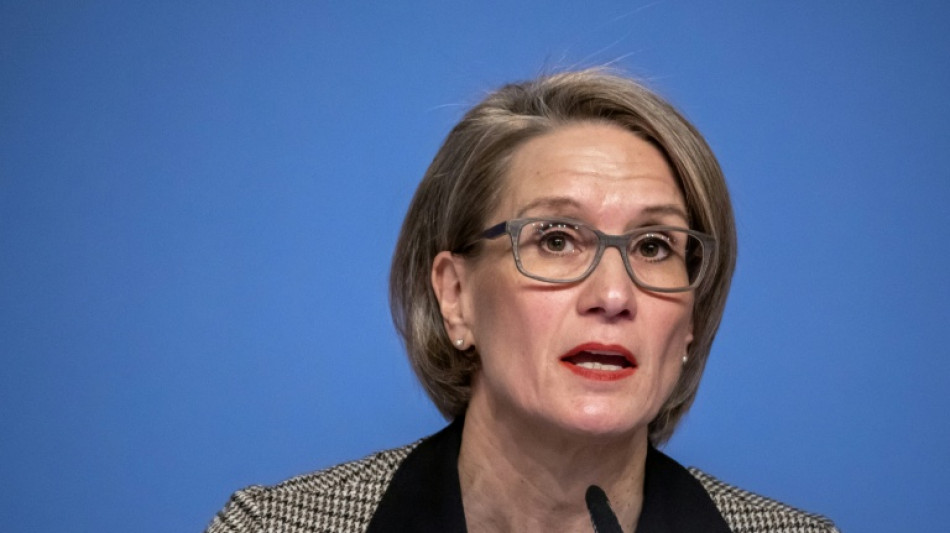
BIS warns 'pressure points' putting global economy at risk / Photo: Fabrice COFFRINI - AFP

 Starc takes 5-11 to leave Bangladesh reeling in 2nd Test

 Injured Rune withdraws from US Open
 Nakashima knocks out Fritz to reach Cincinnati semi-finals

 Ukraine says 'cynical' Russian strike on shopping centre killed 16

 TikTok to pay $400 mn settlement in US children's privacy case

 MLS fines Messi for striking an opponent

 Gouiri double fires Marseille past Strasbourg in Ligue 1 opener

 Mavericks buy out Thompson, now reportedly bound for Heat

 England v Pakistan first Test: Three talking points

 US, Canada push to seal trade deal as deadline nears

 One dead, three wounded after sword attack at Swedish high school

 Ukraine says 'cynical' Russian strike on shopping centre killed 15

 US Supreme Court allows White House ballroom construction for now

 Root hails emerging fast bowlers as England thrash Pakistan

 Brazil's Lula urges tariffs resolution in call with Trump

 Ukraine says 'cynical' Russian strike on shopping centre killed 14

 Heatwave-hit Europe logs over 30,000 excess summer deaths: first figures

 Give LIV Golf 'one more shot,' says DeChambeau
 Duplantis hits the high notes for athletics anthem

 Malaysia's JDT claims unbeaten run world record

 Bolivian economy minister fired after Congress vote

 Russell roars to Dutch GP sprint pole, Antonelli fifth
 Russell takes pole for Dutch GP sprint

 England start life after Bazball with rout of Pakistan

 'Duck run' pest control catching on in S.Africa's winelands

The Bank for International Settlements warned Sunday of multiple "pressure points" in the global economy, from inflation fuelled by the Middle East war to fears of cooling AI investments, threatening financial stability.
In its annual report, published Sunday, the BIS -- considered the central bank of central banks -- called on monetary policy makers to "act now", to help safeguard the stability of the global economy.
BIS deputy general manager Andrea Maechler acknowledged the situation was difficult.
"Central banks are already facing a complex situation in a world marked by a great deal of uncertainty," she told AFP in an interview.
- 'Threatening financial stability' -
In all, BIS identified four significant pressure points for the global economy, starting with inflation linked to the Middle East war, which began with US-Israeli strikes on Tehran on February 28.
The resulting closure of the crucial Strait of Hormuz -- one of the world's most important energy chokepoints -- has delivered a shock to global energy supplies, hiking costs for everything from plastics to fertilisers.
Also on the BIS list were concerns over the longevity of the artificial intelligence investment boom, which has been buoying global growth and keeping it going through crises like last year's tariff hikes.
BIS warned the surging AI capital expenditure could prove "unsustainable", with the risk of a financial market correction.
And the report highlighted the dangerous combination of persisting financial vulnerabilities and the "exuberant risk appetite" in financial markets, warning the situation "could unwind abruptly".
Higher public debt levels were also an issue for central banks, it said, as they could find themselves torn between making necessary rate-hikes to keep down inflation and fears that doing so would hike debt servicing costs, impacting economic growth.
"Each of these areas of tension is likely to be manageable, but taken together, they risk amplifying one another and threatening financial stability," Maechler warned.
She cautioned that "if tensions were to arise on that front, for example in the event of a change in interest rates or market sentiment, contagion effects could be set in motion".
BIS is also concerned about risks linked to the swelling role of non-bank players like hedge funds in bond markets and in AI investments, and is calling for more oversight over such operations.
There must be "adequate regulation also beyond the banking perimeter", to ensure they can absorb the risks they take, Maechler said.
- Preserving independence -
BIS is also calling on governments to reduce their debt levels to help preserve central banks' room for manoeuvre in the case of economic shocks.
Maechler, herself a former governing board member at the Swiss National Bank, said it was vital for central banks to "be able to carry out their mandate with complete independence".
This was needed, she said, "to defend this fundamental public good, namely price stability and confidence in money, without which an economy cannot function well".
Maechler highlighted that "central banks know that they may have to make difficult decisions that would not have political support at the time they need to be made".
"For this, they need this independence."
Th.Gonzalez--AT