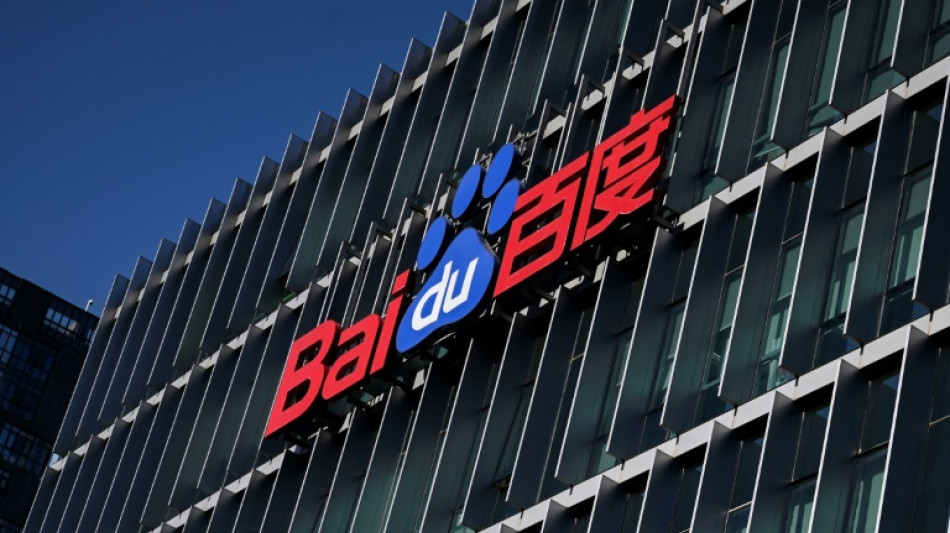
Chip war and censorship hobble Chinese tech giants in chatbot race / Photo: Jade GAO - AFP/File

 England were 'waiting for death' in World Cup semi-final defeat: Tuchel

 NFL star fined for displaying name of slain Palestinian girl

 Witsel retires from internationals after 18-year Belgium career

 US Fed raises rates to battle inflation in move likely to rile Trump

 Fitzpatrick 'not comfortable' over Dubai golf finale

 Gaza apartment block collapse kills 21, including 12 children

 Gaza apartment block collapse leaves 21 dead

 US House targets data centers as midterm backlash grows

 French ex-minister Dati goes on trial in Renault-Nissan corruption case

 'Being Heumann' captures joy in fight for disability rights

 Retired great Nadal to play in exhibition matches
 IR-MED and Dice Technologies Announce collaboration to Evaluate and Advance Pressure-Injury Prevention Platform in Japan
 Watts, Pitt, Cruz to light up Spain's top film festival

 Sweden expels Iran embassy employee over anti-Jewish threats

 Toogood Gold's Table Mountain Sits in the Shadow of a Nevada Gold Rush

 MEXC July–August Security Report: 38.66M USDT in Risk Funds Intercepted, Futures Insurance Fund Hits 792M USDT

 'Breathing toxin every day': Indonesians choked by haze feel helpless

 Stocks edge higher ahead of US Fed rate call

 Philippines ex-leader Duterte makes first in-person ICC appearance

 2027 Formula One calendar includes Monaco sprint race

 Palestinians are the real victims, Thunberg tells Ed Sheeran

 Hashim Thaci: From 'George Washington of Kosovo' to Hague convict

 Amnesty says Iran committed 'crimes against humanity' in crackdown on 2022 protests

 EU to ban social media for under 13s, curb access until 15

 Philippines ex-leader Duterte makes first appearance at ICC

Search giant Baidu's lacklustre unveiling of its chatbot exposed gaps in China's race to rival ChatGPT, as censorship and a US squeeze on chip imports have hamstrung the country's artificial intelligence ambitions.
The highly anticipated preview of "Ernie Bot" last week was limited to a pre-recorded demonstration with simple questions to summarise the plot of a sci-fi novel and solving a straightforward algebra equation -- to avoid politically and factually incorrect answers.
From cloud computing to autonomous driving, none of the array of services Baidu had earlier promised its Ernie Bot could do were on display.
The firm's shares plunged as much as 10 percent during the unveiling, although they rallied the following day on positive reviews from brokerages including Citigroup, whose analysts were among a small group of people invited to test the bot.
A flurry of Chinese companies including Alibaba, JD.com, Netease and TikTok-parent Bytedance have rushed to develop services that can mimic human speech since San Francisco-based OpenAI launched ChatGPT in November, sparking a gold rush in the market.
Google on Tuesday invited people in the United States and Britain to test its AI chatbot, known as Bard, as it continues on its own push to catch up.
The popularity of ChatGPT in China -- where users have to scale Beijing's internet firewall using virtual private networks (VPNs) and foreign phone numbers -- has left Baidu and others scrambling to regain its dominance on home turf.
"OpenAI probably spent as much time just testing GPT-4 as Baidu spent building Ernie Bot," said Matt Sheehan, fellow at the Carnegie Endowment for International Peace.
"China's tech ecosystem doesn't have a tradition of funding open-ended research that doesn't have a clear path to profitability."
- Chip supply -
Ernie Bot is fluent in Mandarin, as well as other regional languages including Hakka spoken in South China and Taiwan, and targets the Chinese market with more than one billion internet users.
A headache for developers is Beijing's heavy-handed censorship of anything seen as challenging the Communist Party -- including a one-time purge of Winnie-the-Pooh after the cartoon bear was compared to Xi Jinping.
When asked if the president of 10 years is "a good leader", one of China's best-performing publicly available ChatGPT-style models, developed by Beijing's Tsinghua University, says: "The input may contain ethical content. Please try a different input."
The strict restrictions on the Chinese internet mean companies have "significantly less data resources for training purposes compared to Western competitors", Lauren Hurcombe, a technology lawyer at DLA Piper, told AFP.
Ernie Bot has not yet been launched for public use.
China has announced ambitious plans to become a global leader in the field of AI by 2030, and consultancy group McKinsey estimates the sector could add about $600 billion every year to China's gross domestic product by then.
Most of the growth will come from producing driverless cars, adding more robots to assembly lines and healthcare breakthroughs, according to McKinsey, and the government has also used AI to beef up its mass surveillance programme.
However, Washington has moved to suffocate China's technology ambitions, blocking through sanctions its access to high-grade chips, chipmaking equipment and software used to design semiconductors.
This has made it difficult for Chinese companies to buy chips including Nvidia's A100 and its successor H100, considered the gold standard for large-scale AI training systems.
"There is a real question whether a domestic supply can be generated in the short term," Hurcombe said.
- AI gap -
But the effect of the US measures will take time to make a dent because Chinese companies rushed to stockpile high-end chips before Washington announced the export controls in October.
Baidu has its own chip design arm, Kunlun, and the company says it is capable of mass-producing a seven-nanometre chip that is partly used to power its AI systems.
Dou Shen, head of Baidu's AI Cloud group, shrugged off questions about the impact of the US restrictions during a call with investors in November, saying: "We think the impact is quite limited in the near future."
For years, China has bragged about filing more artificial intelligence patent applications than the United States.
But the average number of citations of its patents -- an indication of the importance and originality of its inventions -- lagged behind the United States and other developing countries in 2020 and 2021, according to Stanford University's AI Index 2022 report.
The United States also had twice as many AI startups as China, and had three times more private investment flowing into the sector in 2021, according to the report.
The Chinese government's top-down approach to spurring innovation has failed to deliver results.
The Beijing Academy of Artificial Intelligence, established in 2018, introduced a ChatGPT-like product two years ago.
Wu Dao was described by its creators as "the world's largest" AI language model with 1.75 trillion parameters, which is significantly larger than OpenAI's previous GPT-3 model with 175 billion parameters. But it never really caught on.
M.O.Allen--AT