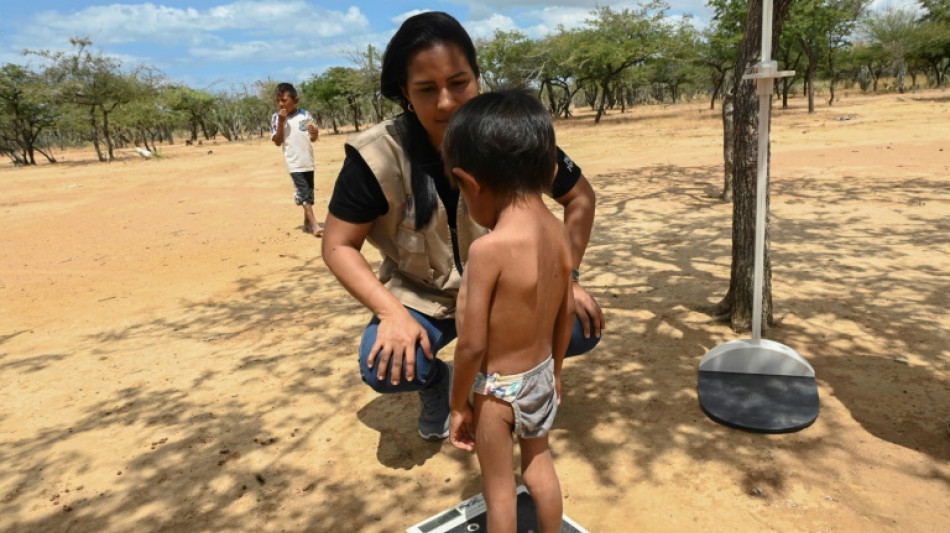
Hunger, thirst stunting Indigenous children in Colombian desert / Photo: JOAQUIN SARMIENTO - AFP

 Barcelona hit seven in Racing Santander rout

 Amorim's Milan beaten by Benfica, Sunderland make dream European return

 US stocks fall, dollar gains after Fed lifts interest rates

 Seahawks rule out Darnold for Sunday game at Arizona

 Mbappe explains Ceuta shirt stance after criticism

 Improving Atletico cruise to comfortable win over Osasuna

 Candidate for UN chief calls for AI regulation akin to nuclear weapons

 O'Neill expects Celtic recovery after Old Firm misery

 Man City midfield trio backed to emulate Rodri and Silva

 'We're losing control,' AI pioneer Yoshua Bengio tells AFP
 WHO eyes 'encouraging' signs in DRCongo fight against Ebola
 Liga boss criticises Real Madrid trio for Ceuta shirt incident

 WTA Finals moved to Charlotte from 2027

 Almost 8,000 excess deaths in France's scorched summer: statistics

 Ex-president's lengthy war crimes sentence shocks Kosovo

 US House faces test on sweeping Russia sanctions bill

 British PM says to make 'difficult decisions' as inflation rises

 TotalEnergies pumps up controversy in France with cut-price gas

 Global fuel price demos: a round-up

 Leverate Launches MCP for Traders to Connect AI Assistants With Trading Platforms

 MEXC Launches $1M "Discover Your Wall Street DNA" Campaign to Help Traders Find Their Market Fit
 Emporio Armani names Dario Vitale new creative director

 Maresca defends VAR officials after Man City benefit from error

 Courts jails LGBTQ activists as Turkey crackdown widens

 French court to hear Depardieu's appeal against rape trial order: sources

After a grueling jeep trip of almost 24 hours on mostly desert roads, two-year-old Rosalinda arrived at the clinic in Uribia, northern Colombia, just in time.
Emaciated by the malnutrition that kills dozens of children in the country's northern La Guajira department every year, Rosalinda received emergency treatment that saved her life.
"It was like carrying a rag," said the girl's mother Magalis Iguaran, 32, who brought Rosalinda to Uribia, a town some 180 kilometers (112 miles) from their rural home in Puerto Estrella on the Guajira peninsula.
"She was very sick."
Iguaran somehow managed to collect the equivalent of nearly $70 dollars from relatives for the jeep taxi ride that brought Rosalinda to the clinic -- a fortune in a region where two-thirds of people live in poverty.
The toddler arrived acutely underweight and dehydrated, said pediatrician Karen Toncel. Her growth is stunted by a lack of food.
Five days after being admitted, Rosalinda was sitting up in bed "asking for food," said her mother, her own thin frame draped in a loose yellow robe.
"When she first arrived she didn’t even want water... They saved her," said Iguaran, whose only income is occasional money sent by her ex-partner, who rides a bicycle taxi.
Iguaran has three other children waiting back home, where she said her family eats no more than twice a day: "an arepa (a small maize cake) with cheese for breakfast and sometimes a lunch of rice with bits of beef.
"Food for five people is expensive."
- 'Failure' -
In 2021, La Guajira, a largely desert department home to the Indigenous Wayuu people, had an under-five mortality rate of 21 per 1,000 births, according to official data.
In war-torn Syria, the figure was 22, according to UNICEF.
The department also has an acute lack of safe drinking water.
At least once a week, said pediatrician Toncel, a critical case of malnutrition requires a child to be transferred to intensive care at another hospital.
The Unidad Materno Infantil Talapuin clinic where Toncel works has no such facilities.
As for fatalities, "there are one or two patients every month," the pediatrician said -- double the national rate.
Almost all patients with malnutrition are members of the Wayuu community.
In La Guajira as a whole, 20 children died of starvation in the first four months of leftist President Gustavo Petro's new government -- a "failure" he has admitted.
Countrywide, 308 children died of hunger last year -- 85 of them in La Guajira, according to the ombudsman's office.
This was 111 more than in 2021.
- Rice and beans -
Elsewhere in the department, in the settlement of Malirachon, Indigenous children take refuge from the sun under a canopy of dried-out cacti.
A visiting nutritionist measures their arms with a gadget that can detect possible malnutrition.
Of the 22 kids gathered there, two are declared at risk.
"I feel sad for the child, he is sick," said 22-year-old Sandra Epieyu of her one-year-old son Jose Fernando.
He and his four-year-old brother are both shockingly thin.
Four months pregnant, Epieyu lights a wood fire in her wooden hut to cook chicha, a corn-based drink that makes up much of her diet.
"In many communities this (chicha) is the only thing you will find for food," said social worker Sandra Guillot.
"A day could go by and this would be all they eat."
Epieyu makes about $8 to $10 per week selling articles she weaves by hand.
"Sometimes there is no food... sometimes we eat only once a day," she told AFP.
Colombia, like many countries, is battling spiraling inflation which has reached a 21st-century record of 13.2 percent.
Like Epieyu, most in Malirachon have to fetch drinking water from a well.
She cannot carry water because of her pregnancy, and said sometimes she and her children use water they collect from puddles of rainwater shared with animals.
Children over the age of five are meant to receive food at school in Colombia, but a teacher who spoke on condition of anonymity for fear of losing her job, said the rations are inadequate.
A former governor of the region is on trial for allegedly embezzling money from the school feeding program.
While children older than five are not included in official statistics, that does not mean the food shortages do not affect them.
In a small community near Manaure town in La Guajira Wilmer Epieyu -- a common family name in the community -- is being measured.
He stands 75 centimeters (29 inches) tall and weighs eight kilograms (about 18 pounds) -- as much as a toddler of one.
He is seven.
"This is a very shocking case," said nutritionist Nielcen Benitez from a local NGO.
Epieyu, she said, "will not be able to develop fully."
Wilmer is one of eight children, five of whom have been treated for malnourishment.
Last year, Colombia took umbrage at being included in a report by UN agencies of 20 "hunger hotspots."
A.Taylor--AT