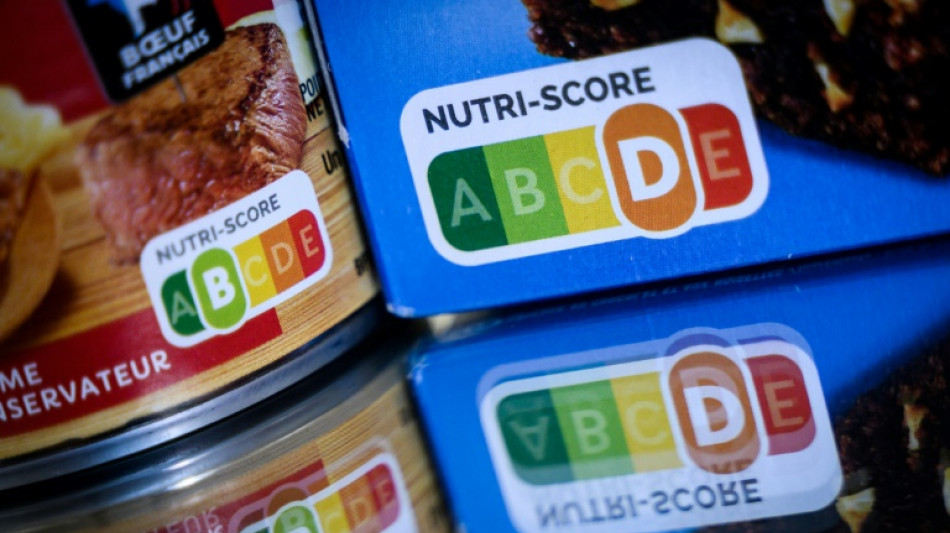
In EU, a food fight over nutrition labels / Photo: LOIC VENANCE - AFP/File

 Trump threatens EU over 'hostile' Canada association plan

 Argentine judge orders suspension of Falklands oil project

 Carrick takes the blame as troubled Man Utd suffer League Cup misery

 Barcelona hit seven in Racing Santander rout
 Amorim's Milan beaten by Benfica, Sunderland make dream European return

 US stocks fall, dollar gains after Fed lifts interest rates

 Seahawks rule out Darnold for Sunday game at Arizona
 Mbappe explains Ceuta shirt stance after criticism
 Improving Atletico cruise to comfortable win over Osasuna

 Candidate for UN chief calls for AI regulation akin to nuclear weapons

 O'Neill expects Celtic recovery after Old Firm misery
 Man City midfield trio backed to emulate Rodri and Silva

 'We're losing control,' AI pioneer Yoshua Bengio tells AFP

 WHO eyes 'encouraging' signs in DRCongo fight against Ebola

 Liga boss criticises Real Madrid trio for Ceuta shirt incident

 WTA Finals moved to Charlotte from 2027

 Almost 8,000 excess deaths in France's scorched summer: statistics

 Ex-president's lengthy war crimes sentence shocks Kosovo

 US House faces test on sweeping Russia sanctions bill

 British PM says to make 'difficult decisions' as inflation rises

 TotalEnergies pumps up controversy in France with cut-price gas

 Global fuel price demos: a round-up

 Leverate Launches MCP for Traders to Connect AI Assistants With Trading Platforms

 MEXC Launches $1M "Discover Your Wall Street DNA" Campaign to Help Traders Find Their Market Fit

 Emporio Armani names Dario Vitale new creative director
Europe is taking longer than planned to concoct an EU-wide food-labelling system after a colour-coded scheme created in France did not go down well in culinary rival Italy.
Fearing that cultural icons such as olive oil or Parmesan cheese would get bad grades, Italy successfully rallied other European Union nations to reject the French system.
The European Commission was supposed to come up by late 2022 with a label aimed at helping consumer make healthier food choices.
France's Nutri-Score system was initially seen as the front-runner to be used across the 27-nation EU. The front-of-pack nutrition label has already been adopted by Belgium, Germany, Luxembourg, the Netherlands and Spain.
Nutri-Score ranks food products on a green-to-red and A-to-E scale based on their nutritional value, from containing a good amount of protein or fibre to too much salt or saturated fat, but companies are not obligated to use the label.
Some 270 scientists signed a call in March 2021 urging the European Commission "not to yield to pressure groups" and back Nutri-Score, saying it was the only label that had undergone peer-reviews showing its "effectiveness and relevance to consumers and public health".
But the European Commission decided against Nutri-Score, with its deputy director-general of food sustainability, Claire Bury, saying in September that it would not put on the table something that "polarizes the debates".
- 'E' for cheese -
Italy, Cyprus, Greece, the Czech Republic, Romania and Hungary opposed the French system.
Italian Prime Minister Giorgia Meloni, who took office in October, had lambasted such food labels as "discriminatory and penalising" for the country's food industry.
"An intensive lobbying campaign against this tool by commercial interests has regrettably muddied the waters and turned a public health debate into a political one," said Emma Calvert, senior food policy officer at European consumers group BEUC.
While the European Commission may still use Nutri-Score for inspiration in devising a system, it is also looking at other labels.
Those include the green or black "Keyhole" system in Nordic countries and one backed by Italy, NutrInform Battery, which takes into account the potential portions of food consumed.
Italy has argued that Nutri-Score is not a good reference because it is based on 100 grams or 100 millilitres of food while certain products such as oil and cheese are consumed in smaller quantities.
Rome worries that labels would be harmful to products that are staples of its Mediterranean diet, including olive oil, cheese, prosciutto and pizza.
Italy's main agriculture association, Coldiretti, has said that Nutri-Score ends up "excluding healthy and natural foods that have been at the table for centuries in favour of artificial products".
In France, the makers of the blue cheese Bleu d'Auvergne refuse to put the label their product, which would get the worst possible grade, a red E, for its salt and fat content.
"How do you explain that Bleu d'Auvergne is classified as E when chips made in oil get an A," said Sebastien Ramade, president of the Auvergne cheese association.
But 875 brands representing 60 percent of the food market in France are using Nutri-Score, the system's founder, nutritionist Serge Hercberg told AFP.
"Some major brands still reject it, but more and more manufacturers are adopting it, some of whom had strongly resisted it in the past," Hercberg said.
"When we look at sales figures, we see that it works and it has had an effect on the reformulation and the improvement of the recipes for thousands of products," he added.
- Chile's strict label -
Time is running short for the commission to propose a label to EU states before the term of the current European Parliament expires next year.
"If the Commission fails to uphold its commitment to propose a mandatory EU-wide front-of-pack nutrition label it will be a major missed opportunity to help European consumers, especially vulnerable ones, to make the healthier choice in the supermarket," Calvert said.
Some members of the European Parliament say artificial foods should be targeted instead.
"The overweight issue among teenagers is not due to eating too much Camembert," said MEP Irene Tolleret.
Elsewhere in the world, Chile has had an even stricter system since 2016, with a black label that warns consumers about high saturated fats, sugar or salt.
Products in Chile that bear the label are barred from advertising on television.
"One of the consequences is that more than 20 percent of products have new formulas," with less salt or sugar, said Guido Girardi, a former senator behind the system who added that similar legislation is in the works in 32 countries.
J.Gomez--AT