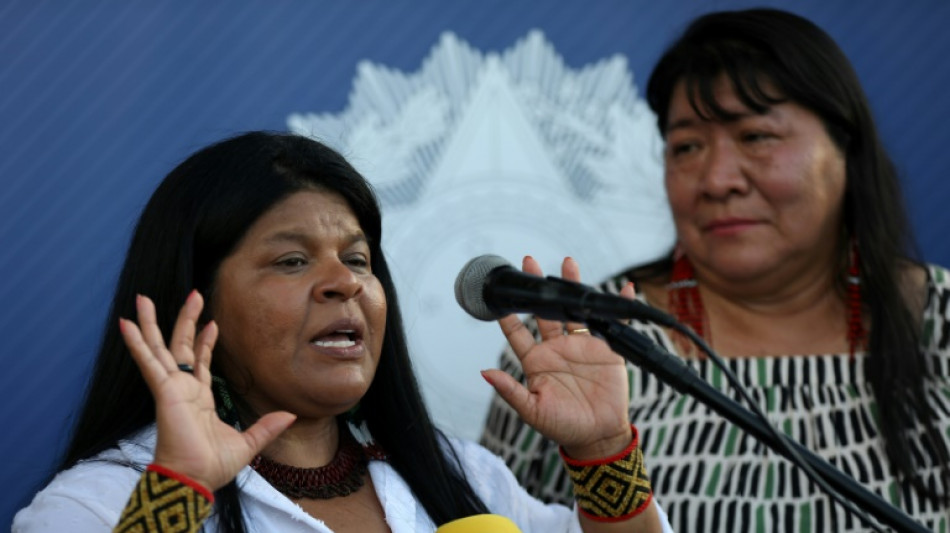
Brazil's new Indigenous affairs chief sets sights on illegal gold / Photo: MICHAEL DANTAS - AFP

 Trump threatens EU over 'hostile' Canada association plan
 Argentine judge orders suspension of Falklands oil project

 Carrick takes the blame as troubled Man Utd suffer League Cup misery

 Barcelona hit seven in Racing Santander rout
 Amorim's Milan beaten by Benfica, Sunderland make dream European return

 US stocks fall, dollar gains after Fed lifts interest rates
 Seahawks rule out Darnold for Sunday game at Arizona
 Mbappe explains Ceuta shirt stance after criticism

 Improving Atletico cruise to comfortable win over Osasuna

 Candidate for UN chief calls for AI regulation akin to nuclear weapons

 O'Neill expects Celtic recovery after Old Firm misery
 Man City midfield trio backed to emulate Rodri and Silva

 'We're losing control,' AI pioneer Yoshua Bengio tells AFP

 WHO eyes 'encouraging' signs in DRCongo fight against Ebola

 Liga boss criticises Real Madrid trio for Ceuta shirt incident
 WTA Finals moved to Charlotte from 2027
 Almost 8,000 excess deaths in France's scorched summer: statistics

 Ex-president's lengthy war crimes sentence shocks Kosovo

 US House faces test on sweeping Russia sanctions bill

 British PM says to make 'difficult decisions' as inflation rises

 TotalEnergies pumps up controversy in France with cut-price gas
 Global fuel price demos: a round-up

 Leverate Launches MCP for Traders to Connect AI Assistants With Trading Platforms

 MEXC Launches $1M "Discover Your Wall Street DNA" Campaign to Help Traders Find Their Market Fit
 Emporio Armani names Dario Vitale new creative director
Joenia Wapichana is used to charting new territory: the first Indigenous woman to earn a law degree in Brazil, she was also the first elected to Congress.
But she faces one of her biggest challenges yet in her new job as the first native person to lead Brazil's Indigenous affairs agency, FUNAI, which she said was dismantled for the past four years under far-right then-president Jair Bolsonaro.
The feisty 49-year-old is the first to admit she faces a daunting to-do list, starting with the issue that thrust her into the spotlight almost from the day she took office last month: rampant illegal gold mining on protected Indigenous reservations.
Newly inaugurated leftist President Luiz Inacio Lula da Silva has ordered a police and army crackdown to wrest back control of the country's largest reservation, the Yanomami territory, from illegal miners, who are accused of poisoning the water with mercury, destroying the rainforest, raping and killing inhabitants, and triggering a humanitarian crisis.
But it is proving difficult for federal authorities to stop the boom in illegal gold, Wapichana said in an interview with AFP at her office in Brasilia.
"Brazil still doesn't have a way to curb the illegal gold trade," she said.
The government response "is very fragile," she added.
- Rampant abuse -
At least 30 percent of the gold mined in Brazil is irregular in origin, according to a recent study by the Federal University of Minas Gerais.
Under Brazilian law, gold dealers are allowed to make a declaration "in good faith" that their product was legally mined -- a system that leads to rampant abuse, according to experts.
The system "is still very immature," said Wapichana, who often wears a traditional headdress of bright feathers.
Her resources to fight the problem are limited: FUNAI's budget is 600 million reais (about $120 million) this year, the majority of which is for administrative costs.
Just one-sixth will remain for key functions such as establishing new Indigenous reservations and policing existing ones.
Wapichana wants at least double that.
She is hoping to get financing from the Amazon Fund, an internationally backed program to protect the world's biggest rainforest.
When Lula took office in January, donor countries revived the fund, which was suspended under Bolsonaro in response to a surge in deforestation.
Wapichana is also hoping to tap funds negotiated at UN climate talks to help vulnerable countries adapt to climate change -- though that will take time.
"Indigenous peoples' contribution to combatting the effects of climate change needs to be compensated," Wapichana said.
Numerous studies have found Indigenous peoples play a crucial role in slowing global warming by protecting the world's carbon-absorbing forests.
- 'Part of this country' -
Wapichana inherited a FUNAI in crisis, after four years of controversy under Bolsonaro.
Indigenous leaders accuse the ex-president of appointing hostile officials to lead the very agency that was supposed to protect Brazil's 800,000 native people.
As president, Bolsonaro (2019-2022) pushed to open protected Indigenous lands to mining. Illegal gold mining in the Brazilian Amazon rose sharply on his watch, destroying a record 125 square kilometers (48 square miles) of forest in 2021, according to satellite monitoring by the national space agency.
Bolsonaro also made good on his vow to ensure that "not a single centimeter" of new Indigenous reservations were allowed.
Lula has promised to resume creating new Indigenous reservations, which currently cover 13.75 percent of the nation's territory.
Bolsonaro "encouraged land invasions, denied our rights and contributed to discrimination against Indigenous peoples, who suffered persecution and criminalization," Wapichana said.
She says it her mission to undo that damage.
She faces a tough job but Wapichana is used to blazing trails.
"This is a country where Indigenous women are seen as submissive domestic workers," she said.
"I'm here to say: 'We're part of this country, and we want to sit at the table as equals.'"
F.Ramirez--AT