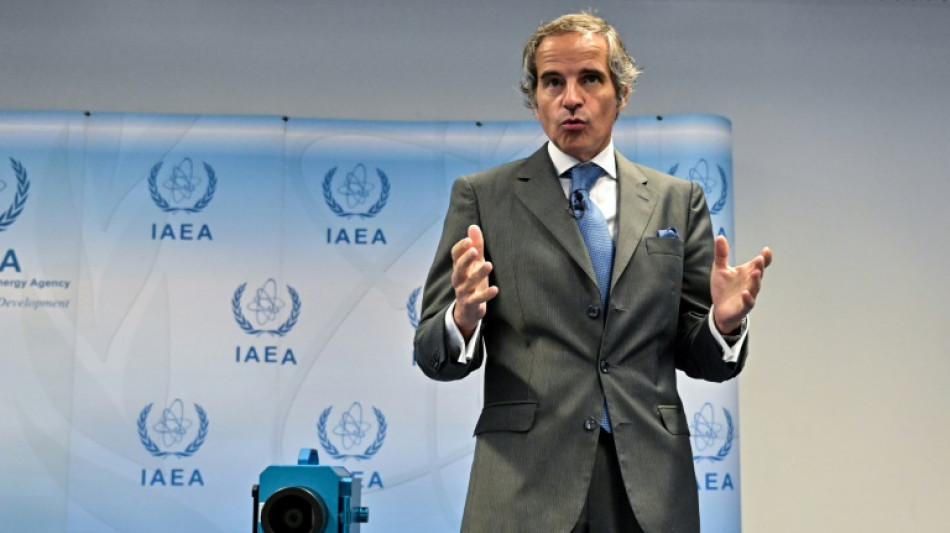
Iran has uranium particles enriched to nearly bomb grade: IAEA / Photo: JOE KLAMAR - AFP

 Where the US-China tariff row stands ahead of White House summit
 Croc-habitat gets green light for 2032 Olympic rowing
 Indonesia cash-for-photos scheme turns animal hunters into protectors
 'Left-field' life: Briton becomes Thailand's top foreign monk

 India's transgender amendment leaves many in limbo

 Trump to host Xi amid pomp, low expectations

 Harry set for UK public outings with security, royal status hazy

 NFL Chiefs' Kelce among investors bilked in Ponzi scheme

 Trump threatens EU over 'hostile' Canada association plan

 Argentine judge orders suspension of Falklands oil project
 Carrick takes the blame as troubled Man Utd suffer League Cup misery

 Barcelona hit seven in Racing Santander rout
 Amorim's Milan beaten by Benfica, Sunderland make dream European return

 US stocks fall, dollar gains after Fed lifts interest rates

 Seahawks rule out Darnold for Sunday game at Arizona
 Mbappe explains Ceuta shirt stance after criticism

 Improving Atletico cruise to comfortable win over Osasuna

 Candidate for UN chief calls for AI regulation akin to nuclear weapons

 O'Neill expects Celtic recovery after Old Firm misery
 Man City midfield trio backed to emulate Rodri and Silva
 'We're losing control,' AI pioneer Yoshua Bengio tells AFP
 WHO eyes 'encouraging' signs in DRCongo fight against Ebola
 Liga boss criticises Real Madrid trio for Ceuta shirt incident

 WTA Finals moved to Charlotte from 2027

 Almost 8,000 excess deaths in France's scorched summer: statistics

The UN nuclear watchdog confirmed on Tuesday it had detected particles of uranium enriched up just under the 90 percent needed to produce an atomic bomb.
"Discussions are still ongoing" to determine the origin of these particles, the International Atomic Energy Agency (IAEA) said in a confidential report seen by AFP.
The report said that during an inspection "on 22 January 2023, the agency took environmental samples... at Fordow (sic) Fuel Enrichment Plant (FFEP), the analytical results of which showed the presence of high enriched uranium particles containing up to 83.7 percent U-235".
"These events clearly indicate the capability of the agency to detect and report in a timely manner changes in the operation of nuclear facilities in Iran," it continued.
Asked about the presence of the particles, Iran said that "unintended fluctuations" during the enrichment process "may have occurred".
Last week, Iran claimed it had not made any attempt to enrich uranium beyond 60 percent.
"The presence of a particle or particles of uranium above 60 percent in the enrichment process does not mean enrichment above 60 percent," said the spokesman for the Atomic Energy Organisation of Iran, Behruz Kamalvandi.
Iran has been enriching uranium well over the limits laid down in a landmark 2015 deal with world powers, which started to unravel when the United States withdrew from it in 2018.
The deal was designed to give Iran much-needed sanctions relief in return for curbs on its atomic programme.
On and off negotiations between world powers to return to the deal started in 2021 but have stalled since last year.
- Tehran visit -
The IAEA report comes as the head of the UN's nuclear watchdog, Rafael Grossi, is expected to visit Tehran "in the coming days", following an official invitation by the Atomic Energy Organization of Iran.
"In recent days, we have had constructive and promising discussions" with the IAEA delegation that was already in Iran to investigate doubts about its nuclear programme, AEOI spokesman Behrouz Kamalvandi said on Monday.
"It is hoped that this trip will form the basis for greater cooperation and a clearer horizon between Iran and the IAEA," he added.
Tehran has repeatedly insisted that it is not planning to build a nuclear bomb.
In the report, the IAEA said that Iran's estimated stockpile of enriched uranium had reached more than 18 times the limit set out in the 2015 accord between Tehran and world powers.
It estimated Iran's total enriched uranium stockpile was 3,760.8 kilogrammes (8,291 pounds) as of February 12, an increase of 87.1 kilogrammes compared to the last report in November.
The limit in the 2015 deal was set at 202.8 kilogrammes of uranium.
- Wake-up call -
The IAEA has repeatedly warned it has lost its ability to fully monitor Iran's programme since the Islamic republic started to restrict its access in February 2021.
Iran's stockpile of uranium enriched to 60 percent stood at 87.5 kilogrammes, up from 62.3 kilogrammes, the report said.
Iran now also has 434.7 kilogrammes of uranium enriched up to 20 percent, up from 386.4 kilogrammes in the November report.
Regarding the particles enriched to 83.7 percent detected in Iran, Kelsey Davenport, expert from the Arms Control Association, said that "even if it is accidental, it is no less worrying".
"This should be a wake-up call" for the international community, she said in a recent online briefing, calling on the United States and Iran to define a new strategy to defuse the crisis.
On Sunday, CIA director William Burns said Iran's nuclear programme was advancing at a "worrisome pace".
Iran has "advanced very far to the point where it would only be a matter of weeks before they can enrich to 90 percent, if they chose to cross that line", Burns told broadcaster CBS.
He added, however, that the United States did not believe Iran's supreme leader, Ayatollah Ali Khamenei, had decided to "resume the weaponisation programme that we judge that they suspended or stopped at the end of 2003".
In January, the IAEA's Grossi said Iran had "amassed enough nuclear material for several nuclear weapons".
R.Garcia--AT