Crown Jewels: The royal family's precious gems / Photo: SUZANNE PLUNKETT - POOL/AFP/File

 Philippine sensation Eala looks forward to Asian Games 'fun'

 Jakarta airport extends closure after volcano eruption
 Lonely woman director in Venice sees industry backsliding on gender

 Tech firms rally on mixed day for Asian markets, with eyes on US inflation
 World number one An sends Asian Games warning with China hat-trick
 PSG go for three in a row as Champions League returns

 "Super-human' Alcaraz books US Open quarter-final clash with Shelton

 ECB set to hike interest rates as Iran war flares anew

 AI data centers are less thirsty now, tech giants say

 North Korea vows nuclear-armed navy as US ally drills open

 Under-fire Labuschagne named in Australia Test squad for South Africa

 Enjoying the moment: Alcaraz steps it up to reach US Open quarter-finals

 Five dead, five injured after Amazon cargo plane overshoots Miami runway
 La Rochelle half-backs lead fightback against Toulouse

 US envoys have 'more effective proposals': Ukraine official
 Defending champion Alcaraz powers into US Open quarter-finals
 Amazon cargo plane overshoots Miami runway, hits vehicles, catches fire

 Toll from Yemen clashes passes 300 as civilians flee homes

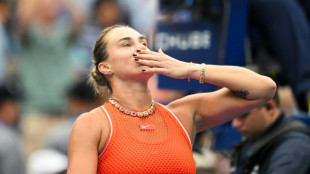
 Sabalenka books US Open quarter-final clash with Noskova

 German AfD supporters jubilant at far right's thumping win

 Zelensky warns war likely to continue into winter after US talks
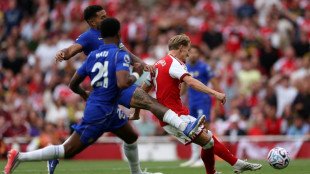 Arsenal deliver statement fightback to end Chelsea's flying start

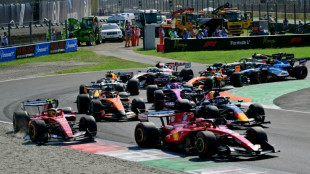 Leclerc accepts blame as Hamilton laments Ferrari approach

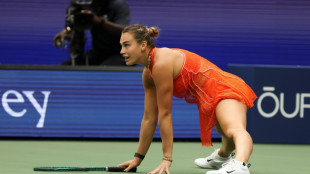 Sabalenka surges past Townsend to reach US Open quarter-finals
 Smiling face of Germany's far-right AfD: Ulrich Siegmund
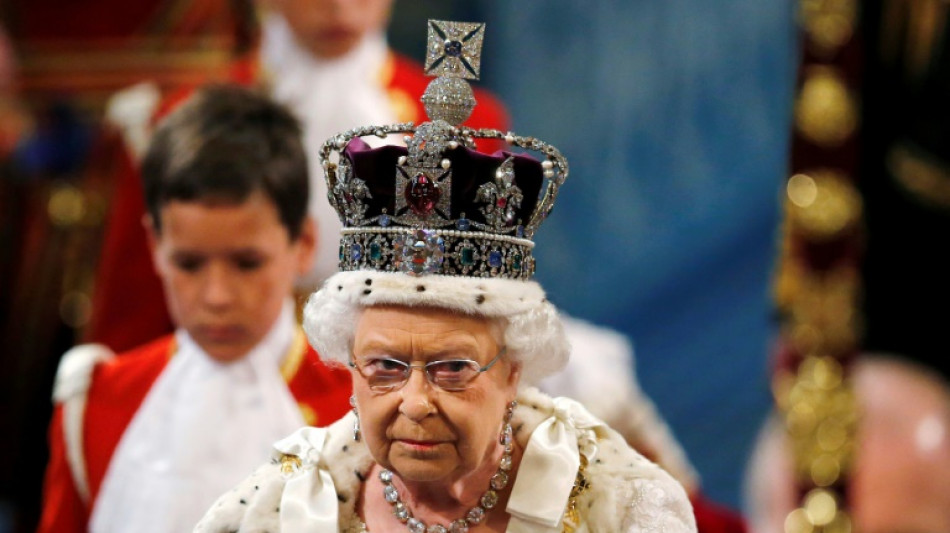
The Crown Jewels form the centrepiece of the royal coronation, and symbolise the pomp and history of the British monarchy over the centuries.
- The Imperial State Crown -
The crown was commissioned for king George VI's coronation in 1937.
Used for formal events such as the state opening of parliament, Queen Elizabeth II wore it following her coronation ceremony.
The crown bears 2,868 diamonds, 269 pearls, 17 sapphires and 11 emeralds.
It weighs 1,060 grams (2.3 pounds) and is 31.5 centimetres (12.4 inches) tall.
The second-largest stone cut from the Cullinan Diamond -- the largest diamond ever mined -- adorns the front.
- The Sovereign's Sceptre -
A gold rod with a globe, cross and dove at the top, the sceptre's design symbolises the Christian Holy Ghost.
It is associated with the monarch's pastoral role towards the people.
It weighs 1,150 grams and is 110.2 centimetres long.
- The Sovereign's Sceptre -
The sceptre represents the monarch's temporal power and good governance and complements the spiritual power symbolised by the Sovereign's Sceptre with Cross.
It weighs 1,170 grams and is 92.2 centimetres long.
The largest colourless cut diamond in the world, the Cullinan I, reigns at the top. It weighs 106 grams and is known as the "First Star of Africa".
The diamond's weight meant the sceptre had to be reinforced in 1910.
- The Sovereign's Orb -
The orb represents the monarch's power and the Christian world.
The gold piece of jewellery is surrounded by a band of diamonds, emeralds, rubies, sapphire and pearls and topped with amethyst and a cross.
It is 27.5 centimetres high and weighs 1,320 grams.
- The gold Ampulla -
The eagle-shaped vessel holds the consecrated oil used in coronation ceremonies.
The eagle's head comes off to allow oil to be poured into the vessel.
The design is based on a legend that the Virgin Mary appeared to medieval English saint Thomas Becket and handed him a golden eagle and oil to anoint future English kings.
It weighs 660 grams and measures 20.7 x 10.4 centimetres.
- The Spurs -
Gold, leather, velvet and gold thread make up one of the most ancient parts of Britain's royal coronation paraphernalia.
The use of spurs to represent knighthood in coronations dates back to the coronation of Richard I in 1189.
Spurs were traditionally fastened to the king's feet during coronation ceremonies but presented and placed on the altar for queens.
- The Cullinan Diamond -
It was the largest diamond ever mined when discovered in South Africa in 1905, weighing 621 grams in its uncut state.
The Transvaal government presented it to King Edward VII on his 66th birthday in 1907 as a gesture of reconciliation after the Second Boer War (1899-1902).
Three employees of Asschers of Amsterdam worked 14-hour days for eight months to cut and polish nine large stones from the original gem.
When workers began to cut the diamond, the first blow broke the knife rather than the diamond.
- St Edward's Crown -
Crown jeweller Robert Viner made it in 1661 for the coronation of king Charles II, after the previous medieval crown was melted down by parliamentarian rebels in 1649 during the English Civil War.
Monarchs did not wear the solid gold crown in coronation ceremonies for more than 200 years as it was too heavy.
It weighs 2,040 grams and is 30.2 centimetres tall.
- Coronation ring -
The ring dates back to the coronation of King William IV in 1831.
Queen Victoria did not wear it for her coronation in 1838 as her fingers were too small.
- Purple Robe of Estate -
Twelve seamstresses from the Royal School of Needlework took 3,500 hours to make it.
The robe is made of silk and embroidered with the monarch's cipher, wheat ears and olive branches.
- The Stone of Scone -
Also known as the "Stone of Destiny", it is the ancient symbol of Scotland's monarchy.
The sandstone slab weighs 152 kilograms (335.1 pounds).
English king Edward I seized it in 1296 and incorporated it into the throne at Westminster, London.
Scottish nationalists stole it from London's Westminster Abbey in 1950 and it later reappeared in Arbroath Abbey, Scotland. It was formally returned to Scotland in 1996.
The stone will only leave Scotland again for a coronation at Westminster Abbey.
A.Moore--AT