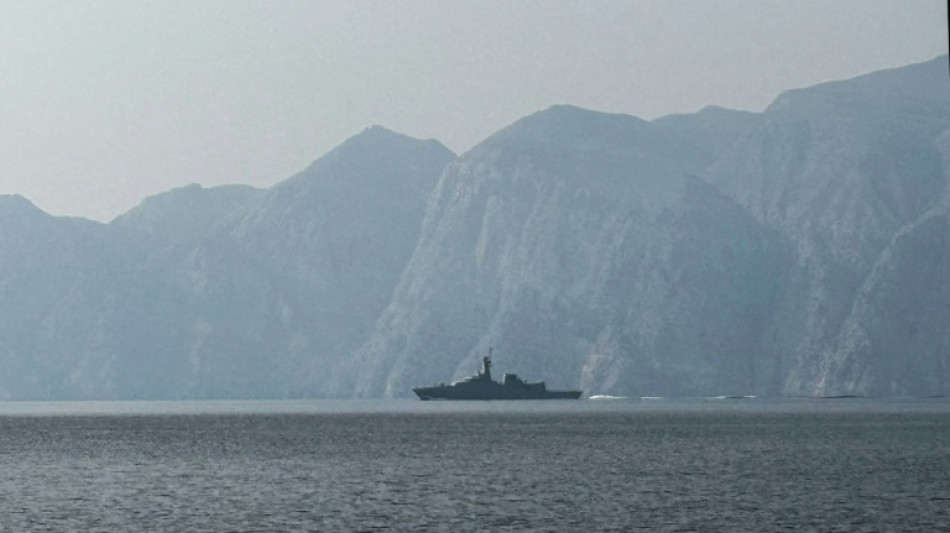
Japan, S. Korea petrochemical industry slows output on Iran war / Photo: Sahar AL ATTAR - AFP

 'I call it a bribe': Pennsylvania residents spurn $10,000 data center checks
 In a former US steel city, ordinary people struggle to get by
 'Liar,' 'clown': Lula and Bolsonaro spar in Brazil poll debate

 Record El Nino? Depends who's counting

 On the front line of ocean conservation off Portugal's Madeira

 Wembanyama targets title breakthrough as NBA season tips off
 With LeBron on board it's title or bust for Philly fans

 One year after Louvre heist, where are the missing jewels?

 Knicks face tall task in NBA championship repeat bid

 Warriors' Curry 'fine' after limping out of practice - Kerr

 Zelensky speaks to US envoys as Trump lashes out

 'Surprise package' Lazio crush Juve to keep pace with Serie A leaders Inter

 China growth expected to miss official target in third quarter

 Lazio crush Juventus to move level with Serie A leaders Inter

 Leeds draw feels like 'fresh start' for Man Utd's Carrick

 Macron denounces 'unbridled' violence as France hit by new clashes

 Hurzeler lauds 'hard worker' Gomez after Brighton goal from halfway line

 Toulouse hold off Exeter, Northampton save English Champions Cup blushes

 Arsenal snatch late win to keep pressure on Man City as Man Utd held
 Arsenal strike late to keep pressure on Man City as Man Utd held

 Four soldiers dead, dozens injured in fire at Canada military base

 Ton-up Agha helps Pakistan down Sri Lanka in tri-series opener

 Man Utd draw at Leeds keeps pressure on Carrick

 Barca defenders Garcia, Kounde injured before key games

 Lula, Bolsonaro to face off in first debate of bruising election

The Middle East war is forcing petrochemical giants in two key Asian economies to cut production as the conflict rattles supplies of a crucial oil-derived component used to make a range of plastic goods.
The scarcity of naphtha -- a liquid distilled from petroleum that is essential for making ethylene, a key ingredient in everything from plastic grocery bags to food packaging -- risks a knock-on effect across many industries.
The petrochemical sector in Japan and South Korea, an important part of both countries' economies, depends on the Middle East for their naphtha supplies -- with 74 percent of Japan's imports coming from the region.
But supplies are drying up, with a vital shipping lane for oil from the Middle East, the Strait of Hormuz, virtually paralysed.
The price of naphtha shipped into Asia has soared 60 percent since the war began.
"We estimate that naphtha inventories currently stand at around 20 days" in Japan, the world's fourth-biggest economy, analysts at Nomura warned last week.
"And if the Strait of Hormuz remains closed for two to three weeks, this could have a major impact" on naphtha production, they said.
That impact is already creeping in.
Last week, Japanese giant Mitsubishi Chemical started cutting production capacity of its steam cracker, a facility that converts naphtha into ethylene and propylene, which it runs as a joint venture.
"We concluded that a reduction in naphtha imports was inevitable. Our goal is to avoid a suspension of our operations," a company spokesperson told AFP.
– 'Economic security' –
Mitsui Chemicals, another leading Japanese chemicals firm, started cutting ethylene output at two plants last week because of concerns over naphtha supply, a company spokesperson told AFP.
Half of Japan's 12 ethylene plants have already reduced production, Bloomberg reported, just two weeks after US-Israeli strikes on Iran ignited the war.
That slowdown increases the likelihood of knock-on effects across other industries.
Shin-Etsu Chemical will hike the selling price of polyvinyl chloride (PVC) -- which is used to make window frames, floor covering, pipes and cable insulation -- in the Japanese market from April 1.
"The price of ethylene -- a key raw material for PVC -- has surged, and we have been subjected to supply volume restrictions by our suppliers, compelling us to curtail our production output," the company said in a statement.
The crisis has also hit South Korea, one of Asia's biggest economies.
"We informed our customers last week that we might declare force majeure on one of our products, dioctyl terephthalate" -- which is used in everything from cosmetics to clothes, a representative of LG Chem told AFP.
In a sign of how critical the situation has become, the South Korean government said Tuesday that it would restrict naphtha exports.
"We will designate naphtha as an item related to economic security by the end of the week," Finance Minister Koo Yun-cheol said.
"The government will work to resolve the difficulties through export restrictions and other necessary measures."
– 'High dependence' –
The shockwave is spreading across Asia, with Singapore's PCS -- a producer of ethylene and other petrochemicals -- announcing on March 5 that it had issued a formal force majeure notice to its customers.
The global supply of polyethylene -- a derivative of naphtha that is ubiquitous, particularly in plastic packaging, bottles and pipes -- is also disrupted, with countries in the Middle East major exporters.
The paradox, noted BloombergNEF analyst Philip Geurts, is that major polyethylene producers like South Korea or Singapore "could have an advantage" given strong demand in other markets and rising prices.
But "it's very hard to benefit from that if you can't produce the chemicals in the first place," he stressed at a briefing, because "the feedstock (naphtha) dependence on the Middle East is just extraordinarily high".
The crisis comes as Japan and South Korea were already closing aging petrochemical facilities because of chronic overcapacity in China, a country with far more competitive infrastructure.
China is relatively spared for now, thanks to its refining capacity and its ability to source Russian naphtha.
According to South Korean reports, Seoul is also considering turning to Russia as an alternative source.
burs-jug/aph/cms
M.O.Allen--AT