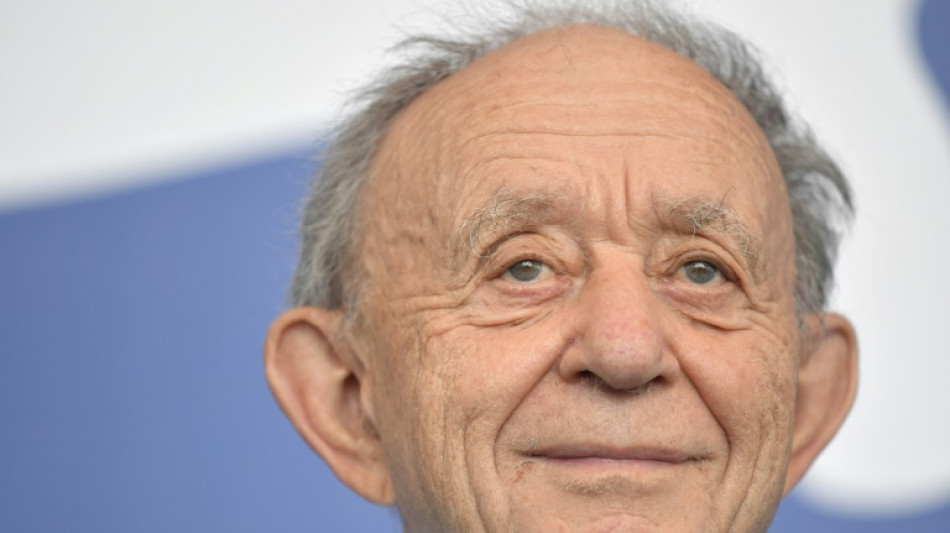
Frederick Wiseman, documentarian of America's institutions, dead at 96 / Photo: Tiziana FABI - AFP/File

 IOC president impressed by 'beautiful' Asian Games wooden huts

 First Asian Games gold goes to Japan as China's 13-year-old Yu lights up pool
 Data centre command hub keeps AI up and running
 Pope Leo in France: the issues on the table
 Packing for a pope: behind the scenes on foreign trips

 Republicans find transgender issues a powerful political weapon in midterm campaigning

 German state elections threaten new shock waves for Merz
 Chile's Bachelet quits race to be next UN chief

 Raphinha treble fires perfect Barca to win at Sevilla
 Thiam makes winning heptathlon return at Decastar meet
 Czechs beat USA to qualify for Davis Cup finals
 Dortmund sink Stuttgart to climb to Bundesliga summit
 Trump says will not tolerate attempts to slow AI growth

 'It has to stop': runners protest women's murders in S.Africa district

 Fire erupts near Riyadh airport as Houthis claim strikes

 Cuba works to restore power after another blackout
 England thrash Sri Lanka again to return to top of T20 rankings
 Arsenal thrashed by Brighton, sorry Spurs lose again

 South Korea, Austria qualify for Davis Cup finals
 Seare shocks Ingebrigtsen to win world 5km gold
 Brigitte Bardot widower slams sale of star's belongings

 Aston Villa compound Tottenham's misery despite late rally

 Asian Games offer 'deepest apologies' for South Korea anthem blunder
 Inter Milan and Italy icon Mazzola dies aged 83

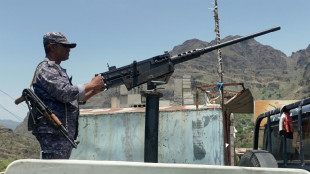 Saudi capital issues first air raid alert since renewed fighting in Yemen

US documentary filmmaker Frederick Wiseman died Monday, a representative confirmed to AFP. He was 96 years old.
Wiseman died peacefully at his home in Cambridge, Massachusetts, according to a statement from his production company, Zipporah Films.
For more than a half century, Oscar-winner Wiseman patiently observed some of America's most familiar institutions through his dozens of documentaries that shine a rare light on people's daily lives.
Viewed through his unobtrusive lens, the drudgery of a welfare office or the cleaning routines at a city zoo became as gripping as an action movie, all of which were presented without voiceovers or talking heads -- taboos in Wiseman's world.
A pioneer of independent US cinema, Wiseman shot with a three-person team while editing and producing himself, creating films with runtimes ranging from an hour to six, all to present a unique and engrossing American epic for the screen.
"What if the Great American novelist doesn't write novels?" the New York Times titled its 2020 profile, describing Wiseman's body of work as "the nearest contemporary equivalent" to the classic novel.
- Harrowing -
Wiseman caused instant controversy with his first film, "Titicut Follies," which remains one of his most famous documentaries, shot in 1967 and capturing the bleak reality of an asylum for the mentally ill, Bridgewater.
Harrowing long takes showed the deplorable treatment of patients, including one excruciating scene of a man being force-fed by a doctor with a cigarette hanging from his mouth, directly above the funnel.
Bridgewater filed a complaint in the hope of banning the film's release on privacy infringement and the case dragged for years, but Wiseman never gave up the fight, and continued working -- revealing a lifelong single-minded focus.
He also had a deep understanding of the law, having followed in his father's footsteps to study and then practice as a lawyer before he got bored and picked up a camera.
- Never-ending list -
Over the following decades Wiseman entered high schools, hospitals, army training camps, meat factories and public libraries to explore America's institutions, incidentally producing rich studies of human behavior.
He eschewed any stylistic qualities drawing attention to the process of filmmaking, deeming "too distracting" the close-ups of mouths talking and body parts that featured in his early films.
A passionate workhorse, he averaged around one documentary every few years for a long time, and kept the industry pressure off by maintaining low production costs and having his own production company.
Even in his ninth decade, in an interview with AFP in 2021, he said the list of institutions he wanted to make films about was "never-ending," and his late works showed no sign of diminishing ambition.
For his 2020 documentary "City Hall," he returned to his roots in Boston, where he was born in 1930, to explore the mayor's office.
Two years later he made a rare foray into fiction with "A Couple," inspired by the relationship and correspondence between Leo Tolstoy and his wife, Sophia.
France was a favoured subject too, where he turned his lens on some of the country's most famous institutions, from the Paris Opera Ballet to the legendary cabaret club Crazy Horse, as well as the Comedie Francaise, the guardian of the flame of French classical theatre.
- Waiting game -
Wiseman typically shot around 140 to 150 hours of footage for each film and then sat alone in his editing studio for months to craft his feature.
Generally, he did not prepare before starting a project, wanting to go in without preconceived ideas and using the shoot as his research.
This approach got him such classic scenes as the ending to one of his most celebrated documentaries, "Welfare" (1975), set in a New York welfare office.
A disheveled man sick of endless waiting launched into an eloquent tirade ending with Samuel Beckett -- "You know what happened in the story of Godot? He never came."
But for Wiseman, on the back of all those hours of shooting, such extraordinary scenes always came.
He was married for more 65 years to the late Zipporah Batshaw, a lawyer and professor who also inspired the name of his production company. They had two sons.
O.Gutierrez--AT