Mystery foot belongs to ancient human relative: scientists / Photo: Michal Cizek - AFP/File

 PSG president Nasser al-Khelaifi under investigation in France for conflict of interest

 China swim sensation, 13, sets Games record after Japan win early

 Drones hit Moscow as Russians go to the polls

 New England boss Fleming says 'wrong' to ask Stokes to end retirement

 Germans vote in elections threatening fresh blow to Merz

 US fears rapid escalation in Mideast after Houthis attack Riyadh

 Japan triathlete Hojo wins first gold of Asian Games

 IOC president impressed by 'beautiful' Asian Games wooden huts

 First Asian Games gold goes to Japan as China's 13-year-old Yu lights up pool

 Data centre command hub keeps AI up and running

 Pope Leo in France: the issues on the table

 Packing for a pope: behind the scenes on foreign trips

 Republicans find transgender issues a powerful political weapon in midterm campaigning

 German state elections threaten new shock waves for Merz

 Chile's Bachelet quits race to be next UN chief

 Raphinha treble fires perfect Barca to win at Sevilla

 Thiam makes winning heptathlon return at Decastar meet

 Czechs beat USA to qualify for Davis Cup finals

 Dortmund sink Stuttgart to climb to Bundesliga summit

 Trump says will not tolerate attempts to slow AI growth

 'It has to stop': runners protest women's murders in S.Africa district

 Fire erupts near Riyadh airport as Houthis claim strikes

 Cuba works to restore power after another blackout

 England thrash Sri Lanka again to return to top of T20 rankings

 Arsenal thrashed by Brighton, sorry Spurs lose again

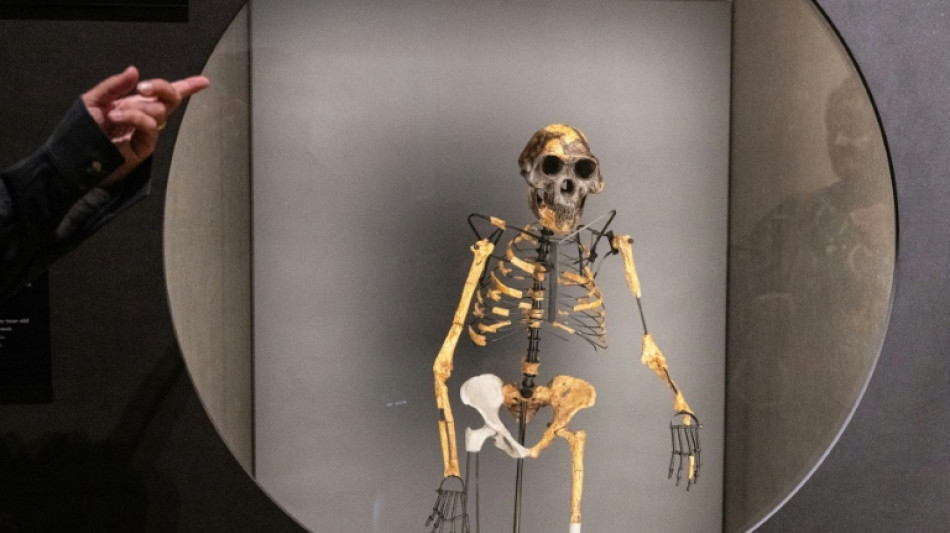
Newly discovered fossils prove that a mysterious foot found in Ethiopia belongs to a little-known, recently named ancient human relative who lived alongside the species of the famous Lucy, scientists said Wednesday.
The discovery is the latest twist in the tale of human evolution and could even cast some doubt on the status of Lucy's species, Australopithecus afarensis, as the direct ancestor of Homo sapiens.
Until the foot was discovered in Burtele in northeastern Ethiopia in 2009, Lucy's species was thought to be the only human relative living in the area more than three million years ago.
But the appendage clearly does not belong to Lucy's species because it has an opposable toe -- similar to a thumb -- allowing its owner to grab onto tree branches like apes.
The team of scientists who found the mystery foot went on to name a new species, Australopithecus deyiremeda, in 2015 based on some roughly 3.4-million-year-old jaw bones found in Burtele.
The announcement was met with some scepticism in scientific circles. Due to the scarcity of fossils, attempts to add a new branch to the human family tree usually provoke fierce debate.
The team was also unable to say that the foot bones -- dubbed the Burtele foot -- belonged to their new species.
Now, in a study published in the journal Nature, the scientists announced that new fossils including a jawbone with 12 teeth found at the site show that the foot was that of A. deyiremeda.
"We have no doubt about the Burtele foot belonging to the same species as these teeth and the jaw," lead study author, Yohannes Haile-Selassie of Arizona State University, told AFP.
The research also revealed more details about this species, offering further clues about who could have been the true ancestor of us Homo sapiens.
- 'Co-existence deep in our ancestry' -
A CT scan of the teeth suggested that A. deyiremeda was more primitive than its cousin Lucy, the study said.
Isotope analysis of the teeth meanwhile showed that its diet consisted mainly of leaves, fruit and nuts of trees.
The grasping big toe also suggested this human relative spent more time in the trees. Big toes played an important role in human evolution, allowing our ancestors to leave the trees behind and walk on two legs.
A lingering question about A. deyiremeda was how it could have co-existed with Lucy's species at the same place and time, Haile-Selassie said.
The new research suggests that the former spent its time in the forest, more likely eating from trees, while the latter spent more time on the ground, a difference that allowed them to live together.
It also demonstrates that "co-existence is deep in our ancestry", Haile-Selassie emphasised.
- Finding our roots -
John McNabb, a palaeolithic archaeologist at the UK's University of Southampton not involved in the study, praised the new research.
"There will always be sceptics, but I think these new finds, and their validation of older ones, will help many researchers to be more accepting of A. deyiremeda," he told AFP.
It also "adds a new player into the mix" in the search for the identity of our true ancestor, McNabb added.
Because A. deyiremeda was more primitive and had a less human-like foot than Lucy, it is unlikely to dethrone her as the prime suspect in this search, both scientists agreed.
But the discovery "opens this possibility that we might still find more species within that time period because it looks like the Australopiths were experimenting with bipedality", or walking on two legs, Haile-Selassie said.
"Could there be another species which could be a better candidate to be the ancestor of the genus Homo?" he asked.
"We don't know -- it depends on what we find."
O.Ortiz--AT