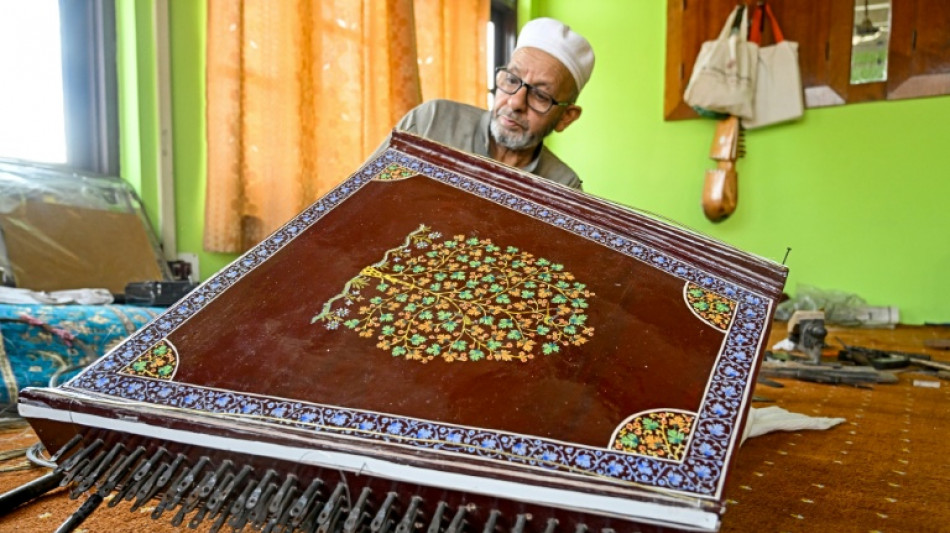
Strings of identity: Kashmir's fading music endures / Photo: Tauseef MUSTAFA - AFP

 Reusser retains world time-trial title

 Man City outgun Sunderland despite Brobbey hat-trick, Liverpool win at Bournemouth

 Top US, Chinese economic officials meet ahead of Trump-Xi summit

 Erdogan's LGBTQ crackdown 'first step of election campaign': activist

 Mass drone barrage on Moscow kills two

 82-year-old dies after beach fight in Greece over sun lounger

 US warns of rapid escalation in Mideast war

 Iran 'put hearts on the court' to win Asian Games basketball bronze

 School girl Yu helps China dominate in Asian Games swimming openers

 Myanmar win first Asian Games teqball gold as Spain great Puyol watches

 China's 13-year-old Yu scorches to first major gold at Asian Games

 Russians vote on last day of parliamentary elections

 Hong Kong pays final respects to former city leader Tung

 Typhoon put people off Asian Games opening ceremony, official says

 China's 13-year-old Yu cruises as Asian Games swimming begins

 AI 'warning shots' focus Beijing on national security risks

 Philippine tribe in limbo over US-led tech hub

 Leo XIV, first US pope transcends his restrained style

 Singer Ed Sheeran says Gaza situation 'unjustifiable' following controversy

 In 'Tenzing', a Sherpa mountaineer gets his due

 Gridko's New Live Drive PTO Roll-Off Trailer Wins the Heavy-Duty TRAILmakER Award 2026 at NATDA Awards

 Chile's Bachelet quits race to be next UN chief

 Raphinha treble fires perfect Barca to win at Sevilla

 Thiam makes winning heptathlon return at Decastar meet

 Czechs beat USA to qualify for Davis Cup finals

In a modest workshop filled with the fragrance of seasoned wood, 78-year-old Ghulam Mohammad Zaz continues a craft his family has preserved for eight generations -- the making of the Kashmiri santoor.
Surrounded by tools that have outlived artisans, he works slowly, each strike and polish echoing centuries of tradition crafting the musical instrument.
"Seven generations have worked and I am the eighth; I have no guarantee anyone after me will do this work," Zaz said softly, speaking in Kashmiri.
Once, several of his family members shared this craft in the heart of Kashmir's main city Srinagar, in the Indian-administered part of the Himalayan territory.
Today, he is the last in the city to make the instruments by hand.
"If I tell anyone to make something, they won't know what to do or how to make it," said Zaz, who produces around eight to 10 instruments every year, selling for around 50,000 rupees ($565) each.
"It is not as simple as just picking some wood -- one needs to find the right kind of wood."
The santoor, a hundred-stringed zither-like instrument played with hammers, has long been central to Kashmir's musical identity, giving the Muslim-majority region its cultural distinctiveness.
The contested Himalayan territory has been divided between India and Pakistan since independence from Britain in 1947.
Militants have fought Indian rule, demanding independence or a merger with Pakistan.
Tensions remain high between New Delhi and Islamabad.
In May, clashes between the nuclear-armed rivals sparked the worst fighting since 1999, killing more than 70 people in missile, drone and artillery exchanges.
- Mystical music -
Historically, the santoor formed the backbone of "sufiana musiqi", Kashmir's mystical music tradition, with its hypnotic and reverberating sound bringing tranquillity.
"Musicians used to come from Iran to Kashmir, they used to play santoor and other instruments," said Muzaffar Bhat, a music professor at a government college in Anantnag.
"They used to sing in Persian... we adapted the santoor from them and assimilated it into our music."
The instrument received a new life in the 20th century.
In the 1950s, celebrated Indian musician Shivkumar Sharma -- born in Jammu and Kashmir in 1938 -- used the santoor to play classical music.
"Due to that, this became popularised in the classical circles throughout India," Bhat said.
Suddenly, the santoor was no longer confined to Kashmiri sufiana gatherings -— it had become a celebrated voice in Indian classical music.
Yet tradition faced challenges as Western instruments and global music trends began to overshadow local sounds.
"A lot of our traditional Kashmiri instruments became sidelined," said Bhat.
For craftsmen like Zaz, this meant fewer patrons, fewer students, and the slow decline of a centuries-old family profession.
Zaz sells his instruments in Kashmir, but also receives orders from Europe and the Middle East.
But there is hope. A revival, however modest, is taking root.
"Since the last few years, a new trend has started," Bhat said. "Our youngsters have started to learn our traditional instruments."
D.Lopez--AT
