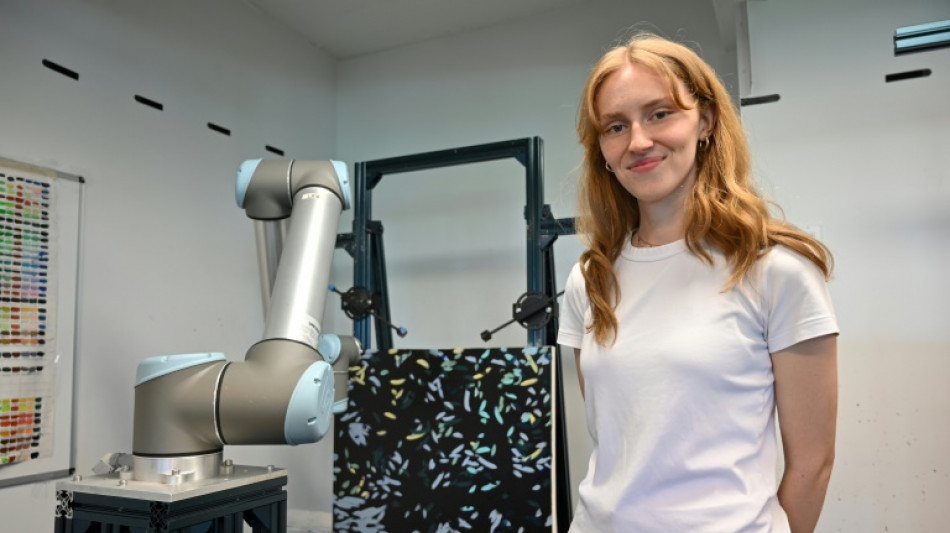
AI-backed robot painting aims to boost artist income / Photo: Daphné LEMELIN - AFP

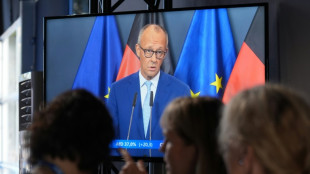
 Germany's Merz vows to stay course despite new vote losses
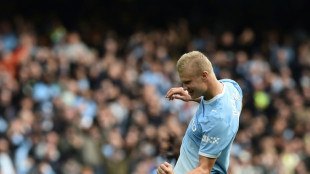 Man City outgun Sunderland despite Brobbey hat-trick, Man Utd rescue Fulham draw

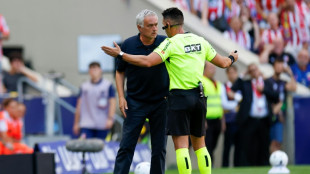 Mourinho blames ref committee for Real Madrid derby defeat
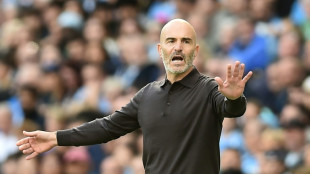 Maresca craves a 1-0 win after eight-goal Man City thriller
 Atletico Madrid beat Real Madrid in tense derby clash
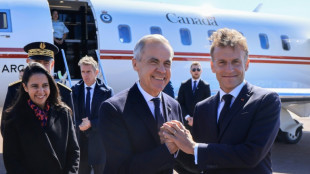
 Reusser retains world time-trial title
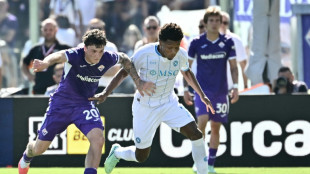
 Man City outgun Sunderland despite Brobbey hat-trick, Liverpool win at Bournemouth

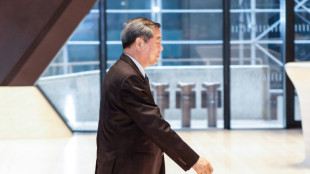 Top US, Chinese economic officials meet ahead of Trump-Xi summit
 Erdogan's LGBTQ crackdown 'first step of election campaign': activist
 Mass drone barrage on Moscow kills two
 82-year-old dies after beach fight in Greece over sun lounger

 US warns of rapid escalation in Mideast war
 Iran 'put hearts on the court' to win Asian Games basketball bronze
 School girl Yu helps China dominate in Asian Games swimming openers
 Myanmar win first Asian Games teqball gold as Spain great Puyol watches
 China's 13-year-old Yu scorches to first major gold at Asian Games
 Russians vote on last day of parliamentary elections

 Hong Kong pays final respects to former city leader Tung
 Typhoon put people off Asian Games opening ceremony, official says
 China's 13-year-old Yu cruises as Asian Games swimming begins
 AI 'warning shots' focus Beijing on national security risks
 Philippine tribe in limbo over US-led tech hub
 Leo XIV, first US pope transcends his restrained style
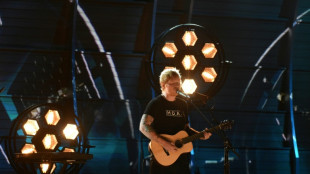 Singer Ed Sheeran says Gaza situation 'unjustifiable' following controversy

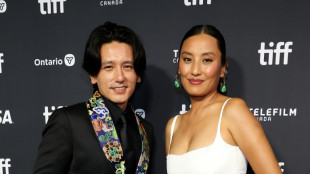 In 'Tenzing', a Sherpa mountaineer gets his due
Montreal-based artist Audrey-Eve Goulet was initially uncertain as she watched an AI-powered robotic arm reproduce one of her works, but said the outcome was "really impressive."
"I was surprised, in a good way," she said, as she watched the device grab a brush, dip it into a pot of paint, and replicate her work stroke after meticulous stroke.
Goulet had agreed to work with Acrylic Robotics, a Montreal-based company that says it aims to help artists earn a living by making high-quality replicas of their work, with their consent.
Company founder Chloe Ryan told AFP the idea began after coming to a discouraging realization about her own income.
She said she first starting selling paintings at 14, but grew frustrated at the weeks, or even months, required to make each piece.
"I did the back of the napkin math, and I said, 'Oh my god, I'm making $2 an hour.'"
Ryan studied mechanical robotics at Montreal's McGill University, and began considering how robots could help reproduce her own work, before launching a company to make the technology accessible to artists worldwide.
- 'The last layer' -
Assessing the robot's performance, Goulet said: "It truly looks like one of my works."
"I like that you can see the strokes... You can really see where the brush went and the shape it drew," she said, conceding the robotically producing version had "less story behind it" than her own.
"My final piece might have gone through five lives before getting to this, but the robot only sees the last layer," she said.
Ryan said that by replicating "stroke chronology" her company's reproductions can capture "the aura of a piece...in a way that a photo print simply never could."
To reproduce Goulet's piece, an Acrylic Robotics specialist recreated the work using digital brush strokes and pigments, developing instructions to guide the robot.
Ryan plans to advance the technology, allowing artists to upload images directly.
She wants to create an on-demand market where clients could make special requests, like a portrait of their dog in the style of their favorite artist.
- 'Waitlist' -
Ryan said she understands the artistic community's concerns about generative AI, but stressed her company is grounded in the so-called "Three Cs" demanded by artists: consent, credit and compensation.
"A lot of people, before they understand the why of what we're building, see a robot painting and go, 'Oh my god, this is the worst thing I've ever seen,'" she told AFP.
Acrylic Robotics is focused on boosting artist income, especially for those who don't break into the elite gallery circuit, Ryan said.
When approaching an artist, she sometimes suggests they send a few references pieces -- work that has already been completed.
When she tells them, "I will just deposit money in your bank account at the end of every month.... There's a warmer reception," she said.
The price of reproductions can vary, averaging between a couple hundred to a thousand dollars.
The revenue split with the artist fluctuates.
An emerging artist who simply uploads a picture of a piece with limited value may get five percent of a sale, but that figure could rise to 50 percent for a prominent artist with their own base of interested buyers.
"We have a wait list of about 500 artists," Ryan said.
Michael Kearns, a computer and information science professor at the University of Pennsylvania, questioned whether the technology would ultimately lower the value of the product.
Kearns, part of an Amazon scholarship program that funds academics to work on technological challenges, said he understood the push to "let many more people make a decent living from (art)."
But, he cautioned, "when you make something that was scarce abundant, it'll change people's perceptions about its value."
R.Lee--AT