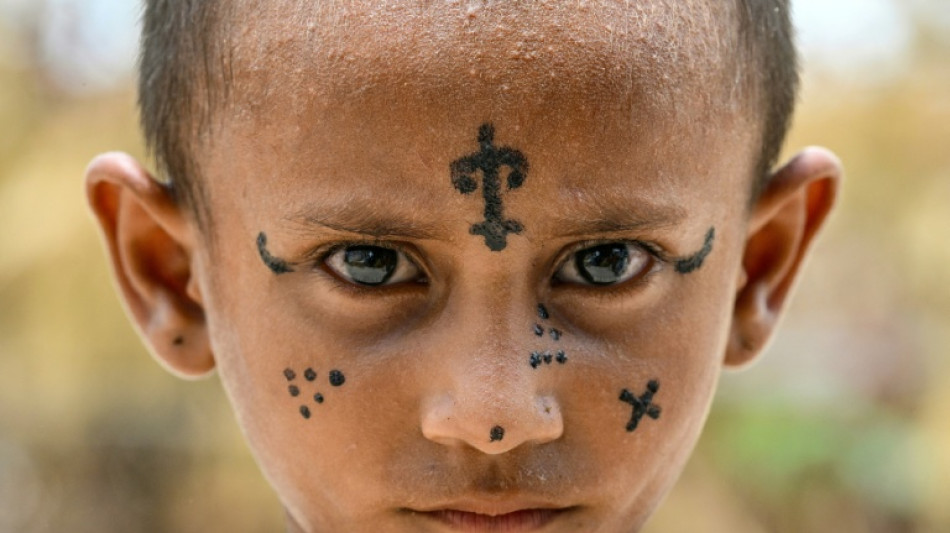
City girls snub traditional Hindu face tattoos in Pakistan / Photo: Asif HASSAN - AFP

 Braves clinch division title as Red Sox reach MLB playoffs

 Bordeaux-Begles hammer Stade Francais despite Jalibert injury

 Milan and Juventus end blips with home wins
 Bridgeman wins PGA Biltmore title with sizzling 61

 Williams injured as Bears shut down by Vikings

 US warns of rapid escalation in Middle East war

 Germany's far-right AfD celebrates another state election win

 Russia vows revenge for election-day attacks as poll shows ruling party win

 Spaun late shows snatches PGA Championship win

 Conceicao strikes as Juventus beat Atalanta
 Britain, Zverev-inspired Germany, Spain complete Davis Cup finals

 Man Utd salvage Fulham draw as pressure mounts on Carrick

 Spanish civil war drama 'The Black Ball' wins at Toronto festival

 Germany's Merz shaken by far-right and far-left gains in state votes

 Macron welcomes Canada's Carney to French Atlantic territory
 Fiorentina frustrate Napoli with Serie A draw, Como upset

 Five-star Man City top Premier League after Sunderland thriller
 Ukrainian drones hit Moscow on last day of Russian elections
 Multi-Asset Trading Venue Monochrome Exchange Announces IEO of Its Native Token, $MCR

 South Korea break Japan hearts to win Asian Games basketball gold
 Acosta takes first victory at Austrian MotoGP

 PSG president Nasser al-Khelaifi under investigation in France for conflict of interest

 China swim sensation, 13, sets Games record after Japan win early

 Drones hit Moscow as Russians go to the polls

 New England boss Fleming says 'wrong' to ask Stokes to end retirement

Grinding charcoal with a few drops of goat's milk, 60-year-old Basran Jogi peers at the faces of two small Pakistani sisters preparing for their first tattoos.
The practice of elder women needling delicate shapes onto the faces, hands, and arms of younger generations stretches back centuries in the Hindu villages that dot the southern border with India.
"First draw two straight lines between the eyebrows," Jogi instructs her friend poised with a sewing needle.
"Now insert the needle along the lines – but slowly, until it bleeds."
Six-year-old Pooja barely winces as dotted circles and triangles are tattooed onto her chin and forehead.
On the outskirts of the rural town of Umerkot in Sindh province, her seven-year-old sister Champa declares eagerly beside her that "I am ready too".
In recent years, however, as rural Hindu communities in Muslim-majority Pakistan become more connected to nearby cities, many young women have opted out of the "old ways".
"These signs set us apart from others," said 20-year-old Durga Prem, a computer science student who grew up in the nearby city of Badin.
"Our generation doesn't like them anymore. In the age of social media, young girls avoid facial tattoos because they think these marks will make them look different or unattractive."
Her sister Mumta has also refused to accept the tattoos that mark their mother and grandmothers.
"But if we were still in the village, we might have had these marks on our faces or arms," she reflects.
- Ward off evil spirits -
Just two percent of Pakistan's 240 million people are Hindu, and the majority live in rural areas of southern Sindh province.
Discrimination against minorities runs deep and Hindu activist Mukesh Meghwar, a prominent voice for religious harmony, believes younger generations do not want to be instantly identified as Hindu in public.
Many Muslims believe tattoos are not permissible in Islam, and even those who have them rarely display them in public.
"We can't force our girls to continue this practice," Meghwar told AFP. "It's their choice. But unfortunately, we may be the last generation to see tattoos on our women's faces, necks, hands, and arms," he said.
Few Hindus that AFP spoke with recalled the meaning behind the practice of tattoos or when it began, but anthropologists believe it has been part of their cultural heritage for hundreds of years.
"These symbols are part of the culture of people who trace their roots to the Indus civilisation," anthropologist Zulfiqar Ali Kalhoro told AFP, referring to a Bronze Age period that pre-dates modern religion.
"These 'marks' were traditionally used to identify members of a community" and to "ward off evil spirits", he adds.
Admiring the work on the grinning faces of the two little sisters, elder Jogi agreed that it was an ancestral tradition that enhanced the beauty of women.
"We don't make them for any specific reason – it's a practice that has continued for years. This is our passion," she told AFP.
The marks that begin dark black quickly fade to a deep green colour, but last a lifetime.
"They belong to us," said Jamna Kolhi, who received her first tattoos as a young girl alongside Jogi.
"These were drawn by my childhood friend –- she passed away a few years ago," 40-year-old Jamna Kolhi told AFP.
"Whenever I see these tattoos, I remember her and those old days. It's a lifelong remembrance."
W.Nelson--AT