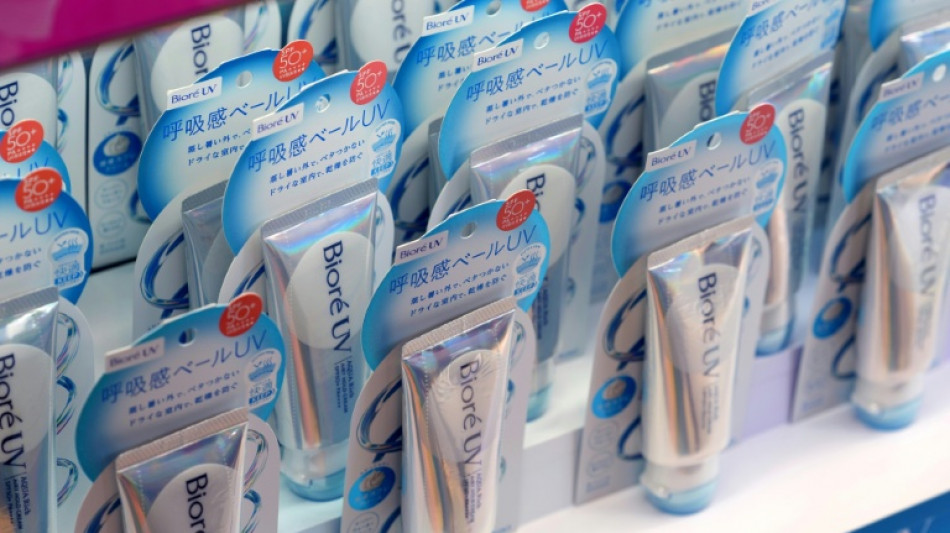
Japan's high-tech sunscreens tap into skincare craze / Photo: Kazuhiro NOGI - AFP

 New Zealanders pick endangered black robin as Bird of the Year
 Asia stocks rise on AI, US-China trade talks optimism

 Malaysia's 'elephant whisperer' fights to save Borneo's endangered giants
 'I live in fear': 1.5 million Pakistani children sexually exploited online

 Cowboys beat Commanders, Vikings down Bears as star QBs injured
 4 Hacks for Yearlong Savings on Your Kids' Wardrobes

 Forest fire threatens tourist town in Colombian Andes

 Torres on target again as PSG beat 10-man Marseille in Ligue 1

 Germany's Merz vows to stay course despite new election defeats

 Carrick demands Man Utd response after 'pathetic' jibes

 Liverpool boss Iraola urges Isak to raise his level

 Evenepoel wins record 4th straight world time-trial title

 France's Macron, Canada's Carney announce closer ties
 Carrick defends troubled Man Utd after Fulham escape
 Horror movie 'Resident Evil' tops N. American box office

 Germany's Merz vows to stay course despite new vote losses

 Man City outgun Sunderland despite Brobbey hat-trick, Man Utd rescue Fulham draw

 Mourinho blames ref committee for Real Madrid derby defeat
 Maresca craves a 1-0 win after eight-goal Man City thriller
 Atletico Madrid beat Real Madrid in tense derby clash
 Reusser retains world time-trial title

 Man City outgun Sunderland despite Brobbey hat-trick, Liverpool win at Bournemouth

 Top US, Chinese economic officials meet ahead of Trump-Xi summit
 Erdogan's LGBTQ crackdown 'first step of election campaign': activist
 Mass drone barrage on Moscow kills two

When YouTuber Hannah Price set out to compare Japanese and Australian sunscreen, she wasn't expecting her deep dive into the subject to rack up over two million views.
The huge number of people poring over Price's video shows the growing interest in skincare products from Japan, much like the K-beauty phenomenon from South Korea.
It includes sun protection, increasingly recognised as a daily essential by influencers who want to shield their skin from ageing and enthuse about the lightweight texture of Japanese brands.
Companies that have perfected their secret formulas want to capitalise on booming demand, including by building factories overseas and selling to Japan's record influx of foreign tourists.
Price, 32, fell into a "year-long rabbit hole" while making her video, learning about everything from SPF science to cultural attitudes to sun exposure.
"I always loved Japanese sunscreen, since I first moved to Japan in 2012," she told AFP at her studio in Tokyo.
"I remember trying it for the first time and thinking, 'this is so much better than anything I tried in Australia'," her home country where sun cream felt "thick, sticky, greasy".
"I thought that the video would be popular... but I wasn't expecting it to reach as far" as it did, Price said.
The habit of regular sunscreen use is spreading, especially among younger generations, said Takuya Wada, who works in marketing for Japanese chemical and cosmetics firm Kao.
"There are no borders when it comes to obtaining information on social media, especially Instagram and TikTok," he said, adding that influencer posts have a "very large" impact on global sunscreen sales.
- 'Beautifully white' -
The global skincare market was worth more than $115 billion in 2024 and is expected to grow to $194 billion by 2032, according to Fortune Business Insights.
A boom in celebrity skincare brands has contributed to the industry's growth -- with A-listers like Kylie Jenner using social media to share their beauty routines, including sun protection, with hundreds of millions of followers.
When it comes to sunscreen, country-specific regulations mean no single company dominates the field, as the entry barriers to new markets are higher.
Kao's main sunscreen brand Biore UV is ranked 10th worldwide for sales, and second in Asia -- competing with the likes of L'Oreal and Beiersdorf, and Japanese rivals such as Shiseido.
The company wants sales from sun protection to reach 35 billion yen ($240 million) in 2027, up 1.6 times from 2023.
It plans to boost overseas production by opening three new sunscreen factories, in Indonesia, Brazil and Germany.
It is technically difficult to develop formulas that block the rays effectively with a smooth texture, as demanded by Japanese consumers, said Takashi Fukui, research and development director for Kao skincare products.
But using scientific know-how to strike this tricky balance is what makes Kao "different from other European or American makers".
In Japan, a cultural obsession with light skin dates back to the sixth century and using white powder imported from China later became a status symbol among nobility.
Fair skin indicated a life away from outdoor labour and sun exposure, and an old Japanese proverb says "white skin covers the seven flaws".
In the 1990s, people began using sunscreen or other cosmetics to avoid tanning -- a trend dubbed "bihaku", or beautifully white.
These days, Japanese women use sunscreen as everyday protection against sunspots and ageing, caused when UV rays penetrate into the skin, said Fukui.
- Winter sun -
Tans have long been fashionable in Western countries, but awareness of skin cancer risks is rising, making sunscreen an important healthcare product there, Fukui said.
One fan of Japanese brands is Thai skincare influencer Suari Tasanakulpan, who calls them "lightweight" compared to "heavy and uncomfortable" Western offerings.
"There are always new technologies and innovative textures that are often ahead of other countries," the 40-year-old, who reviews sunscreens on YouTube, told AFP.
At an outlet of drugstore chain MatsukiyoCocokara in Tokyo's Shibuya district, around 90 sunscreen products are lined up on the shelves.
"Sales of sunscreen is improving year on year," said Takeshi Otsuki, deputy manager of the chain's cosmetic division.
"More people are using sunscreen on a daily basis these days, so their needs are becoming more diverse," he said.
The number of male customers is also increasing, and Japanese sunscreens are very popular with overseas tourists who buy them in multipacks, Otsuki said.
While summer is high season, sunscreen is popular year-round, because Japan has a "relatively high number of sunny days in the winter, and the sunlight hours are long".
YouTuber Price now uses both Japanese and Australian sunscreen, depending on the occasion.
She sees the rise in education about sunscreens worldwide as a win-win situation.
It "means you're going to be better protected in general, which is great for everyone", she said.
R.Lee--AT