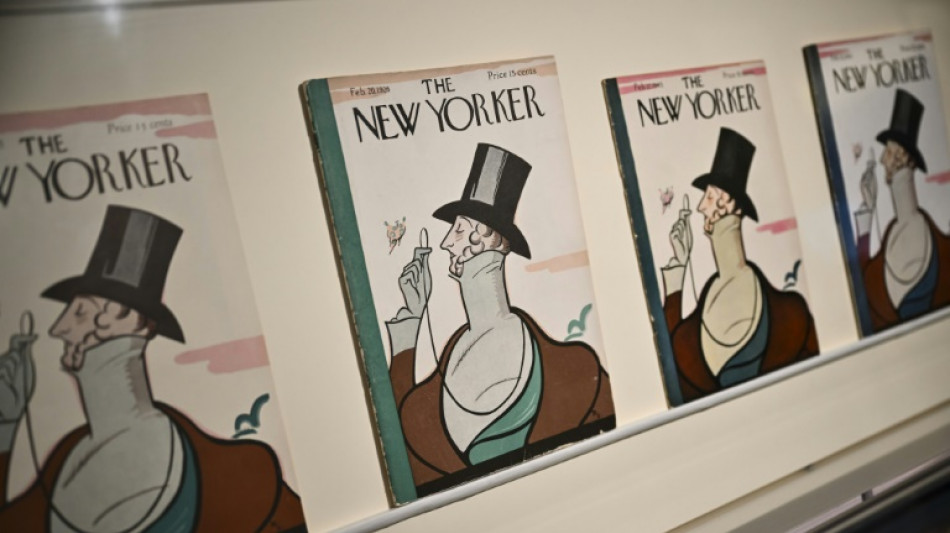
Talk of the town: Iconic covers of the New Yorker magazine / Photo: ANGELA WEISS - AFP

 US media outlets to sue Trump administration after White House ban

 Global stocks rally on lower oil prices, US-China hopes

 EU proposes energy rating for data centres
 Schoolgirl Yu scorches to second gold as doping case rocks Games

 Putin's party secures record score in Russia election

 Haupt Koleksiyonu: Paranın Biz İnsanlar Hakkında Anlattıkları

 Spanish PM says unregulated AI could be 'devastating'

 Yu, 13, smashes record again with second Asian Games gold

 Switzerland to play without Xhaka over fake Covid certificate

 From Korean Chipmakers to Leveraged Semiconductor ETFs: STARTRADER Launches 49 New 24/7 Stock and ETF CFDs

 Thai badminton player first doping case at Asian Games: testers

 Колекція Гаупта: Що гроші розповідають про нас, людей

 German far-right AfD poll winner says Merz 'twilight' has begun

 Flights scrapped, evacuations urged as Typhoon Dujuan nears Japan
 China confirms Xi to visit US this week for Trump talks

 مجموعة هاوبت: ما يكشفه المال عنا نحن البشر

 Colecția Haupt: Ce ne dezvăluie banii despre noi, oamenii

 Sisters of jailed Pakistan ex-PM Imran Khan arrested

 African players in Europe: Semenyo brace helps City top table

 'For my family': India boxer beats hardship, injury to go for Games gold
 Indonesia doing 'everything' but still struggling to curb fires

 Once decried as 'human cockfighting', MMA wants Olympic spot

 China's Yu, 13, great for swimming says multiple Olympic medallist

 Putin's party set to retain power after Russia vote hit by cyberattacks, drones

 Germany's Merz under pressure after bruising state election losses

From its first edition 100 years ago through the atomic bombs dropped on Japan, to the attacks of September 11, 2001 and on to the present day, New Yorker covers have won both artistic and journalistic acclaim.
Here are some of the magazine's most memorable covers:
- Dandy turned mascot -
The publication's first edition came out on February 21, 1925 priced at 15 cents, emblazoned with a caricature of a fictional dandy, inspired by the Count d'Orsay, looking at a butterfly through a monocle.
Created by the artist Rea Irvin, the fictional character dubbed Eustace Tilley has become the mascot of the journal, reappearing year after year in a humorous way, depicted variously as a hipster, wearing an anti-Covid mask -- and with a smartphone in place of a monocle.
- Hiroshima -
In 1946, the New Yorker devoted an entire issue to John Hersey's report on the consequences of the US atomic bomb on Hiroshima.
The cover features a bucolic landscape, drawn by Charles E. Martin.
At the time, "the images had to be almost a way to console ourselves over the world's trauma," said the New Yorker's artistic director, Francoise Mouly.
The disparity is such that it necessitated the inclusion of banner on the cover -- "this entire issue is devoted to the story of how an atomic bomb destroyed a city."
- September 11, 2001 attacks -
The Twin Towers of the World Trade Center adorn the front cover, shrouded in darkness so black and opaque that they are barely distinguishable.
"It responds to what I experienced that day," said Mouly, who was near the towers with her husband, the famous cartoonist Art Spiegelman, and her daughter when the two skyscrapers collapsed.
The couple co-signed the cover.
"I really felt that there was no possible reaction," Mouly said.
- Controversial Obama issue -
One cover of note published when the 2008 presidential campaign was in full swing, as hardline conservatives had brought a lawsuit against Barack Obama, questioning his "American-ness" and falsely insinuating that he was not born in the United States, or that he was Muslim.
The New Yorker responded to the kerfuffle with satire, a drawing titled "The Politics of Fear" by Barry Blitt, depicting the Democratic candidate in a djellaba, and his wife Michelle dressed as an armed militant in the Oval Office.
The illustration shows a portrait of Osama bin Laden hanging on the wall and an American flag burning in the fireplace.
The caricature "raised an outcry," said Mouly.
N.Mitchell--AT