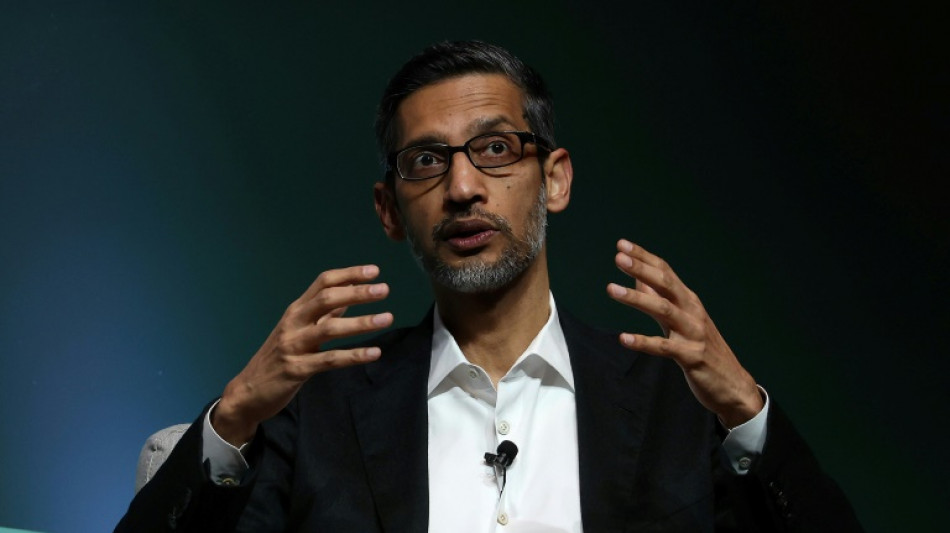
US judge rules Google is monopoly in key anti-trust case / Photo: JUSTIN SULLIVAN - GETTY IMAGES NORTH AMERICA/AFP

 Missing F-35 fighter parts 'not sensitive', says Australia minister

 Cambodia showcases scams crackdown with global conference

 Afghan cyclist who disguised herself as man wins Asian Games silver

 Typhoon Dujuan leaves four dead in Japan, 45,000 houses without power

 G7 leaders condemn Houthi strikes on Saudi Arabia

 Google data centre sparks protests in Austria

 Shin Ohashi: Junk food-loving teen and Japan's next big swimming hope

 Stocks rise on AI buzz, drop in oil prices

 China's robot dancers limber up for America's Got Talent final

 Despite military might, Saudi struggles to crush the Houthis

 Trump to tout deals, defend Iran war in UN speech

 Sri Lanka to issue verdict in landmark Easter attack trial

 Coretura Selects Alloy Kore to Advance a Unique Software-Defined Vehicle Platform for Its Commercial Vehicle Customers

 Akkodis and Hamburg Public Transport Association Showcase hvv mia at InnoTrans 2026, Demonstrating the Future of AI-Powered Mobility

 Macron says talks with Trump on Red Sea, Ukraine 'constructive'

 Green policies just good politics, says UK minister

 Bardot auction in Paris fetches nearly one million euros

 No timeline on Daniels injury return, says Commanders coach

 British Columbia sues OpenAI in US court over Canada school shooting

 French star Batum retires after 18-year NBA career

 Zidane leads first France training session

 Man shot by ICE agent in Texas detained with bullet inside him: lawyer

 California declares state of emergency ahead of El Nino

 South Africa arrests three more suspects, after nine women murdered
 Carse needs time away from England, says captain Brook

A US judge on Monday handed Google a major legal blow, ruling in a closely-watched anti-trust case that it has a monopoly with its dominant search engine.
The landmark decision against a "big tech" giant could alter how the sector operates in future.
District Court Judge Amit Mehta found that Google maintained a monopoly for search and for text ads through exclusive distribution agreements that made it the "default" option that people were likely to use on devices.
"After having carefully considered and weighed the witness testimony and evidence, the court reaches the following conclusion: Google is a monopolist, and it has acted as one to maintain its monopoly," Mehta wrote in his ruling.
The internet behemoth "has a major, largely unseen advantage over its rivals: default distribution," he added.
The anti-trust trial pitting US prosecutors against Google ended in May with a two-day hearing.
The case was the first of five major lawsuits by the US government to reach trial, with Meta, Amazon, Apple and a separate case against Google also heading for federal courtrooms.
Held in Washington, the trial was the first time the US Department of Justice has faced a big tech company in court since Microsoft was targeted more than two decades ago over the dominance of its Windows operating system.
Mehta presided over several months of testimony late last year that saw Google CEO Sundar Pichai and other top executives take the stand.
At the heart of the government's case was the massive payments made by Google to Apple and other companies to keep its world-leading search engine as the default on iPhones, web browsers and other products.
Court testimony revealed that these payments reach the tens of billions of dollars every year to keep its prime real estate on Apple hardware or the Safari and Mozilla browsers.
The Department of Justice lawyers argued that Google achieved and perpetuated its dominance -- and strangled rivals -- through these default deals that also expanded to Samsung and other device makers.
Mehta concluded, however, that Google's violation of the Sherman Act did not have "anticompetitive effects."
B.Torres--AT