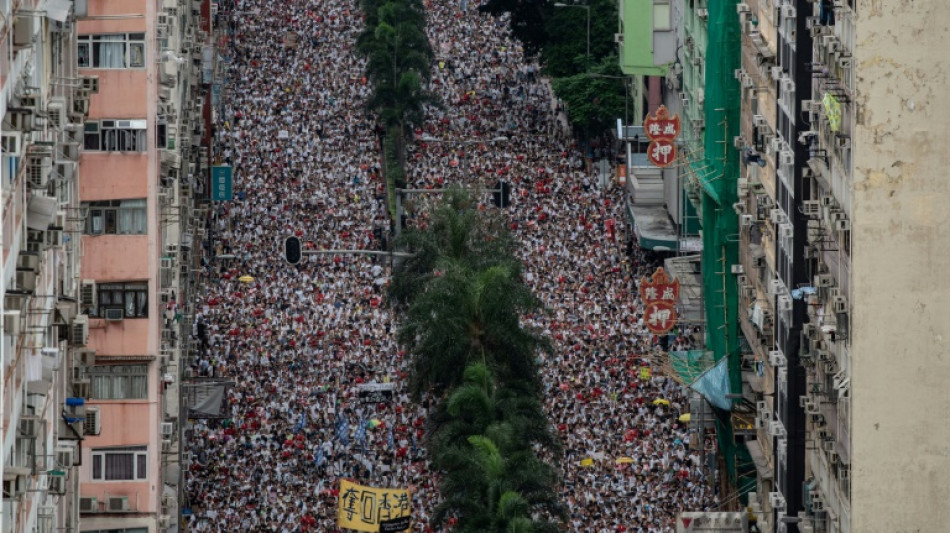
Hong Kong novelists seek freedom in exile after democracy crackdown / Photo: Philip FONG - AFP/File

 Japan's Kojima sounds Marchand warning with Asian Games gold

 England rugby star Pollock signs new Northampton deal

 STARTRADER Expands Its Chinese Equity CFD Range with CXMT and Unitree Robotics

 MEXC Expands Opportunity Compass with Stock Trading Handbook to Help Crypto Users Build Investment Knowledge

 England paceman Wood retires from international cricket

 Magnificent Mandhana's 79 helps India to Asian Games cricket gold

 Marchand 'stressed' about racing Japanese rivals at LA Olympics

 Mobile boat clinics bring healthcare to India's remote islands

 Former India paceman Zaheer Khan named Chennai coach in IPL

 Six-year-old Chinese girl sets world record with Rubik's Cube
 Swimming prodigy Yu, 13, says 'interviews way harder than racing'

 Star coaches make their bows as Nations League returns
 Rams bounce back as Giants reel from Dart injury
 In Bangladesh, Pakistan's Jinnah photo stirs anger

 Two New Zealand naval ships transit Taiwan Strait

 Zidane gets down to work as France start new era

 Inside the Venezuelan prison meant to 'drive you insane'
 UK king braces as memoir by Diana's brother goes on sale
 Jaguar Mining Commences New Underground Drilling Program Targeting Untested High-Grade Zones at Turmalina Mine, Brazil
 Caledonia Mining Corporation PLC: Notification of Relevant Change to Significant Shareholder

 InterContinental Hotels Group PLC Announces Transaction in Own Shares - September 22

 American Critical Minerals Completes Drilling Operations at the AP-S-02 Duma Point Well Confirming Potash Mineralization and Deep Brine Aquifers

 Connecting Excellence Group PLC Announces Institutional Subscription Raising £600,000

 Kingsway to Present at Sidoti Small-Cap Virtual Conference on Wednesday, September 23 at 10:00 AM ET

 Macron says talks with Trump on Red Sea, Ukraine 'constructive'

When Hong Kong author Kay So left her home city in 2020, she had in her luggage two short stories she had written about the huge, at times violent democracy protests that upended the city in 2019.
It was then three months after Beijing imposed a sweeping national security law on the financial hub to quell political dissent after the protests were quashed.
So knew it would be improbable for her writing project to grow into a book in Hong Kong, so she moved to self-ruled Taiwan to study creative writing.
"I don't want to do creative work in a place... where I have to self-censor. The freedom to write is an important freedom," the 30-year-old told AFP on the phone from Taiwan, where she now lives.
She has since completed a collection of eight short stories written in Chinese that draw inspiration from the protests, entitled "Gazing Into a Fire".
It was published in Taiwan in May -- a month before the fifth anniversary of when a million Hong Kongers took to the streets to oppose a bill to extradite criminal suspects to China's opaque system.
The former British colony -- handed back to China in 1997 -- saw the march morph into a larger movement for more autonomy from Beijing for seven heady months before authorities crushed it.
More than 10,000 people were arrested and over 2,900 prosecuted for participating in the protests.
Since then, protests and anti-government opposition -- which used to make Hong Kong distinct from other Chinese cities -- have all but disappeared, while democracy activists have either been jailed, moved away or muted.
But the movement appears to live on in the pages of several fiction titles published in recent years by Hong Kong authors -- many of them choosing to live and write abroad.
So said her book was dedicated to the democracy movement of 2019, which she called "the most compelling and influential episode" in her life.
"Many people are still serving time in prison or waiting for trial," she said.
"I would like to speak to people who still care... so they would know right here there is a writer who also still cares."
- 'Can't let go' -
Under the Beijing-made security law, media outlets regarded as critical to the government have been prosecuted as "seditious publications", while some independent bookstores -- seen as a leftover bastion of liberal circles -- have faced increased government inspections.
Hong Kong also enacted a second law in March that includes a widened definition of "sedition", which foreign governments like the United States say will curb further freedoms in the city -- effectively silencing an already muted opposition bloc.
But the Hong Kong painted in the pages of So's stories remains in a state of roiling agitation.
A mother tries to send her jailed son his favourite dish; a student struggles with her professor over politics; a daughter writes a letter to her late father accused of being an anti-government suicide bomber.
"I found that I was trapped, I had to keep writing about the movement," So said.
Award-winning novelist Leung Lee-chi, also based in Taiwan, professed the same urgency.
"I can't let go of Hong Kong," she told AFP.
Leung has produced a trilogy since she moved to the island in 2021 -- "Everyday Movement" about those caught in the protests, "Survivor's Notes" exploring what led to the movement, and the latest on the post-protest diaspora titled "The Melancholy of Trees".
"After a political turmoil, literature can help us rediscover ourselves in the sweeping waves," Leung said.
- 'Sustaining the freedom' -
Those who have chosen to continue working creatively in the city must look for "space within its framework", said a Hong Kong-based novelist.
"That's what I believe literature should do," he said, requesting anonymity to avoid repercussions as he has published stories about the 2019 protests.
The memory of the protests remains "a constantly inflamed wound" for many Hong Kongers, he said.
"There is basically no space, no soil for people to discuss, to narrate, to express... but it's not non-existent," he said.
Pointing to the pending court cases against democracy activists and recent arrests under Hong Kong's security laws, he said writing has become his way to connect with people and maintain the spirit of freedom.
"If we persist in... exercising it in our daily life, we are inheriting and sustaining the freedom."
A.Clark--AT