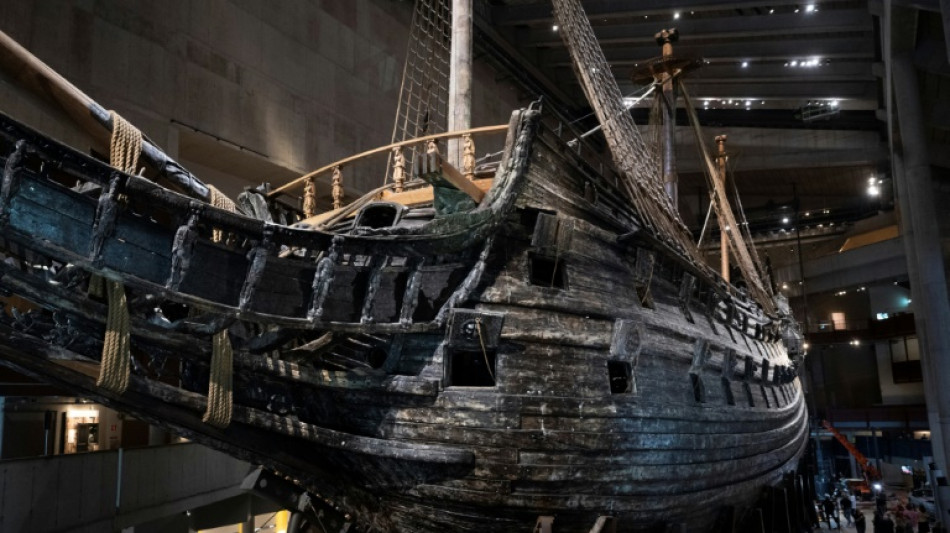
Sweden splashes out to save its unluckiest warship / Photo: Fredrik SANDBERG - TT News Agency/AFP

 Memoir by Diana's brother goes on sale after rocking UK monarchy

 Newcomers South Korea face holders Italy in Davis Cup finals

 Japan's Kojima sounds Marchand warning with Asian Games gold

 England rugby star Pollock signs new Northampton deal

 STARTRADER Expands Its Chinese Equity CFD Range with CXMT and Unitree Robotics

 MEXC Expands Opportunity Compass with Stock Trading Handbook to Help Crypto Users Build Investment Knowledge

 England paceman Wood retires from international cricket

 Magnificent Mandhana's 79 helps India to Asian Games cricket gold

 Marchand 'stressed' about racing Japanese rivals at LA Olympics

 Mobile boat clinics bring healthcare to India's remote islands

 Former India paceman Zaheer Khan named Chennai coach in IPL

 Six-year-old Chinese girl sets world record with Rubik's Cube
 Swimming prodigy Yu, 13, says 'interviews way harder than racing'

 Star coaches make their bows as Nations League returns

 Rams bounce back as Giants reel from Dart injury

 In Bangladesh, Pakistan's Jinnah photo stirs anger

 Two New Zealand naval ships transit Taiwan Strait

 Zidane gets down to work as France start new era

 Inside the Venezuelan prison meant to 'drive you insane'

 UK king braces as memoir by Diana's brother goes on sale

 Silver X Increases Measured and Indicated Resources 173% to 10.4 Mt at 213 g/t AgEq (70.8 Moz AgEq) and Inferred Resources 43% to 21.6 Mt at 252 g/t AgEq (180.9 Moz AgEq)

 SLAM Uncovers Antimony, Gold and Silver on Its Moose Lake Trenching Program

 Arrive AI to Demonstrate Autonomous Delivery Infrastructure at Investor Showcase

 Amber Book Expands California Supplemental Exam Prep with New Practice Tools Designed for How Architects Learn
 Jaguar Mining Commences New Underground Drilling Program Targeting Untested High-Grade Zones at Turmalina Mine, Brazil
Sweden is embarking on a colossal four-year project to safeguard a nearly 400-year-old warship that is the centrepiece of its famous Vasa Museum.
The ship, one of Stockholm's main tourist attractions, sank on its maiden voyage in 1628 and remained at the bottom of the sea until it was salvaged in 1961.
"We want Vasa to be preserved for the future," project manager Peter Rydebjork told AFP.
Despite the long delicate recovery operation, the ship "started to deteriorate faster" once it emerged from the sea after three centuries, he said.
In one of the most embarrassing naval calamities ever, the Vasa capsized only 15 minutes into its maiden voyage because of a design flaw, costing the lives of several dozen crew members.
- Stopping the movement -
After being protected by mud and the brackish waters of the Baltic Sea for three centuries, preserving it while on display at one of Stockholm's most popular museums has proved more complicated.
The wood has contracted over the years, and the ship is being compressed due to gravity. It is also tilting slightly to port.
"We have to stop the movement," Rydebjork said.
Work on building a new support structure began in April to replace the fragile current one.
The first phase of the project, dubbed "Stotta Vasa" (Support Vasa), is to stabilise the wreck.
Then comes the creation of a structure to support its weight and finally the ship will be righted.
- Steel skeleton -
By 2028 -- if all goes well -- the hull will be supported both externally and internally and the current 17 external struts will be replaced by 27 steel cradles with fixings under the keel.
Because the Vasa currently has difficulty supporting its own weight, a type of steel skeleton will be installed inside the ship.
Rydebjork said it has taken more than a decade of research to prepare for the ambitious project -- which is expected to cost upwards of 200 million kronor ($19 million).
"It's a really interesting job," Rydebjork added.
Despite its age, the ill-fated vessel is still well-preserved, with 98 percent of the original parts intact.
Polish tourist Lukasz Szyszka told AFP that the ship was in great condition and worth seeing, despite it being "freezing inside" the museum.
Its main hall is kept at a temperature of between 18 and 20 degrees Celsius (between 64 and 68 degrees Fahrenheit) with a humidity level of 55 percent to slow the deterioration.
The 43-year-old shopkeeper said work on the wreck was needed, saying it was also part of Polish history.
Swedish king Gustav II Adolf (1611-1632), who commissioned the Vasa, wanted to use it so he could to control Poland's ports on the Baltic.
T.Perez--AT