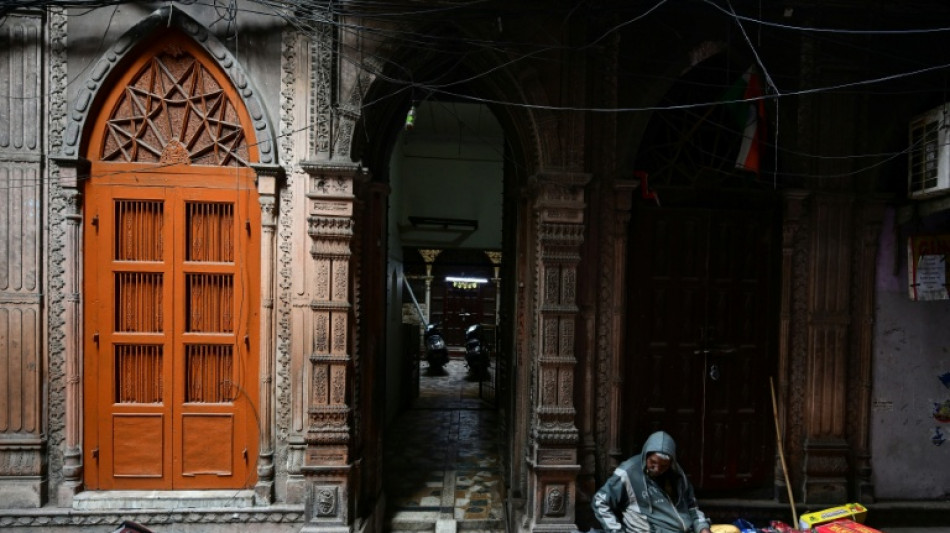
India's historic haveli homes caught between revival and ruin / Photo: Manan VATSYAYANA - AFP

 Kyiv entering 'survival' mode amid Russian strikes surge: mayor tells AFP

 Verdict due in Mexico trial over murders of Australia, US surfers

 B2PRIME Welcomes Christina Barbash as Commercial Manager

 Russia forcing Kyiv into 'survival' mode before winter, mayor tells AFP

 Closing arguments begin in Maradona death trial

 UEFA president Ceferin to stand for re-election in 2027

 Nearly 300,000 Nepalis at flood risk: study

 Riyadh kindergarten hit by interception debris as Houthis say targeted airport

 Alex Bodi mizează, alături de CRIF, pe investiții transparente și pe prevenirea riguroasă a spălării banilor
 Gulf Labs, Part of Thailand’s $27 Billion GULF Group, Goes Live as an Injective Validator

 EU okay for winter despite 'historically low' gas stocks: operators

 Rwanda to host F1 Grand Prix: sources close to both sides

 EU top diplomat says bloc in favour of UN Lebanon peacekeepers' extension

 Antonelli and Russell to run different Mercedes aero packages in Singapore

 WTO hikes 2026 trade growth forecast on AI boom

 'I love that challenge': Hamilton prays for rain in Singapore

 G.Bissau moves towards postponement of December general election

 Verstappen out to settle 'unfinished business' at Singapore Grand Prix

 WhiteBIT Launches Bitcoin Lightning Network Support, Powered by Voltage

 Oil surges, stocks sink as US reportedly eyes fresh Iran strikes
 Anne Carson: modern takes on Greek classics

 Canada's Anne Carson wins Nobel literature prize

 Ethiopia drones hit Eritrean troops in Tigray

 Russian strike on buses kills 30 in frontline Ukrainian city

 Thailand begins extradition process against Chinese journalist

Once the grand residences of Mughal-era nobility, the Indian capital's haveli homes now stand at a fragile crossroads -- a handful lovingly restored but many more sliding quietly into ruin.
Across Old Delhi -- the 17th‑century walled city founded as the Mughal capital Shahjahanabad -- cracked facades, shuttered gateways and sagging balconies tell the story of a heritage under siege from neglect, inheritance battles and relentless urban pressure.
Only a few restored pockets provide a glimpse of what once was -- airy courtyards, carved sandstone pillars and homes built around a deeply social way of life.
Inside one restored mansion that now houses a cultural centre, sunlight filters through stained glass onto carved sandstone arches, the air infused with freshly polished wood and rosewater.
Musicians tune their instruments in a frescoed courtyard, where nobles may once have entertained guests, offering a rare peek into Old Delhi's rich architectural past.
But outside in the narrow lanes of Old Delhi's Chandni Chowk district, the contrast is stark.
Many havelis are abandoned or on the verge of collapsing, their carved facades fading beneath peeling paint.
The contrast reflects two futures -- one of careful restoration and the other of gradual decay.
- 'Who will pay?' -
The Kathika Cultural Centre's founder Atul Khanna said his initiative hoped to create an immersive cultural space inside a restored structure.
But he admitted that conservation in Old Delhi remains a huge challenge.
Many havelis are split among multiple heirs, with no single stakeholder willing or able to invest in costly upkeep.
"When there are multiple ownerships, that becomes a challenge," he said.
"If the haveli is decaying, who is going to spend the money?"
Khanna also blamed bureaucratic hurdles for discouraging restoration.
"There should be some kind of a single window for anyone who is working with heritage," he said, arguing that easing red tape would be more effective than offering subsidies for restoration.
Another prominent restoration is the 18th century Haveli Dharampura, now converted into a heritage hotel.
"Restoration in Old Delhi is still isolated unless there is sustained support and awareness," said Vidyun Goel, whose family owns the property.
Residents say family disputes and the push to convert properties into shops or apartments have led to rapid decline.
In nearby Roshanpura, only a scattering of old homes still stand. Among them, the century-old Mathur ki Haveli is a rare example of a lived-in heritage home.
- Showpiece projects -
"We are in love with this house," said Ashok Mathur, a fourth‑generation resident who continues to live in the ancestral property despite mounting challenges.
Wooden ceilings are deteriorating, floors are wearing thin and doors require constant repair, he said, walking through rooms that bear only traces of intricate craftsmanship.
Still, he said he has never considered leaving -- although he can only imagine the social world that once defined haveli life.
"There is no community left," Mathur, 56, said. "We are living in a cocoon."
Conservationist K. T. Ravindran said that while Old Delhi is economically vibrant, its havelis suffer from unclear titles and multiple claimants.
"Often buildings that look intact from outside conceal deeper damage," he said, noting that the condition was worse in the inner lanes hidden from public view.
Ravindran said revival was still possible, but only through neighbourhood‑level regeneration rather than isolated showpiece projects.
Oral historian Sohail Hashmi said each haveli once formed part of "a larger social ecosystem of neighbourhoods, crafts and traditions", with architecture and community deeply intertwined.
As Khanna put it, the loss goes beyond architecture.
"When you lose a haveli, you are not only losing the structure," he said.
"Every element in it is a piece of art."
Ch.P.Lewis--AT