
'Wars bring back the past': Booker Prize winner Georgi Gospodinov / Photo: DIMITAR KYOSEMARLIEV - AFP

 Anthropic touts AI-led biology discovery
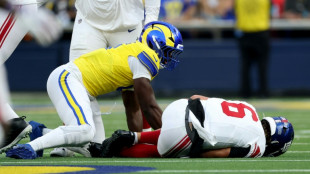 Giants QB Dart to have season-ending surgery
 Venezuelan shot by ICE needs urgent surgery, mother tells AFP

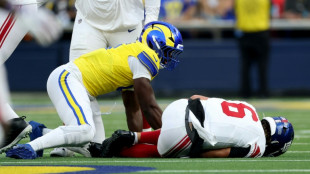 Giants QB Dart to have season-ending surgery: reports

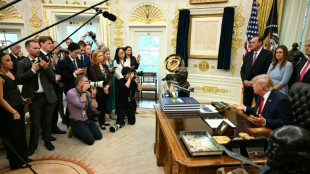 Judge urged to lift Trump's White House ban on media outlets
 Stocks fall on soaring bond yields, higher oil prices
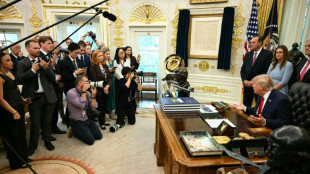 US judge weighing Trump's White House ban on media outlets
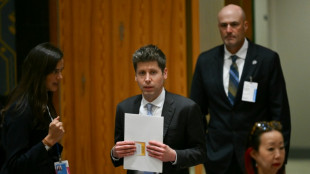 At UN, OpenAI's Altman calls 'for extreme care' in AI

 Hamilton gives thumbs up to Gulf GPs despite Iran conflict
 Leclerc admits going 'too far' in Hamilton shunt in Italy
 Row engulfs Dolly Parton's estate as manager accuses nephew of making threats
 Mandela Digital Extends Early Access Programme to 11 February 2027 Following Strong Response

 US seeks 11th Presidents Cup win in a row over global foes

 McDonald's to boost franchisees as inflation weighs on consumers
 Trump invites Putin to G20 summit in Miami
 Archaelogical 'breakthrough' could confirm origins of Paris

 ILO financial crisis takes centre stage in leadership race

 Stocks dip, oil soars despite Trump hailing "productive" Iran talks

 China's Xi to get rare airport welcome from Trump

 Turkey reassures investors over investment fund crisis
 Saka says England still have 'scar' from World Cup semi-final loss
 アレックス・ボディ氏とシュテファン・ハウプト教授、ルーマニアの伝説的な美術コレクションをめぐり提携に合意
 亞歷克斯·博迪與史蒂芬·豪普特教授就羅馬尼亞傳奇藝術收藏達成合作協議
 Алекс Боди и проф. д-р Стефан Хаупт договорились о сотрудничестве в рамках легендарной коллекции произведений искусства в Румынии
 French foreign minister says Palestinians 'must' hold polls
Bulgarian writer Georgi Gospodinov doesn't view himself as a predictor of the future. But he said his International Booker Prize-winning dystopian novel "Time Shelter" has become reality.
"When you live in dystopian times, dystopian books become reality or turn into some kind of documentary," he told AFP in an interview.
He said he hadn't foreseen Russia's invasion of Ukraine, though.
"These things were in the air. (But) I'm not a prophet, nor did I think it would come to this. I did not foresee the war."
"Wars bring back the past," he continued, describing Russian President Vladimir Putin as "a dictator" who "wanted to take his country back to the time of World War II".
"Time Shelter" -- which brought Gospodinov and translator Angela Rodel the prestigious British Booker Prize last month -- focuses on a "clinic for the past" that offers experimental Alzheimer's treatment.
To trigger patients' memories, it recreates the atmosphere of past decades down to the smallest detail.
But, with time, healthy people start coming to the clinic, seeking an escape from modern life.
- Return to the past -
Such is the success that the past invades the present.
Across Europe, governments organise "referendums for the past" to choose their own "happy decade" -- which ends up in a re-enactment of World War II.
Gospodinov said he came up with the idea for his third novel -- published in 2020 in Bulgarian and 2022 in English -- after witnessing societies' glorification of the past.
"The past is what nationalism and populism thrive on," the 55-year-old said, giving as examples former US president Donald Trump's "Make America Great Again" slogan, as well as Brexit.
Born in 1968 in the town of Yambol in southeastern Bulgaria, Gospodinov said people who had lived through Communism, like him, "have more experience to recognise the danger... of populist abstractions".
"Because we had already lived in a promised future, in a promised time," he said.
He urged "everyday work with memory" so people remembered that peace cannot be taken for granted.
When Gospodinov -- who describes literature as "an antidote to propaganda" -- began his novel back in 2016, he thought he would need to explain his title "Time Shelter" as a play on words in reference to "bomb shelter".
But the war in Ukraine has "disastrously" revived the word, the poet and playwright said.
- Euphoria at home -
Despite the book's sinister themes, Bulgarians celebrated the Booker Prize win.
Local media in the European Union's poorest member state compared the euphoria to when the national football team came fourth in the 1994 World Cup.
"I didn't expect that this joy could bring people together like that," Gospodinov said, remembering the 1994 "feeling that now you can move mountains".
"Now I realise how much Bulgarian society actually needs good news."
When he returned from the Booker ceremony in London, Gospodinov attended the spring book fair in Sofia.
As usual, he exchanged greetings with each of the hundreds of people who queued for hours in the rain to meet him.
He said he drew the "empathy" needed for his writing from his childhood, when his family lived on the "ground floors" -- literally and metaphorically.
Writers -- just like everyone else -- "have а right to be fragile, vulnerable, sad, insecure; to be hurt, to be lonely; to be on the weak, losing side", he said.
"Otherwise you can't experience, you can't tell stories about people who are on the losing side if you're not on their side. It doesn't work," he added.
R.Chavez--AT