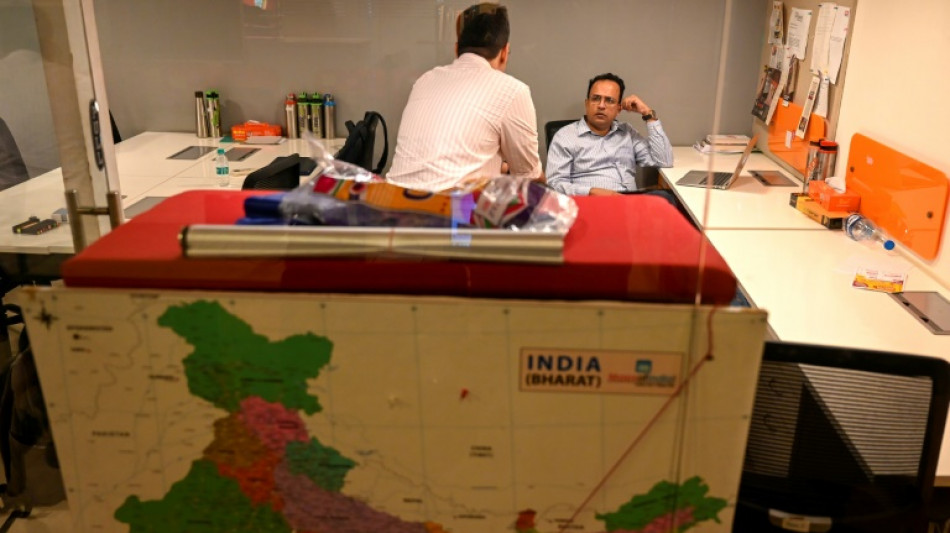
India fact-checkers face threats, jail in misinformation fight / Photo: Punit PARANJPE - AFP

 Qatar Facilities Management Market to Reach $11.15bn by 2032

 Black Friday Discounts Cut Prices on Two Top-Rated Wiper Blades

 Twickenham Grounds Team Prepares Pitch for Six Matches in Three Days

 Luxembourg City Plans €13 Million Abrigado Centre for 2029

 Two A1 Crashes Create Kilometres of Rush-Hour Congestion

 South Africa Places 36 Hospitals on Standby for Possible Imported Ebola Cases

 TCC Network Linked to 200% Surge in Global School Attacks

 Beyond Black Friday: A Guide to This Week’s Holidays and Deal Days
Hunched over laptops in small office cubicles, a group of Indian fact-checkers is on the frontlines of a war against misinformation, braving online abuse and legal threats.
India has the world's largest number of certified fact-checking organisations, but many feel outnumbered and outgunned in a country with hundreds of millions of internet users and a climate of growing religious intolerance, hate speech and declining press freedom.
BOOM Live is among the organisations methodically debunking some of the tsunami of falsehoods, but their efforts can feel like a drop in the bucket.
"It's an unequal fight," Jency Jacob, managing editor of BOOM Live, told AFP in the firm's cramped office in a defunct Mumbai industrial complex.
"Fact-checkers are always going to be the underdogs who are going to fight this out... with limited resources."
On a recent workday in October, Jacob huddled with his small team as an air conditioner blasted cool air and a generator hummed in the background.
The team scoured WhatsApp groups –- a leading source of misinformation in India -– and trawled the internet for potential stories to debunk: a politician claiming religious minorities were the biggest users of condoms; rumours that the central bank had misplaced bank notes worth millions; footage showing a political party's rally drew fewer crowds than it claimed.
- 'Harassment' -
BOOM, which launched in 2016 and has 15 fact-checkers across India, has its task cut out in a country where hundreds of millions of smartphones, low data costs and a lack of digital literacy have accelerated the spread of internet falsehoods.
Press freedom in the world's biggest democracy is also increasingly under attack under Hindu nationalist Prime Minister Narendra Modi, activists say.
India fell eight spots this year to 150 out of 180 countries in the World Press Freedom Index compiled by Reporters Without Borders.
Fact-checkers are no exception. They say they are increasingly experiencing vicious trolling and online abuse, especially when tackling posts that seek to inflame religious hatred.
Geeta Seshu, co-founder of Indian media watchdog Free Speech Collective, points the finger at a motivated right wing as well as vigilante groups who know they have been caught out.
"(They are) worried that they (the fact-checkers) have managed to very successfully and very quickly point out the kind of disinformation and fake news that is being put out," Seshu told AFP.
A growing number of fact-checkers face "targeted harassment and threats of litigation", Enock Nyariki of the International Fact-Checking Network (IFCN) at the Poynter Institute in the United States told AFP.
In June, Mohammed Zubair, co-founder of fact-checking organisation Alt News and a prominent thorn in the side of Modi's government, was jailed after an anonymous Twitter user accused him of insulting a Hindu god in a four-year-old tweet.
Amid a torrent of abuse by right-wing campaigners, he was granted bail weeks later after battling a pile of cases that left him shuttling between various courts.
Pratik Sinha, the other co-founder of Alt News, said the court battle as well as a slew of defamation notices had added to the financial burden of his organisation, which is entirely funded by donor contributions.
Sinha alleged that those giving money feared retribution after a fintech firm handling the payment gateway to receive donations shared donor data with police following Zubair's arrest.
"Many (donors) have asked: 'Is there a way we could give you money indirectly?'" Sinha told AFP.
- 'Psychological impact' -
India, with a population of 1.4 billion people, has 17 IFCN-certified fact-checking organisations, the most of any country. The United States by comparison has 12.
But the proliferation of misinformation -- in hundreds of regional languages -- has massively outpaced the growth in fact-checking operations.
The consequences of viral misinformation can be deadly. In 2018, dozens of people were killed in a series of lynchings that rocked the country after false rumours of child kidnapping spread on smartphones.
A 2019 study by Microsoft said India had more internet hoaxes and falsehoods than the rest of the world. It showed that 64 percent of Indians had encountered "fake news" compared with a global average of 57 percent.
As in other countries, Indian fact-checkers operate in an ecosystem where internet lies travel faster than truth, and posts peddling misinformation often get more traction than real news.
BOOM's recent debunking of false reports of a coup in China –- fuelled by multiple Indian accounts as well as some mainstream television channels -- highlighted the disturbing reality of misinformation profiteers.
The baseless rumour got so much traction that some online retailers began using the #Chinacoup hashtag to boost posts advertising furniture, cooking ware and appliances, further propelling the lie.
Facing growing pressures, Seshu noted the "psychological impact" on fact-checkers, especially as the job often involves poring over graphic content for long hours.
"It's not easy," Seshu said.
E.Flores--AT


