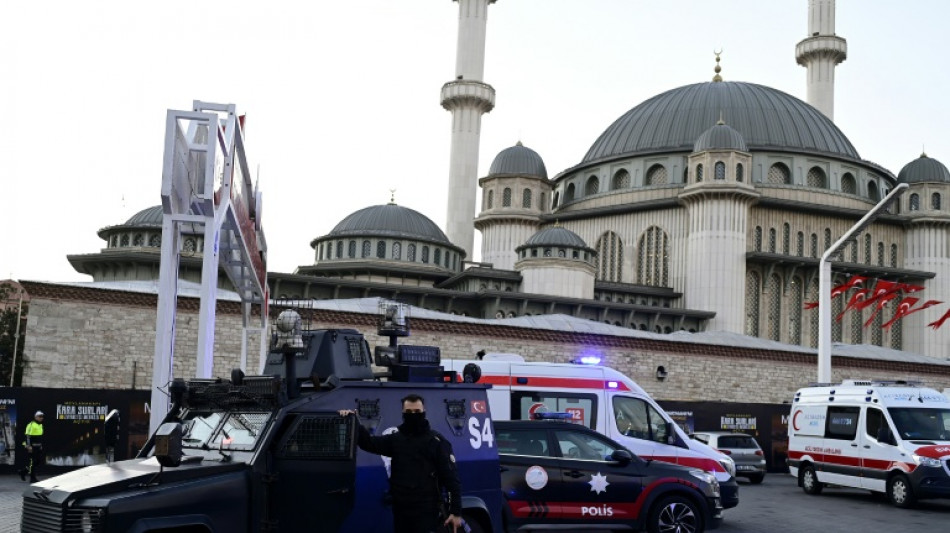
Erdogan says Istanbul 'attack' blast kills six / Photo: Yasin AKGUL - AFP

 Qatar Facilities Management Market to Reach $11.15bn by 2032

 Black Friday Discounts Cut Prices on Two Top-Rated Wiper Blades

 Twickenham Grounds Team Prepares Pitch for Six Matches in Three Days

 Luxembourg City Plans €13 Million Abrigado Centre for 2029

 Two A1 Crashes Create Kilometres of Rush-Hour Congestion

 South Africa Places 36 Hospitals on Standby for Possible Imported Ebola Cases

 TCC Network Linked to 200% Surge in Global School Attacks

 Beyond Black Friday: A Guide to This Week’s Holidays and Deal Days
An explosion tore through a busy Istanbul shopping street on Sunday, killing six and wounding dozens in what Turkey's president said bore the signs of a terror attack.
Police cordoned off an area around Istiklal, where crowds were dense on Sunday afternoon, and helicopters flew over the city centre as sirens sounded.
"I was 50-55 metres (yards) away, suddenly there was the noise of an explosion. I saw three or four people on the ground," witness Cemal Denizci, 57, told AFP.
"People were running in panic. The noise was huge. There was black smoke," he said.
President Recep Tayyip Erdogan condemned what he called a "vile attack" that killed six people and wounded over 50 others.
"It might be wrong if we say for sure that this is terror but according to first signs... there is a smell of terror there," Erdogan told a press conference.
- Area targeted previously -
Authorities offered few details and no groups immediately claimed the blast, but Turkish cities in the past have been struck by Islamists and other groups.
Istiklal Avenue had already been hit in the past during a campaign of attacks in 2015-2016 that targeted Istanbul and other cities including the capital Ankara.
Those bombings were mostly blamed on the Islamic State group and outlawed Kurdish militants, and killed nearly 500 people and injured more than 2,000.
Sunday's explosion occurred shortly after 4:00 pm (1300 GMT) in the famous Istiklal shopping street which is popular with locals and tourists.
According to images posted on social media at the time of the explosion, it was accompanied by flames and immediately triggered panic, with people running in all directions.
A large black crater was also visible in those images, as well as several bodies lying on the ground nearby.
According to an AFP video journalist on the scene, police established a large security cordon to prevent access to the damaged area for fear of a second explosion.
Istiklal in the historic district of Beyoglu, is one of the most famous arteries of Istanbul, entirely pedestrian on 1.4 kilometres (nearly a mile).
Criss-crossed by an old tramway, lined with shops and restaurants, it is used by large crowds during the weekend.
A massive deployment of security forces equally barred all entrances, while a heavy deployment of rescue workers and police were visible.
A reaction came quickly from Greece, which "unequivocally" condemned the blast and expressed condolences to the government and people of Turkey.
F.Wilson--AT


