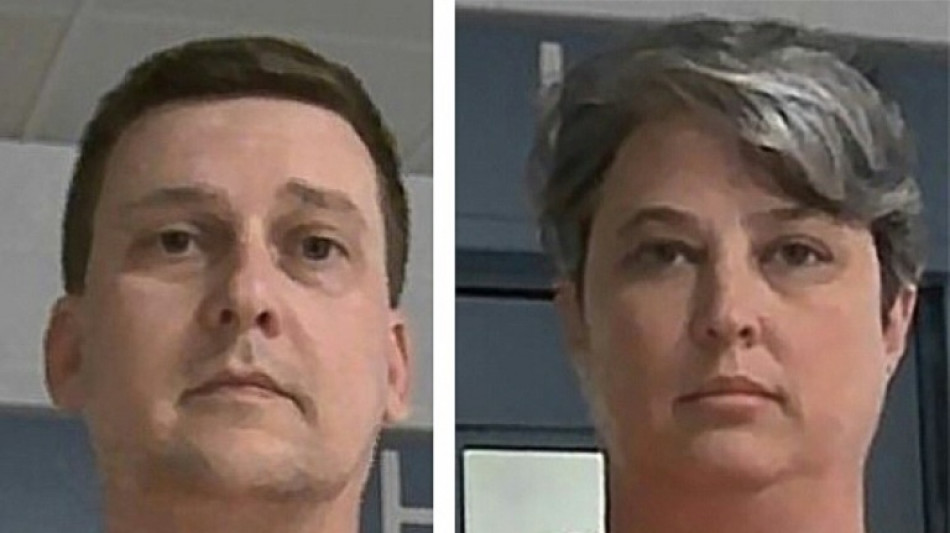
US nuclear engineer, wife get long jail terms in sub secrets plot / Photo: - - West Virginia Regional Jail and Correctional Facility Authority/AFP

 Qatar Facilities Management Market to Reach $11.15bn by 2032

 Black Friday Discounts Cut Prices on Two Top-Rated Wiper Blades

 Twickenham Grounds Team Prepares Pitch for Six Matches in Three Days

 Luxembourg City Plans €13 Million Abrigado Centre for 2029

 Two A1 Crashes Create Kilometres of Rush-Hour Congestion

 South Africa Places 36 Hospitals on Standby for Possible Imported Ebola Cases

 TCC Network Linked to 200% Surge in Global School Attacks

 Beyond Black Friday: A Guide to This Week’s Holidays and Deal Days
A US Navy nuclear engineer and his wife were sentenced to long prison terms on Wednesday for plotting to sell submarine secrets to a foreign country.
Jonathan Toebbe, 44, and his wife, Diana Toebbe, 46, pleaded guilty in February to conspiring to sell information related to naval nuclear propulsion systems.
Jonathan Toebbe was sentenced to 19 years and three months in prison while his wife, Diana Toebbe, 46, received a prison term of 21 years and eight months, the Justice Department said.
According to court documents, Diana Toebbe acted as a lookout while her husband delivered highly classified information on nuclear submarine technology to the unidentified foreign buyer in a series of surreptitious "dead drops" in the region around their Annapolis, Maryland, home.
A teacher at a private school, she initially pleaded innocent to the charge of conspiracy to communicate restricted data.
But she changed her plea after her husband pleaded guilty and in doing so admitted that his wife took part in the plot.
Jonathan Toebbe was a nuclear engineer for the US Navy dealing with nuclear submarine propulsion systems when the two were arrested on October 9, 2021 after he hid a small SD card carrying US secrets at a dead drop location in West Virginia.
Court documents described a tantalizing, spy-novel-like plot in which they traveled hundreds of miles to secretly hand over information, took payments in cryptocurrency, and followed signals made from an embassy building in Washington.
In one message, Toebbe indicated that he had been considering his actions for several years and was happy to work with "a reliable professional partner."
He also wrote that he had divided all the data he had collected into 51 "packages" of information, and sought $100,000 for each.
But the FBI was following the plot, after having been alerted to it by the target country in December 2020, though that was nearly nine months after the Toebbes first mailed their offer to the country's military intelligence.
The country, which cooperated in the FBI investigation, has not been identified.
One of the Toebbes' communications indicated that English might not be the country's native tongue, and others suggest that the country's navy is familiar with nuclear propulsion technology.
Russia, China, Britain, France and India operate nuclear-powered naval vessels, and Australia is planning to buy one or more from the United States.
G.P.Martin--AT


