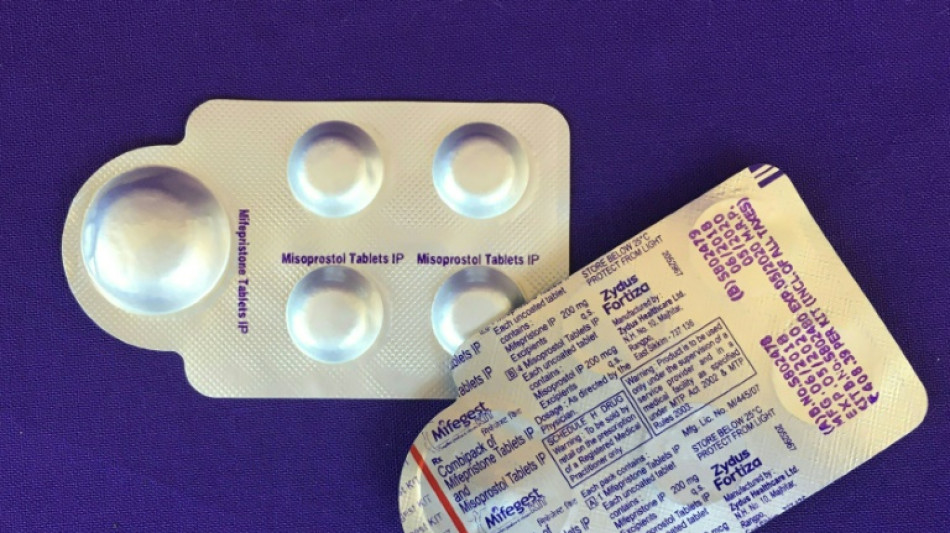
US requests for overseas abortion pills surges: study / Photo: Elisa WELLS - PLAN C/AFP

 Qatar Facilities Management Market to Reach $11.15bn by 2032

 Black Friday Discounts Cut Prices on Two Top-Rated Wiper Blades

 Twickenham Grounds Team Prepares Pitch for Six Matches in Three Days

 Luxembourg City Plans €13 Million Abrigado Centre for 2029

 Two A1 Crashes Create Kilometres of Rush-Hour Congestion

 South Africa Places 36 Hospitals on Standby for Possible Imported Ebola Cases

 TCC Network Linked to 200% Surge in Global School Attacks

 Beyond Black Friday: A Guide to This Week’s Holidays and Deal Days
Requests by Americans for abortion pills from outside the United States have surged since the US Supreme Court's explosive decision last summer to overturn the nationwide right to the procedure, according to a study published Tuesday.
Researchers, whose work was published in the medical journal JAMA, analyzed the number of requests submitted to telemedicine service Aid Access, which delivers abortion pills from abroad to 30 US states.
Aid Access was purposefully set up to help women "self-manage" their abortions at home, circumventing local bans or other barriers.
After the Supreme Court's controversial decision in late June, many Republican-led states severely restricted or outright banned abortions.
According to the study, Aid Access received an average of 83 requests per day before the Supreme Court's decision from the 30 states in which it operates.
But in the two months after, that number jumped to 213 per day -- an increase of about 160 percent.
Proportional to the number of women in each state, the increase in Aid Access requests were highest in Louisiana, Mississippi, Arkansas, Alabama and Oklahoma -- all of which completely banned abortions.
In the states that outlawed abortions, "current legal restrictions" was cited as women's motivation for using the service in about 62 percent of cases after the Supreme Court decision, compared to 31 percent before.
The study did analyze requests for the pills on other sites, where they are easily available for a few hundred dollars -- but without medical supervision.
Another study, also published Tuesday in the journal JAMA, looked at the average travel time for women to reach an abortion clinic in the United States.
The average time was 28 minutes before the Supreme Court's decision, and it increased significantly to 1 hour and 40 minutes afterward. The national average however masks wide local disparities.
In states that implemented a total abortion ban or limits after six weeks of pregnancy, the average travel time increase was four hours, according to the study, which added that the lack of access was especially a problem for those with fewer resources.
In the 100 days following the Supreme Court ruling, at least 66 clinics stopped performing abortions, according to a report in early October by the Guttmacher Institute.
Ch.P.Lewis--AT


