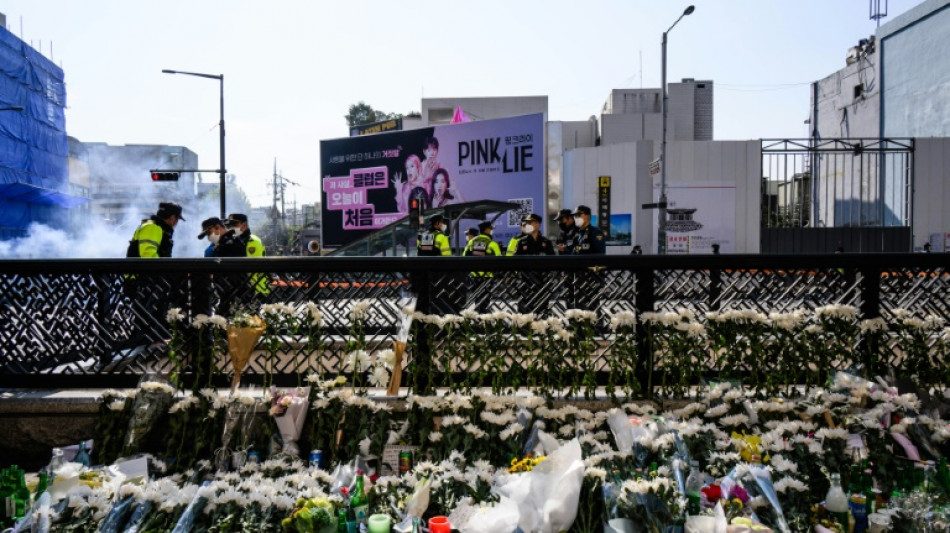
S. Korea police chief says crowd surge response was 'insufficient' / Photo: ANTHONY WALLACE - AFP

 Qatar Facilities Management Market to Reach $11.15bn by 2032

 Black Friday Discounts Cut Prices on Two Top-Rated Wiper Blades

 Twickenham Grounds Team Prepares Pitch for Six Matches in Three Days

 Luxembourg City Plans €13 Million Abrigado Centre for 2029

 Two A1 Crashes Create Kilometres of Rush-Hour Congestion

 South Africa Places 36 Hospitals on Standby for Possible Imported Ebola Cases

 TCC Network Linked to 200% Surge in Global School Attacks

 Beyond Black Friday: A Guide to This Week’s Holidays and Deal Days
South Korea's police chief said Tuesday that officers had received multiple urgent reports of danger ahead of a deadly crowd crush at a Halloween event but their handling of them was "insufficient".
At least 156 mostly young people were killed, and scores more injured, in a deadly crowd surge late Saturday at the first post-pandemic Halloween party in Seoul's popular Itaewon nightlife district.
An estimated 100,000 people had flocked to the area, but because it was not an "official" event with a designated organiser, neither the police nor local authorities were actively managing the crowd.
"There were multiple reports to the police indicating the seriousness at the site just before the accident occurred," national police chief Yoon Hee-keun said.
Police knew "a large crowd had gathered even before the accident occurred, urgently indicating the danger," he said, acknowledging the way this information was handled had been "insufficient".
South Korea is typically strong on crowd control, with protest rallies often so heavily policed that officers can outnumber participants.
But in the case of the Itaewon Halloween festivities, there was no designated event organiser, with people flocking to the area to attend events held by individual bars, clubs and restaurants.
Police said they had deployed 137 officers to Itaewon for Halloween -- but 6,500 officers were present at a protest across town that was only attended by about 25,000 people, local reports said.
South Korean President Yoon Suk-yeol said Tuesday the country needed to urgently improve its system for managing large crowds in the wake of the disaster.
"The safety of the people is important, whether or not there is an event organiser," he told a cabinet meeting.
He called for the country to develop "cutting-edge digital capabilities" to improve crowd management -- but critics claim such tools already exist and were not deployed in Itaewon.
- Disaster was avoidable -
Seoul's City Hall has a real-time crowd monitoring system that uses mobile phone data to predict crowd size, but it was not employed Saturday night, local media reported.
Itaewon's district authorities also did not deploy any safety patrols, with officials saying the Halloween event was considered "a phenomenon" rather than "a festival", which would have required an official plan for crowd control.
On the night, tens of thousands of people thronged a narrow alleyway, with eye-witnesses describing how, with no police or crowd control in sight, confused partygoers pushed and shoved, crushing those trapped in the lane.
Analysts say this was easily avoidable, even with only a small number of police officers.
"Good, safe crowd management is not about the ratio, but about the crowd strategy -- for safe crowd capacity, flow, density," said G. Keith Still, a crowd science professor at the University of Suffolk.
South Korean expert Lee Young-ju said that if local police knew they would be short-handed, they could have sought help from local authorities or even residents or shop owners.
"It's not just the numbers," Lee, a professor from the Department of Fire and Disaster at the University of Seoul, told AFP.
"The question is, how did they manage with the limited number (of police) and what kind of measures did they take to make up for it."
O.Ortiz--AT


