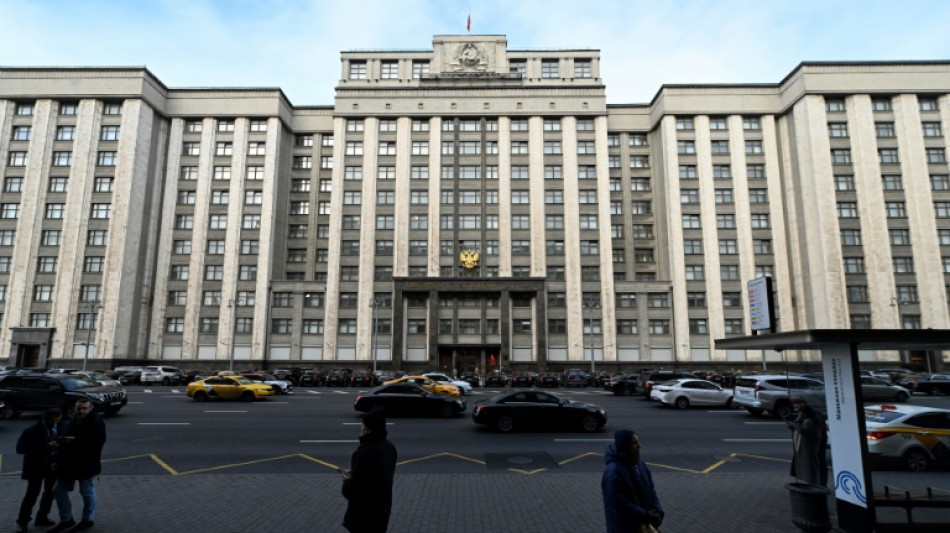
Russia paves way for toughening of 'LGBT propaganda' law / Photo: Kirill KUDRYAVTSEV - AFP

 Qatar Facilities Management Market to Reach $11.15bn by 2032

 Black Friday Discounts Cut Prices on Two Top-Rated Wiper Blades

 Twickenham Grounds Team Prepares Pitch for Six Matches in Three Days

 Luxembourg City Plans €13 Million Abrigado Centre for 2029

 Two A1 Crashes Create Kilometres of Rush-Hour Congestion

 South Africa Places 36 Hospitals on Standby for Possible Imported Ebola Cases

 TCC Network Linked to 200% Surge in Global School Attacks

 Beyond Black Friday: A Guide to This Week’s Holidays and Deal Days
The lower house of Russia's parliament, the Duma, paved the way for toughening a notorious 2013 "gay propaganda" law on Thursday, its official website said.
Lawmakers "unanimously adopted in the first reading amendments to the legislation regarding the prohibition of propaganda of non-traditional sexual relations", a statement on the Duma's website said.
Officials had urged parliament to adopt the law, portraying it as part of a civilisational clash with the West as Moscow's troops fight in Ukraine.
The amendments extend to all Russian adults the 2013 law that previously criminalised spreading what authorities deemed "gay propaganda" to minors.
The bill now outlaws "gay propaganda" in the media, internet, advertisement, literature and cinema.
It also bans the "propaganda of paedophilia".
The bill outlaws the "denial of family values" and also has a clause against propaganda that could "cause minors to desire to change their sex".
Foreigners who violate the law will face expulsion, according to its text.
The bill still needs to be approved by the upper house of Russia's parliament, the Federation Council, before it can be signed into law by President Vladimir Putin.
Rights campaigners, who condemn the 2013 law, say that in effect any act or public mention of same-sex couples is being criminalised.
Some Russian book publishers and film producers have raised censorship concerns, saying the law could even affect productions of Russian classics.
Putin has made social conservatism a cornerstone of his rule.
In his speech annexing Ukrainian territories last month, he railed against families with a "parent number one and a parent number two" -- apparently alluding to same-sex parenting.
New constitutional amendments passed in a controversial vote in 2020 define marriage in Russia exclusively as the union of a man and a woman.
K.Hill--AT


