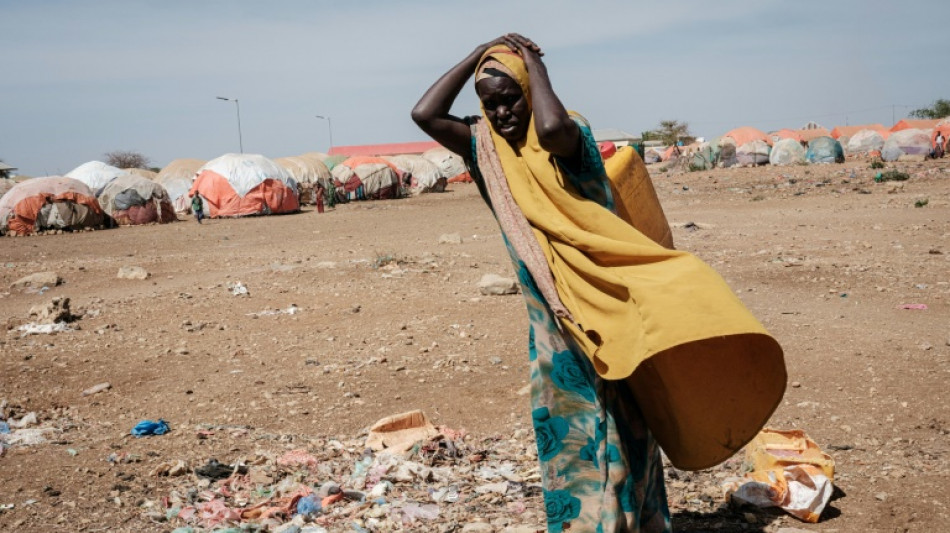
UN warns Somalia humanitarian crisis remains 'dire' / Photo: YASUYOSHI CHIBA - AFP/File

 Qatar Facilities Management Market to Reach $11.15bn by 2032

 Black Friday Discounts Cut Prices on Two Top-Rated Wiper Blades

 Twickenham Grounds Team Prepares Pitch for Six Matches in Three Days

 Luxembourg City Plans €13 Million Abrigado Centre for 2029

 Two A1 Crashes Create Kilometres of Rush-Hour Congestion

 South Africa Places 36 Hospitals on Standby for Possible Imported Ebola Cases

 TCC Network Linked to 200% Surge in Global School Attacks

 Beyond Black Friday: A Guide to This Week’s Holidays and Deal Days
The United Nations said on Wednesday that the humanitarian response to the crisis in Somalia where a historic drought is threatening famine has gathered pace but warned the situation remained "dire".
The impoverished Horn of Africa nation is on the brink of a famine for the second time in just over a decade, with UN humanitarian chief Martin Griffiths stressing in September that time was running out to save lives.
The humanitarian response has intensified since then but some 7.8 million people or nearly half Somalia's population still need assistance, including 230,000 at serious risk of starvation, according to the UN.
"We believe that approximately 6.5 million are reached with some level of assistance and that amount has increased very significantly since the beginning of the summer," the UN special representative for Somalia, James Swan, said Wednesday.
"There have been very substantial additional contributions of donor assistance, particularly since the beginning of August, with something in the order of $800 million in new commitments," he told reporters.
But, Swan added, "We are confronting a situation that for reasons of the continuing drought and an existing relatively fragile population... the risks remain severe."
Somalia, much like neighbours Kenya and Ethiopia, is in the grip of the worst drought in four decades after four failed rainy seasons wiped out livestock and crops.
Since January 2021, 1.1 million people in Somalia have left their homes in search of food and water, according to the United Nations.
The conflict-wracked nation is considered one of the most vulnerable to climate change but is particularly ill-equipped to cope with the crisis as it battles a deadly Islamist insurgency.
- 'Efforts cannot stop' -
UN High Commissioner for Refugees Filippo Grandi on Tuesday rallied international donors to keep their wallets open to fight the crisis.
"Some of it (the drought) has been contained but unfortunately this is not an effort that can stop," he told reporters in Nairobi after a trip to Somalia and northeastern Kenya.
"If it stops now, then we go back to the very dangerous situation of people dying, especially children, in large numbers."
On Wednesday, the UN's World Food Programme (WFP) said only 46.7 percent of its $2.26 billion funding needs had been met.
"There are some hard to reach areas where we are, where we are going, also hard to reach populations -- minorities, displaced people, people with different abilities," said El-Khidir Daloum, WFP's country director in Somalia.
"The situation is dire."
Somalia was hit by a famine in 2011 which killed 260,000 people, more than half of them children under five.
In 2017, more than six million people in the country, more than half of them children, needed aid because of a prolonged drought across East Africa.
But early humanitarian action averted famine that year.
A.Taylor--AT


