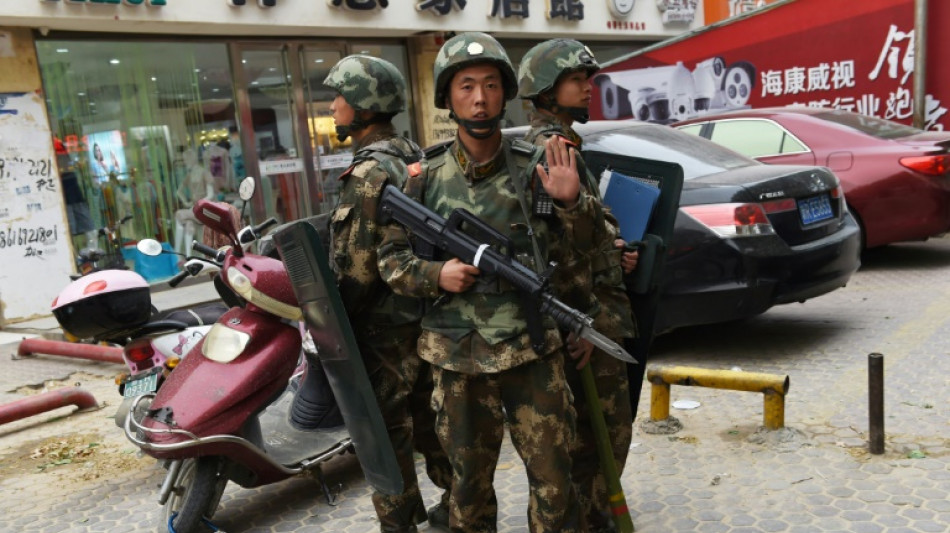
UN Human Rights Council rejects holding Xinjiang debate / Photo: GREG BAKER - AFP/File

 Qatar Facilities Management Market to Reach $11.15bn by 2032

 Black Friday Discounts Cut Prices on Two Top-Rated Wiper Blades

 Twickenham Grounds Team Prepares Pitch for Six Matches in Three Days

 Luxembourg City Plans €13 Million Abrigado Centre for 2029

 Two A1 Crashes Create Kilometres of Rush-Hour Congestion

 South Africa Places 36 Hospitals on Standby for Possible Imported Ebola Cases

 TCC Network Linked to 200% Surge in Global School Attacks

 Beyond Black Friday: A Guide to This Week’s Holidays and Deal Days
The UN Human Rights Council on Thursday voted against holding a debate on alleged abuses in China's Xinjiang region in a major setback for Western nations.
The United States and its allies last month presented the first-ever draft decision to the UN's top rights body targeting China, seeking a bare minimum of holding a discussion on Xinjiang.
The move came after former UN rights chief Michelle Bachelet released her long-delayed Xinjiang report last month, citing possible crimes against humanity against Uyghurs and other Muslim minorities in the far-western region.
But following intense lobbying by Beijing, countries on the 47-member council in Geneva voted 19-17 against holding a debate, with 11 countries abstaining.
The nations voting against having a discussion were Bolivia, Cameroon, China, Cuba, Eritrea, Gabon, Indonesia, Ivory Coast, Kazakhstan, Mauritania, Namibia, Nepal, Pakistan, Qatar, Senegal, Sudan, the United Arab Emirates, Uzbekistan and Venezuela.
Those abstaining were Argentina, Armenia, Benin, Brazil, Gambia, India, Libya, Malawi, Malaysia, Mexico and Ukraine.
Western allies had been scrambling for votes in the run-up to Thursday's moment of drama at the UN Palais des Nations.
The draft decision was co-sponsored by Britain, Canada, Sweden, Denmark, Finland, Iceland, Norway, Australia and Lithuania.
One Western diplomat stressed that regardless of the outcome, "the number one objective has been fulfilled" in putting the spotlight on Xinjiang.
- 'The fight goes on' -
Bachelet's report, which was published on August 31 minutes before her term ended, highlighted "credible" allegations of widespread torture, arbitrary detention and violations of religious and reproductive rights.
It brought UN endorsement to long-running allegations by campaigners and others, who accuse Beijing of detaining more than one million Uyghurs and other Muslims and forcibly sterilising women.
Beijing vehemently rejected the charges and accused the UN of becoming a "thug and accomplice of the US and the West".
It insists it is running vocational training centres in the region to counter extremism.
China launched an all-out offensive in Geneva and in country capitals to dismiss the report and to hammer home the "truth" about the rights situation in Xinjiang.
African countries, where China is the leading creditor after making massive infrastructure and other investments, have faced particularly heavy lobbying, observers say.
"We know the amount of leverage that the Chinese have, particularly in Africa," the Western diplomat said, adding that many nations are loathe to vote against a permanent member of the UN Security Council.
"It's genuinely a difficult call for a lot of countries," the diplomat acknowledged.
"The fight goes on."
A.Anderson--AT


