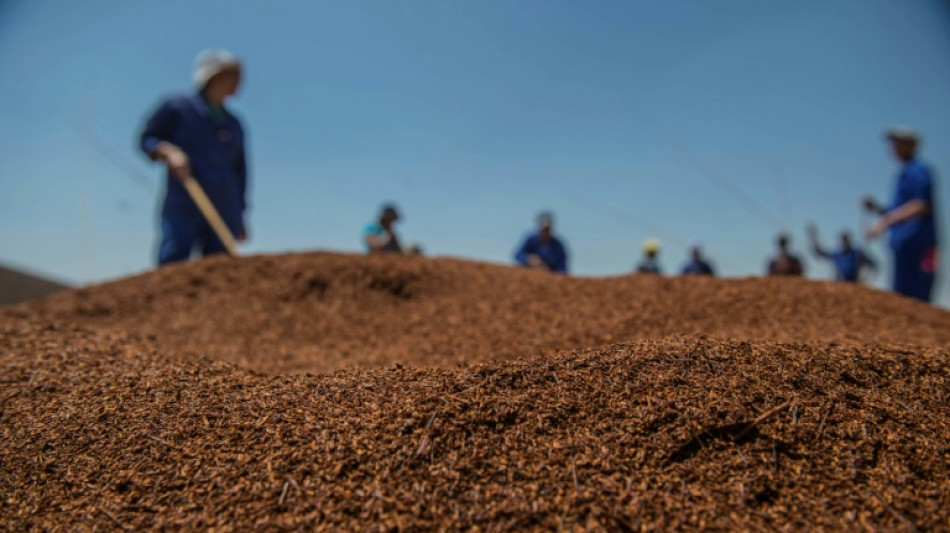
South Africa's rooibos heads to space / Photo: MUJAHID SAFODIEN - AFP

 Qatar Facilities Management Market to Reach $11.15bn by 2032

 Black Friday Discounts Cut Prices on Two Top-Rated Wiper Blades

 Twickenham Grounds Team Prepares Pitch for Six Matches in Three Days

 Luxembourg City Plans €13 Million Abrigado Centre for 2029

 Two A1 Crashes Create Kilometres of Rush-Hour Congestion

 South Africa Places 36 Hospitals on Standby for Possible Imported Ebola Cases

 TCC Network Linked to 200% Surge in Global School Attacks

 Beyond Black Friday: A Guide to This Week’s Holidays and Deal Days
Seeds from South Africa's world-famous rooibos tea are headed to the International Space Station to see how they respond to space conditions, in the first such experiment for Africa, organisers announced Thursday.
Uniquely South African, the rooibos plant is used to make a sweetish, caffeine-free infusion that is high in antioxidants and sold across the world.
The mission facilitated by MaxIQ Space is set for October and the seeds are expected back on Earth by December or January, the South African Rooibos Council (SARC) said.
"The seeds will be the first indigenous South African species, and the first seeds on the African continent, to go to space," director Dawie de Villiers told AFP.
They will be kept in a nanolab for at least six weeks with more than a dozen student experiments as part of a MaxIQ Space programme to encourage STEM subject learning.
"The purpose is to expose the seeds to microgravity and space radiation to find out how these seeds adapt to space conditions and if there is a future for sustainable food production beyond Earth," de Villiers said.
The seeds back from space will be planted alongside controlled seeds and studied by school students for differences in factors such as germination and growth, contributing to global research into how plants respond to space conditions.
Rooibos -- which means "red bush" in the Afrikaans language -- was in 2021 added to a European Union list of protected products, meaning only leaves cultivated in South Africa's southeastern Cederberg region can be sold as "rooibos" in EU countries.
The SARC says on average 22,000 tons of rooibos are produced in South Africa a year, depending on rainfall and temperature.
About half is consumed domestically with the remainder exported to more than 50 countries, mainly Japan, France, Germany, the Netherlands and Britain.
P.A.Mendoza--AT


