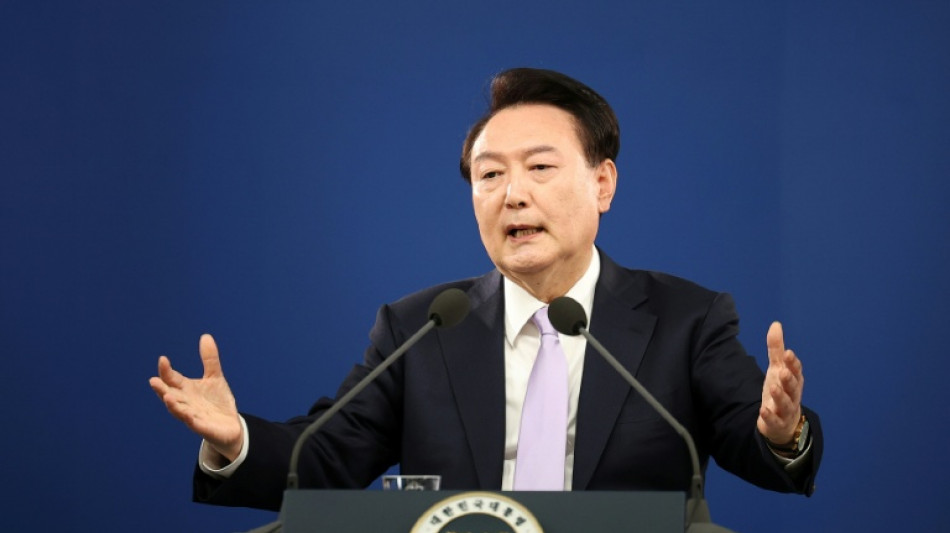
S. Korea's ex-president gets 30 years over North Korea drone incident / Photo: KIM HONG-JI - POOL/AFP/File

 Gauteng Health Department Warns of Rising Antibiotic Resistance Threat

 Bishop Museum Races to Save Rare Megamouth Shark Specimen

 InterContinental Hotels Group PLC Announces Transaction in Own Shares - November 26

 Raheem Sterling Receives Suspended Sentence After Lamborghini Crash

 Luxembourg Pay Rise Delayed as Regional and World Headlines Develop

 Audience to Choose the Set List at Luxembourg's First FAMIL Jukebox Night

 Twickenham Grounds Team Prepares Pitch for Six Matches in Three Days

 Black Friday Discounts Cut Prices on Two Top-Rated Wiper Blades

 TCC Network Linked to 200% Surge in Global School Attacks

A South Korean court sentenced ex-president Yoon Suk Yeol to 30 years in prison on Friday for sending military drones into North Korea, saying he planned the action as pretext for his disastrous martial law declaration in 2024.
The drone flights two months before Yoon suspended civilian rule, had sparked anger in Pyongyang, which accused the South of dropping propaganda leaflets as well.
Judges said Yoon intended to provoke Pyongyang "into carrying out armed or equivalent acts against South Korea's military of people", according to a summary of their ruling seen by AFP.
Yoon planned to "heighten inter-Korean military tensions and manufacture a national crisis" so his martial law could have been justified, they added.
The former president was given 30 years in jail over the drone incursion, a spokesperson for the Seoul Central District Court told AFP Friday.
Yoon is in detention while he appeals a life sentence for leading an insurrection with his martial law declaration.
He insists that he declared martial law "solely for the sake of the nation".
His defence has also denied the charge over the drones, arguing that operation was in response to North Korea sending balloons carrying trash across the border that year.
On Friday, the court's judges said the 2024 drone operation "entailed the use of South Korea's military capabilities for private purposes".
The judges added that powers vested in the president, including supreme command of the armed forces and the authority to declare martial law, must be exercised to protect the nation's survival and security.
But Yoon approved the military drone operation, "believing he could arbitrarily use such powers for his own political gain," the judges said.
- 'Most hostile' -
Yoon's shock late-night national televised address in December 2024 that suspended civilian rule plunged South Korea into an unprecedented political crisis.
Martial law lasted only about six hours as lawmakers raced to the assembly building and voted it down in an emergency session.
However, it triggered protests, sent the stock market plunging and caught key allies like the United States off-guard.
Yoon is facing multiple legal cases, and Lee Jae Myung was elected president after months of political chaos in the country.
Drone flights remain a flashpoint in tensions between the two Koreas, which remain technically at war.
In an incident unrelated to Yoon's drone case, South Korean investigators found that government officials had sent drones into the nuclear-armed North in January.
President Lee expressed regret earlier this year over the incident.
North Korean leader Kim Jong Un's powerful sister called Lee's statement "wise behaviour", but hopes for a rapprochement faded after the diplomatically isolated nation returned to calling the South its "most hostile" enemy.
Ch.Campbell--AT
