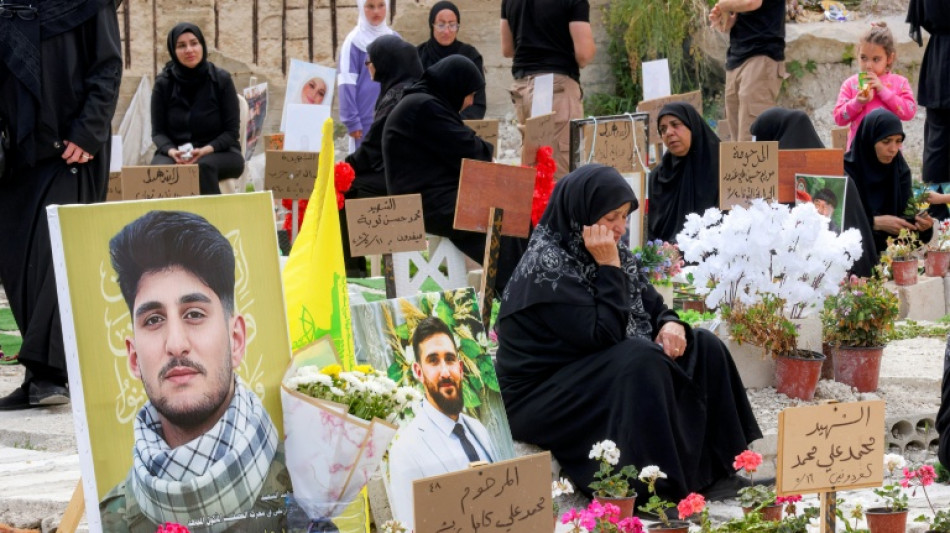
Displaced families bury Hezbollah dead in temporary graves / Photo: MAHMOUD ZAYYAT - AFP

 Gauteng Health Department Warns of Rising Antibiotic Resistance Threat

 Bishop Museum Races to Save Rare Megamouth Shark Specimen

 InterContinental Hotels Group PLC Announces Transaction in Own Shares - November 26

 Raheem Sterling Receives Suspended Sentence After Lamborghini Crash

 Luxembourg Pay Rise Delayed as Regional and World Headlines Develop

 Audience to Choose the Set List at Luxembourg's First FAMIL Jukebox Night

 Twickenham Grounds Team Prepares Pitch for Six Matches in Three Days

 Black Friday Discounts Cut Prices on Two Top-Rated Wiper Blades

 TCC Network Linked to 200% Surge in Global School Attacks

At a cemetery in southern Lebanon, Ghada Hussein clutched images of her son, a Hezbollah fighter killed in an Israeli strike and buried in a temporary grave because the family cannot return to her border village.
In a section just above the regular cemetery in Haret Saida, dozens of graves have been dug into the gravelly earth, many lined with cement blocks and holding coffins made with construction board.
Not all the dead were combattants, but a poster of Hussein's son Mohammed Tufayli, who was killed last month, showed a man in his early thirties in Hezbollah fighter's garb. Another pictured him in civilian clothes, under the title of engineer.
"My dearest person has gone... I did everything to raise him," said Hussein, 60, sitting on plastic artificial turf placed carefully over the grave in Haret Saida, a suburb of the coastal city of Sidon.
Hussein said her son had married earlier this year.
"I said, 'Come with us'. He said 'No, I won't leave the village'," said Hussein, who is from Kfar Tibnit, near the Israeli border, and has been displaced repeatedly in recent months.
"Our village is destroyed," she said, but vowed: "Mohammed is going to go back to his village, even if it's in 10 years."
"He's going to be next to me. I will visit him morning and night," she said, her voice filled with pain.
- New graves -
Lebanese authorities say Israeli attacks have killed more than 3,700 people since the latest war erupted on March 2 with Hezbollah's rocket fire at Israel in support of its backer Iran in the Middle East conflict.
The militant group says the toll includes its fighters.
A ceasefire, announced in April, has failed to halt the conflict, with Israel still pummelling south Lebanon and Hezbollah announcing attacks on invading Israeli troops.
Lebanese authorities say the war has displaced more than one million people, and have accused Israeli troops of razing towns and villages near the border.
In the cemetery, many graves bore makeshift placards as tombstones, handwritten with information including the name and date of burial.
A man recited the Quran over one plot. Others were decorated with flowers and plants, or with posters, both with images of fighters and civilians.
Shia Muslim rites provide for temporary burial when circumstances prevent a proper funeral or the deceased cannot be buried where they wished.
Haret Saida has a significant Shia population.
Hassan Saleh, who is responsible for burials at the cemetery, said the temporary area was established during the previous round of Israel-Hezbollah hostilities, which began in 2023.
Despite a November 2024 ceasefire, some families had still been unable to bury their relatives in their border villages when the new war erupted this year.
Since March, "we've buried around 120" people temporarily and "we're still digging new graves", Saleh said. Those buried have included first responders "and unarmed people who were in their homes", he said.
- 'Terrible scenes' -
If "a family of four or five arrives, we bury them together, everyone in their own coffin", he said, decrying "terrible scenes due to the Israeli aggression".
Other temporary burial sites have been established elsewhere in Lebanon, including in the southern city of Tyre and on the outskirts of Beirut's southern suburbs, a Hezbollah stronghold.
At the Haret Saida cemetery, a woman in black let out a harrowing scream as pallbearers carried a coffin, covered in a yellow Hezbollah flag, as mourners began to pray.
The coffin, bearing the image of a fighter named Hassan Ali Kallas, was then taken up the hill to a temporary grave, where men carefully removed the body, wrapped in red material, and placed it in the tomb.
The presence of "the (Israeli) planes won't let us go to the village", said Bassem Yassine, 55, a relative of Kallas, explaining the burial in the cemetery instead of in Nabatieh al-Fawqa further south.
Israel has been pounding Nabatieh al-Fawqa in recent weeks.
But "it's better than him staying in the morgue", Yassine added.
A man screwed the construction-board coffin shut, before others covered it with slabs of stone.
N.Walker--AT
