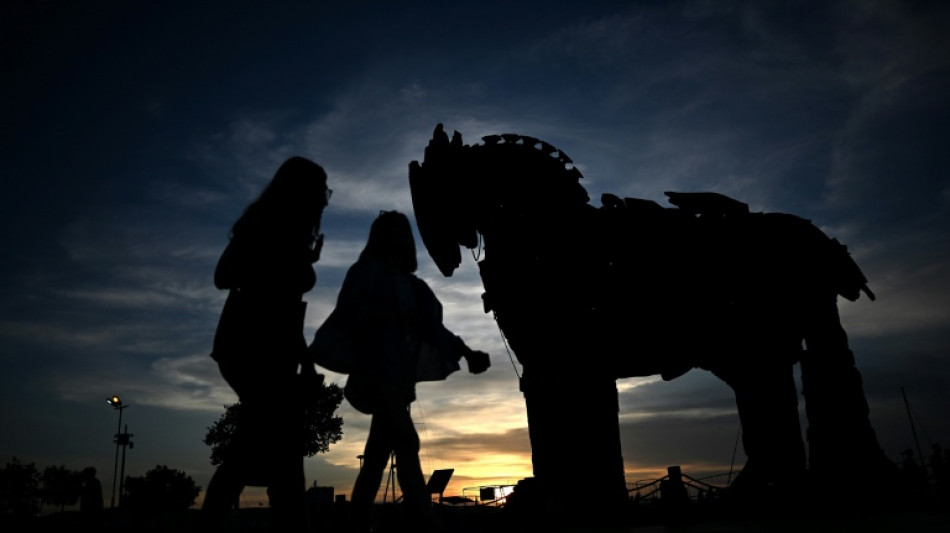
Between Homer and Hollywood: Troy a source of Turkish pride / Photo: Ozan KOSE - AFP

 Gauteng Health Department Warns of Rising Antibiotic Resistance Threat

 Bishop Museum Races to Save Rare Megamouth Shark Specimen

 InterContinental Hotels Group PLC Announces Transaction in Own Shares - November 26

 Raheem Sterling Receives Suspended Sentence After Lamborghini Crash

 Luxembourg Pay Rise Delayed as Regional and World Headlines Develop

 Audience to Choose the Set List at Luxembourg's First FAMIL Jukebox Night

 Twickenham Grounds Team Prepares Pitch for Six Matches in Three Days

 Black Friday Discounts Cut Prices on Two Top-Rated Wiper Blades

 TCC Network Linked to 200% Surge in Global School Attacks

A gift from the film set of "Troy", a giant Trojan Horse replica looms over the port of Canakkale on the Dardanelles Strait in western Turkey.
First related by Homer, then retold for the silver screen in 2004, with Brad Pitt as Achilles, the legend of the ancient city travels to Rome's Colosseum this week, where a major new exhibition opens on Friday.
Keen to showcase the city's Anatolian roots, Turkey has loaned out more than 220 artefacts that will be on show at the exhibition, "Troy and Rome", which runs until mid-October.
"When you read Homer, you don't get a very clear idea of the Trojans' identity. But at the time of the Trojan War, they were certainly among the Anatolian peoples," said Reyhan Korpe, deputy head of the Troy excavations and an ancient history expert at Canakkale University.
Located on Turkey's Aegean coastline, the remains of Troy are a UNESCO-listed World Heritage site comprising 185 hectares (457 acres) of stones and crumbling ramparts dotted with poppies and scampering squirrels.
For 30 years, Korpe has walked every inch of this huge site, whose layers tell the story of nine different settlements, the remains of their ramparts intertwined and layered on top of one another.
- Western flank of the east -
"I spent a whole year just walking through the stones, maps in hand, trying to understand how they fit together," he told AFP.
His passion is evident for the site, which was founded in 3,000 BC and was constantly inhabited until being abandoned in the sixth century AD.
"It was the most western part of eastern civilisation," which is what gave Troy its significance, Korpe said.
The Trojan War, which took place around 1,200 BC and lasted 10 years, until the siege and the city's defeat -- parts of which are recounted in the Iliad -- "was the first confrontation between the East and the West", he said of the Anatolian world and its Greek equivalent, referring to it as "the first world war".
It is an idea with strong resonance in these wooded hills, which several millennia later witnessed the World War I battles of 1915, when Allied troops suffered a bloody defeat trying to seize the Dardanelles from the Ottoman Empire.
- Luwian hieroglyphics -
Of the hundreds of artefacts Turkey has loaned to the Rome exhibition, more than 100 come from the Troy museum, some of which will be on display for the first time.
One piece is a bronze seal marked with hieroglyphics that was discovered in 1995, which offers important clues about the city's Anatolian roots.
"It's the only trace of writing found at Troy that was written in an Anatolian language, which proves that the first language spoken there was that of the Luwian peoples," explained museum director Sinem Duzgoren.
The Luwians were an ancient people who lived in western and southern Anatolia during the Bronze and early Iron Ages, whose language played a major role in the Hittite empire.
- From Wilusa to Ilion -
Although Troy was not a Hittite city, it was part of the Hittite empire, which referred to it as Wilusa. That became Ilion for the Greeks -- or Ilios for Homer.
"These pieces may not be the most spectacular, but they are the most important from a historical point of view, because they bear witness to the history of Troy," Duzgoren told AFP.
Also sent to Rome are a large number of weapons for use in war -- stones for use in a sling, knives, spears and arrowheads.
"These weapons are mentioned in the Iliad and date from the same period that they were mentioned by Homer," she said.
But it is a reality that is a far cry from the epic, romanticised fighting that plays out in Wolfgang Petersen's "Troy" (2004).
Apart from bequeathing the 12-tonne replica of the Trojan Horse looming over Canakkale's waterfront, the film did a lot to fuel renewed interest in Troy, Korpe said.
"Neither the producers nor the director came here, even though that was when we made some of the most significant discoveries," he said sadly.
"But the number of tourists did grow, even if they were just looking for traces of Brad Pitt among the ruins!"
R.Chavez--AT
