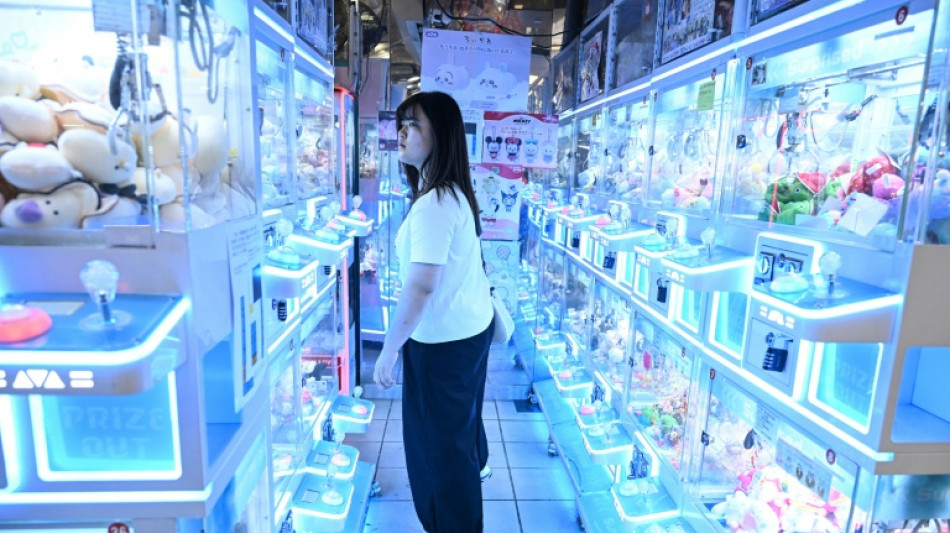
'Totally hooked': Hong Kong targets claw machine addiction / Photo: Peter PARKS - AFP

 Gauteng Health Department Warns of Rising Antibiotic Resistance Threat

 Bishop Museum Races to Save Rare Megamouth Shark Specimen

 InterContinental Hotels Group PLC Announces Transaction in Own Shares - November 26

 Raheem Sterling Receives Suspended Sentence After Lamborghini Crash

 Luxembourg Pay Rise Delayed as Regional and World Headlines Develop

 Audience to Choose the Set List at Luxembourg's First FAMIL Jukebox Night

 Twickenham Grounds Team Prepares Pitch for Six Matches in Three Days

 Black Friday Discounts Cut Prices on Two Top-Rated Wiper Blades

 TCC Network Linked to 200% Surge in Global School Attacks

Claw machine lover Neiki Lee carefully lowers the metal jaws of a crane with a joystick into a pool of prizes, only to have the small toy slip from its clutches again and again.
Dozens of stores filled with claw machines have sprung up on streets and in malls across Hong Kong's finance hub in recent years, promising players a treasure trove of prizes and a sense of fulfilment.
The colourfully lit machines, often seen drawing people like moths to a flame, have come under regulatory scrutiny this month, as officials raised addiction concerns over the seemingly harmless games.
Lee, 48, admitted that she was "totally hooked" and that "this is definitely gambling", adding that she bets at least five Hong Kong dollars every time she attempts to win a higher-value plush toy.
- 'Sunk cost fallacy' -
An office clerk, Lee said she has spent around HK$100,000 (US$12,800) on claw machines over two years -- roughly half her annual salary.
"For a HK$70 toy, you might eventually spend 700, or even 1,700, and still not be able to grab it," Lee told AFP.
"I really want to give it up. Every day I scold myself and tell myself to quit: no more, no more."
Player Tommy Yu, 23, said he sometimes spends hundreds of dollars a day on it despite saying some machines have "traps" built-in.
"When you put money in but don't get anything back, you feel like you've lost out," he said.
"Yet it keeps driving you to play."
Gambling counsellor Chu Ho Ming told AFP that "the more (the players) invest, the harder it is to leave empty-handed and walk away".
"This is the sunk cost fallacy," he said, adding that "it keeps the addictive behaviour loop".
Chu said his team have noticed an increase in youth playing games with "gambling elements".
- Too late? -
Claw machine operators have been able to expand and operate largely unrestricted, after a court ruled in 2022 they are not required to possess public entertainment licenses.
But after a sharp rise in the number of public complaints related to so-called claw machine gambling over the last two years, Hong Kong authorities proposed this month to tighten regulations over prize-based arcades, calling the situation after the 2022 ruling "not ideal".
The design and business models of such gaming machines are "extremely diverse", officials said, adding that they were committed to tackle the "deep-seated issues".
Some lawmakers have suggested capping the prize value at HK$300 or below, in line with countries including Britain and Singapore.
Matthew Chan, who owns three claw machine shops in town, told AFP tighter regulation was needed as the industry "was heading in the wrong direction".
Chan bemoaned the government's slowness to act, citing that Taiwan's machines must offer a "guaranteed prize" if a certain amount of money is spent.
"The market already saw a downsize... (Hong Kong's) consumers have lost confidence in it," he said, adding that some machine operators were ramping up the difficulty and keeping players hooked.
But player Lee said she believed operators would find ways to evade any regulation enacted.
"It's impossible that a law... can be applied in a way that is both flawless and fair" for the industry, she said.
"It is difficult to root out addiction problems simply by passing a law."
Ch.P.Lewis--AT
