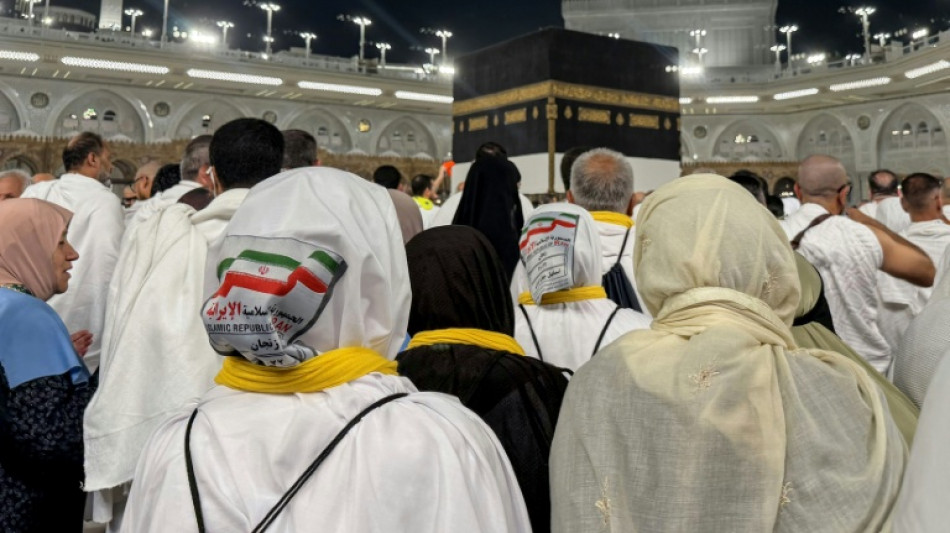
Iranians find 'peace and safety' in Mecca during hajj / Photo: - - AFP

 Gauteng Health Department Warns of Rising Antibiotic Resistance Threat

 Bishop Museum Races to Save Rare Megamouth Shark Specimen

 InterContinental Hotels Group PLC Announces Transaction in Own Shares - November 26

 Raheem Sterling Receives Suspended Sentence After Lamborghini Crash

 Luxembourg Pay Rise Delayed as Regional and World Headlines Develop

 Audience to Choose the Set List at Luxembourg's First FAMIL Jukebox Night

 Twickenham Grounds Team Prepares Pitch for Six Matches in Three Days

 Black Friday Discounts Cut Prices on Two Top-Rated Wiper Blades

 TCC Network Linked to 200% Surge in Global School Attacks

Being in Mecca has been nothing short of blissful for Hassan Qadiri, where participating in the festivities of the hajj pilgrimage is a welcome relief after weeks of devastating war back home in Iran.
Qadiri and his family took cover as intense Israeli and American bombing raids targeted his native city of Isfahan in central Iran until an April ceasefire began.
"We hear the call to prayer every day, not explosions here," Qadiri told AFP.
"I'm very happy."
Like many Iranians at this year's hajj, Qadiri and his family are staying in a hotel near the Grand Mosque under the protection of Saudi security personnel, who actively prevent others from approaching the grounds to meet or speak with the pilgrims.
The protocol is not provided to other visiting pilgrims.
"The Saudi treatment of us is good and everything is fine," Qadiri added.
His wife, who did not give her name and wore a black abaya with a turquoise vest that read "Isfahan", agreed.
"Being here makes the war easier for us to bear," she added.
Throughout the holy city, Iranian flags can be seen printed on white pilgrims' garments, cloaks, bags and buses.
- Tense past -
According to Iran's IRNA state news agency, due to the "wartime situation" just over 30,000 Iranian pilgrims out of an expected 86,700 made the journey to Saudi Arabia for hajj.
The hajj has been an uneasy flashpoint in the past between the Sunni monarchy in Riyadh and the Shia revolutionary government in Tehran.
In the years following Iran's 1979 Islamic revolution, Saudi officials accused Iranian pilgrims of triggering stampedes and other violence, while also yelling political slogans -- an act seen as taboo by the religious establishment in Mecca.
The last major dispute erupted after one of the pilgrimage's biggest tragedies, in 2015, when 464 Iranians were among 2,300 pilgrims killed in a stampede, prompting recriminations between Riyadh and Tehran.
Relations were severed a year later after protesters attacked Saudi Arabia's embassy in Tehran and consulate in the northwestern city of Mashhad, following Riyadh's execution of Shia cleric Nimr al-Nimr.
No Iranian pilgrims were allowed that year, as the two sides were unable to organise a protocol for them to attend.
The rivals only re-established ties in a 2023 deal brokered by China, which saw embassies reopen in their respective capitals.
But the detente was upended following the US and Israeli attack on Iran in late February that set off Iran's wide-ranging retaliation against its Gulf neighbours.
Energy installations, airports, export terminals, ports and other civilian infrastructure were targeted by Tehran, as Iranian attacks on the Strait of Hormuz choked Gulf oil and gas exports to the outside world.
- No slogans -
This year, Saudi authorities are working to prevent the war from affecting the environment at the hajj.
Saudi Arabia "has been very keen to de-politicise hajj in every manner whether it is about political activities or sloganeering during the pilgrimage," said Umer Karim, an expert on Saudi foreign policy at the University of Birmingham in Britain.
Inside one hotel hosting Iranian pilgrims posters lined the walls written in Arabic and English stating: "Raising flags and saying religious or political slogans is prohibited," echoing an earlier warning broadcast by the interior ministry.
Members of the official Iranian delegation declined to speak with AFP reporters.
The beginning of the hajj this week comes as speculation was rife over a potential agreement between Washington and Tehran.
US Secretary of State Marco Rubio said a deal to end the war with Iran could materialise as early as Monday, while President Donald Trump tempered expectations.
But even as the trajectory of the war remained uncertain, Iranians in Mecca were keen to enjoy their reprieve from the conflict.
"It is a very beautiful feeling to be here for the hajj," Ali Reza told AFP while enjoying a cigarette with a friend near his hotel.
The sentiment was echoed by Pardis, a woman in her forties from Tehran whose relative was killed by an air strike.
"I feel peace and safety here," she said.
T.Perez--AT
