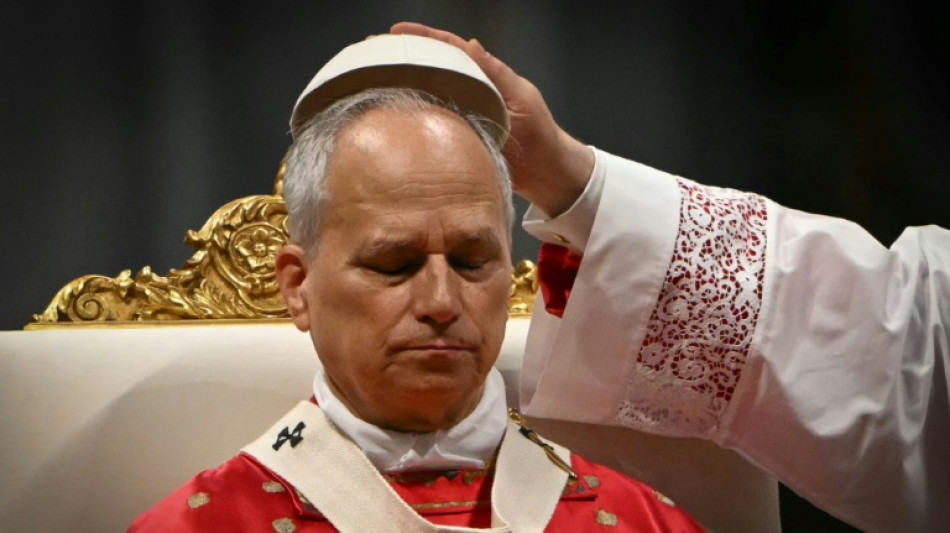
Pope to release major artificial intelligence manifesto / Photo: Andreas SOLARO - AFP

 Gauteng Health Department Warns of Rising Antibiotic Resistance Threat

 Bishop Museum Races to Save Rare Megamouth Shark Specimen

 InterContinental Hotels Group PLC Announces Transaction in Own Shares - November 26

 Raheem Sterling Receives Suspended Sentence After Lamborghini Crash

 Luxembourg Pay Rise Delayed as Regional and World Headlines Develop

 Audience to Choose the Set List at Luxembourg's First FAMIL Jukebox Night

 Twickenham Grounds Team Prepares Pitch for Six Matches in Three Days

 Black Friday Discounts Cut Prices on Two Top-Rated Wiper Blades

 TCC Network Linked to 200% Surge in Global School Attacks

Pope Leo XIV will release on Monday his long-awaited manifesto on artificial intelligence (AI), a bid to address ethical and social challenges as the technology rapidly develops worldwide.
The US pope will attend the presentation of the "Magnifica Humanitas" (Magnificent Humanity) encyclical at the Vatican in person -- a first for the Catholic Church.
He will be joined not only by officials from the Holy See but experts including the co-founder of the American startup Anthropic, a key player in the booming AI landscape.
Anthropic is in a legal battle with the US military after refusing to change its internal policy prohibiting the use of its Claude model for lethal autonomous warfare or mass surveillance.
Leo has denounced the race for AI in the military field, saying that "delegating decisions concerning the life and death of human beings to machines" is a "destructive spiral".
Since his election a year ago as the Church's first US pope, he has repeatedly warned of the dangers of AI, including "the gradual replacement of reality by its simulation".
And he has slammed the "environmental devastation" caused by the "frenzied race" for rare earth elements, which are essential for modern electronics.
- 'Wake-up call' -
AI could be worth up to $4.8 trillion (4.13 trillion euros) by 2033, a 25-fold increase in a decade, while concentrating its profits in the hands of a limited few, according to the UN.
UN Secretary-General Antonio Guterres last year warned "the window is closing to shape AI -- for peace, for justice, for humanity".
Leo has made the hot-button issue a cornerstone of his papacy in dedicating to it his first encyclical -- a document which lays the basis for Church teaching and longer-term debate.
Experts say "Magnifica Humanitas" could prove as influential as Pope Francis's "Laudato Si", a 2015 climate manifesto that triggered political and civic reactions worldwide.
The Vatican sees this new text as an extension of its social teachings on "protecting people in the AI era".
It was signed on May 15, the 135th anniversary of a 1891 encyclical by Leo XIII which laid the foundations of the Church's social doctrine during the Industrial Revolution.
"The Industrial Revolution transformed the labour market, people's lives, hegemony, and power dynamics," said Marijana Grbesa, political science professor at the University of Zagreb, and a speaker at an AI conference in the Vatican.
"At the time, it was necessary to train individuals in the use of tools. The same is true today: we need to train and educate," she told AFP.
The pope, she said, will emphasise that "education is not enough today".
"It's a wake-up call for the whole of civilisation", to "be rational when we use these tools".
- 'Perception of reality' -
Leo has emphasised the need for "digital literacy... to understand how algorithms shape our perception of reality."
In April he warned against the use of AI to fuel "polarisation, conflict, fear, and violence". And in January he lamented "the lack of transparency in the creation of the algorithms" that govern the operation of various chatbots, whose use is growing rapidly worldwide.
The release of "Magnificent Humanity" follows several years of study by the Church of AI-related technologies.
As early as 2020, the Holy See launched the "Rome Appeal for an AI Ethic", which called for new technologies to respect human dignity.
Leo's predecessor Pope Francis spoke extensively on the subject, calling for AI to be regulated and warning that it could exacerbate inequalities.
O.Brown--AT
