
Drug-fueled Enhanced Games not beating world marks early / Photo: Etienne LAURENT - AFP

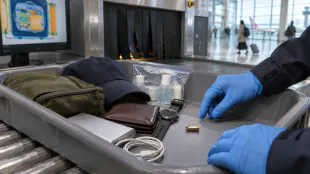 Former soldier stopped with blank round at Incheon Airport

 NYC Mayor Zohran Mamdani Undergoes Successful Achilles Surgery

 Korea Post breach exposes data of at least 113,855 customers

 Verso Books Releases Free Online Edition of The Encyclopedia of the American Left

 Alvechurch Sign Jenson Kilroy on Loan Following Redman Evans Departure

 US Aircraft Disable Iranian-Linked Vessel in Gulf of Oman; Tehran Vows to Defy Blockade

 Apple Black Friday Deals 2026: AirPods Pro 3, MacBook Air, and More

 Egyptian Business Leaders and Banks Pledge EGP 60 Million for Giza Ring Road Fire Victims

 Ireland’s Hearing Crisis: 300,000 Adults Wait Years for Care as National Plan Lags

 Malta-registered tanker sinks off Ibiza, killing one crew member
Juiced-up athletes kicked off the first-ever Enhanced Games on Sunday in Las Vegas, where early competitors failed to "beat" official world records despite using performance-enhancing drugs that have sparked health concerns.
Around 40 sprinters, swimmers and weightlifters are taking part in the divisive event. The vast majority have taken combinations of testosterone, human growth hormone, peptides, anabolic steroids and other substances banned by events like the Olympics.
The Games have been denounced by athletics governing bodies and anti-doping agencies as dangerous and against the spirit of sport.
But participants, lured by prize money of up to $1 million for beating world records, and $250,000 for event wins, include Olympic medallist swimmers James Magnussen, Cody Miller and Ben Proud, who have all taken drugs.
Co-founder Max Martin has predicted "quite a few" world records will be unofficially "beaten." But the first batch of competitions did not immediately bear that out.
Weightlifter Beatriz Piron, who reportedly surpassed a world record in training, attempted to get the Games off with a bang with the same feat in the very first event -- but narrowly failed.
The first swimming event was then won by an athlete who chose not to dope. Hunter Armstrong won the men's 50m backstroke, defeating two rivals on performance-enhancing drugs.
US swimmer Miller rolled back the years to win the 50m men's breaststroke, telling the crowd that he had "just shaved off seven-tenths (of a second) off my personal best at 34."
Miller and fellow Enhanced Games swimmers are also wearing the types of "supersuits" that led to many official records falling around the 2008 Beijing Olympics, but were subsequently prohibited.
The event's chief sporting officer Rick Adams said he respects that "specific international organizations" will not accept any records set on Sunday, even if they are broken by clean athletes like Kerley.
"But it is uncontroverted that if one of our 50m freestyle... moves through that water in less than 20.88 seconds, they have moved through that water faster than any other human being in history," he said, referring to Cam McEvoy's official record.
- 'Reasonably confident' -
The Enhanced Games are taking place at a purpose-built $50 million arena in a Las Vegas casino parking lot, a structure to be dismantled hours after the final race.
In a marriage of sports, biohacking, politics and entertainment, investors including billionaire Peter Thiel are rumored to be attending, while rock band The Killers will play a closing set. Donald Trump Jr is among the event's investors.
Health experts warn that several of the substances could risk "life-shortening and fatal consequences," including heart, liver and kidney issues, as so little is known about their long-term effects.
But Enhanced Games officials say all medications are approved by the US Food and Drug Administration, and no expense had been spared on hiring top medical experts.
Emergency officials will be standing by in case something goes wrong.
"I'm reasonably confident nothing will happen," said chief medical officer Guido Pieles.
Pieles described the risk of the medications as "clearly there" but "really manageable."
His team has published the percentage of athletes taking each substance, with Martin vowing that "transparency is core to our DNA."
Yet athletes said that they are not able to disclose the specific combinations each has taken.
"The reason for that is because actually it doesn't matter," Martin told AFP, noting that combinations are tailored to each athlete.
Also, parent company Enhanced -- which sells many of the substances being taken by its athletes to the public -- does not want to "advertise for certain protocols to create imitation potential," said Martin.
Y.Baker--AT