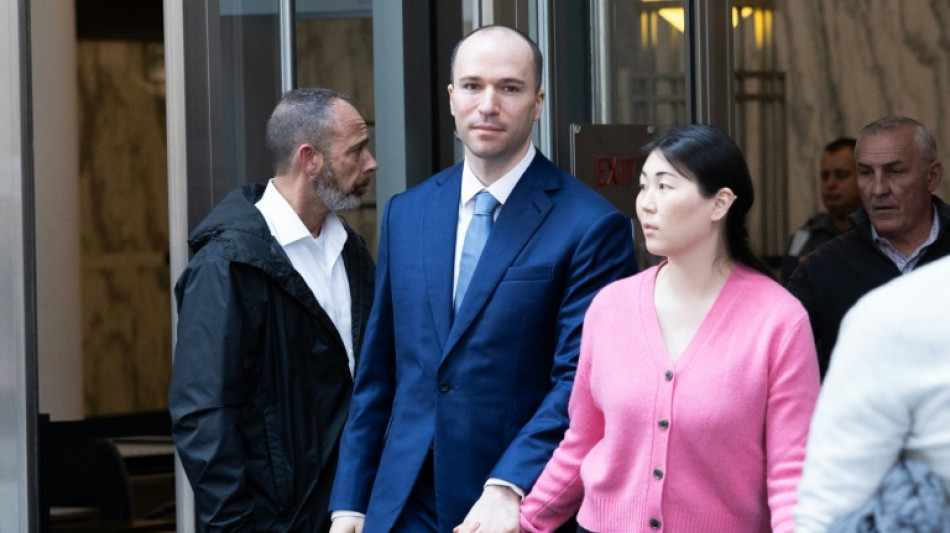
Musk 'was going to hit me,' OpenAI executive says at trial / Photo: Benjamin Fanjoy - GETTY IMAGES NORTH AMERICA/AFP

 Gauteng Health Department Warns of Rising Antibiotic Resistance Threat

 Bishop Museum Races to Save Rare Megamouth Shark Specimen

 InterContinental Hotels Group PLC Announces Transaction in Own Shares - November 26

 Twickenham Grounds Team Prepares Pitch for Six Matches in Three Days

 Luxembourg Pay Rise Delayed as Regional and World Headlines Develop

 Audience to Choose the Set List at Luxembourg's First FAMIL Jukebox Night

 Raheem Sterling Receives Suspended Sentence After Lamborghini Crash

 Black Friday Discounts Cut Prices on Two Top-Rated Wiper Blades

 TCC Network Linked to 200% Surge in Global School Attacks
OpenAI President Greg Brockman told a California jury Tuesday that Elon Musk physically threatened him during a 2017 confrontation, testifying that the billionaire stormed out after he was refused absolute control of the artificial intelligence company.
"I actually thought he was going to hit me," Brockman said.
The testimony came on the second day of Brockman's appearance at the trial of Musk's lawsuit against OpenAI and CEO Sam Altman, in which the Tesla and SpaceX founder accuses the company of betraying its original nonprofit mission.
According to Musk, the company pivoted to a for-profit structure and misappropriated his $38 million founding donation to build a company now valued at more than $850 billion.
OpenAI counters that Musk left voluntarily after failing to seize majority control and has since become the company's direct competitor through his own AI venture, xAI.
Under cross-examination by OpenAI attorney Sarah Eddy, Brockman sought to reframe diary entries that Musk's lawyers had used the previous day to portray him as a calculating opportunist.
One November 2017 entry read: "It'd be wrong to steal the non-profit from him... That'd be pretty morally bankrupt."
"It's very painful, very deeply personal writings that were never meant for the world to see, but there's nothing in there I'm ashamed of," Brockman said in court.
Brockman also testified that when Musk announced his departure from OpenAI in February 2018, he told staff he intended to pursue AI development inside Tesla without regard for safety.
"If the sheep are dictating safety and the wolves are not, then there's no purpose," Brockman said Musk allegedly told employees at the time.
OpenAI's legal team argues the timeline proves Musk was fully aware of the company's commercial pivot -- and that his 2024 lawsuit, filed after he launched rival lab xAI, is meritless.
Brockman said that OpenAI now spends $50 billion a year on computing power -- compared to just $30 million in 2017 -- showing how expensive the technology has become and why a charity-style organization could never have footed the bill.
Brockman acknowledged Monday that his stake in OpenAI is valued at $30 billion.
Altman is expected to testify as early as next week.
D.Lopez--AT
