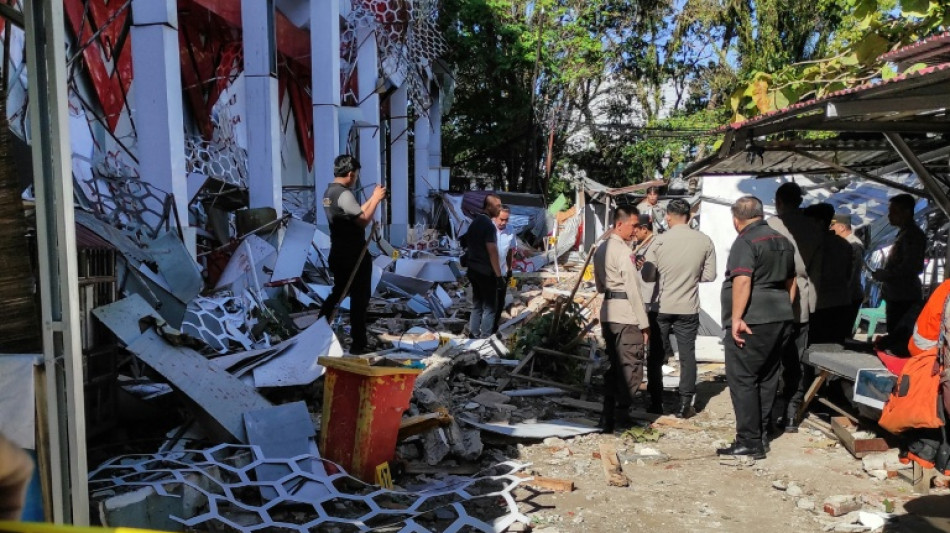
7.4-magnitude quake off Indonesia kills one, tsunami warning lifted / Photo: Tonny Rarung - AFP

 Gauteng Health Department Warns of Rising Antibiotic Resistance Threat

 Bishop Museum Races to Save Rare Megamouth Shark Specimen

 InterContinental Hotels Group PLC Announces Transaction in Own Shares - November 26

 Twickenham Grounds Team Prepares Pitch for Six Matches in Three Days

 Luxembourg Pay Rise Delayed as Regional and World Headlines Develop

 Audience to Choose the Set List at Luxembourg's First FAMIL Jukebox Night

 Raheem Sterling Receives Suspended Sentence After Lamborghini Crash

 Black Friday Discounts Cut Prices on Two Top-Rated Wiper Blades

 TCC Network Linked to 200% Surge in Global School Attacks
A major 7.4-magnitude quake struck off the coast of eastern Indonesia on Thursday, killing at least one person, causing waves of up to 75 centimetres (2.5 feet) and triggering a tsunami warning that was subsequently lifted.
The US Geological Survey (USGS) said the tremor hit at a shallow depth of 35 kilometres in the Molucca Sea between the Sulawesi and Maluku island groups in the early morning.
One person was killed when a building collapsed in the city of Manado in North Sulawesi province, a local search and rescue official told AFP.
"The quake was felt strongly and around Manado... one person died and one person had a leg injury," George Leo Mercy Randang told AFP by telephone.
The victim was "buried under the rubble" of a collapsed building, he said.
The Hawaii-based Pacific Tsunami Warning Center (PTWC) initially said hazardous tsunami waves were possible within 1,000 kilometres (621 miles) of the epicentre along the coasts of Indonesia, the Philippines and Malaysia.
Within half an hour of the quake, waves up to 75 centimetres were recorded in North Minahasa and 20 centimetres in Bitung, both in the north of Sulawesi island, according to Indonesia's BMKG geological agency.
Thirty-centimetre waves were also logged in North Maluku province.
The PTWC lifted its warning just over two hours after the tremor, saying the tsunami threat "has now passed."
Ternate resident Budi Nurgianto, 42, said he was inside his house when the tremor struck, sending people panicking outside.
"The quake was felt strongly. I heard it first from the walls of the house that shook," he said.
"When I went outside, there were many people outside. They were panicked. The quake was felt (for) quite long, more than a minute.
"I even saw some people leaving their house without having finished their shower."
- Aftershocks -
BMKG head Teuku Faisal Fathani told journalists in the capital Jakarta there were 11 aftershocks, the biggest with a magnitude of 5.5.
An AFP journalist in Manado on Sulawesi, about 300 kilometres west of Ternate by sea, said the shaking woke him and others in the city of around 450,000 people.
"I immediately woke up and left my house. People (were) immediately scrambling outside. There is a school and the pupils rushed outside," he said.
The shaking persisted for "quite long" but he did not witness "significant damage", he added.
The PTWC had initially warned that tsunami waves of up to one metre were possible for parts of Indonesia, with smaller waves possible for the Philippines, Malaysia, Japan, Taiwan, Guam and Palau.
"Government agencies responsible for threatened coastal areas should take action to inform and instruct any coastal populations at risk," the agency said.
The Japan Meteorological Agency said it expected "slight changes" in the sea level along the Pacific coast from northern Hokkaido to southern Okinawa, but has not issued any warnings.
The earthquake centres of the Philippines and Malaysia have also not issued tsunami alerts.
Indonesia and neighbouring countries experience frequent earthquakes due to their location in the Pacific "Ring of Fire" -- an arc of intense seismic activity where tectonic plates collide that stretches from Japan through Southeast Asia and across the Pacific basin.
In 2004, a magnitude-9.1 quake struck Aceh province, causing a tsunami and killing more than 170,000 people in Indonesia.
burs-mlr/mjw
R.Chavez--AT
