
Not All CBD Is Medicine: Why Medicare's Plan Could Undermine FDA Marijuana Science

 As Canada takes on US tariffs, what's behind the David and Goliath fight?

 UEFA 'likely' to drop threat to boycott FIFA tournaments: source

 US disrupts platforms allegedly used by Chinese hackers

 The foreign tourists missing in Nepal's flash floods

 Hundreds missing after Nepal-Tibet flood kills 98

 CIA director was on 'semi-routine' mission in Moscow: Trump

 Aldeguer switches to Rossi's VR46 for next season

 Rent TRON Energy and Reduce USDT Fees : TronBid Expands Marketplace

 Pakistan captain Babar Azam returns against England '90 percent fit'

 Stocks mixed as oil drops, inflation stays high

 Improving standards transform pole vault as spectacle, says Duplantis

 India close in on win despite Sri Lanka fightback in second Test

 MEXC TradFi Gala Concludes With Over 170,000 Registrations and $4.3 Billion in Daily Trading Volume

 Olympic skating champion Liu to skip new season

 Benfica sign midfielder Palhinha from Bayern

 Flick says Barca may go without striker as Atletico resist Alvarez sale

 Too hot to incubate: Nile crocodiles hatch on their own in French reserve

 Spurs closing in on Man City's Marmoush after signing Savio

 Celtic count the cost of Champions League flop

 Lebanon accuses Israel of burning forest, farmland in south

 Nepal floods at China border kill 8, cause 'major casualties' in Tibet

 France eases cow diets as cheesemakers sweat

 America unites in mourning for Dolly Parton

 Meta and US states discuss settlement in landmark social media trial: report

 Fire haze threatens health of millions in Indonesia, ministry warns

"You cannot claim to follow science while bypassing the scientific process," said Duane Boise, CEO of MMJ International Holdings.
"Not all CBD is the same. Without FDA validation, you're not practicing medicine-you're experimenting on patients with inconsistent products."
WASHINGTON, D.C. / ACCESS Newswire / March 20, 2026 / In what may become one of the most controversial healthcare policy experiments in recent years, the Centers for Medicare & Medicaid Services (CMS) is preparing to launch a pilot program that would provide federal reimbursement for cannabidiol (CBD) products.
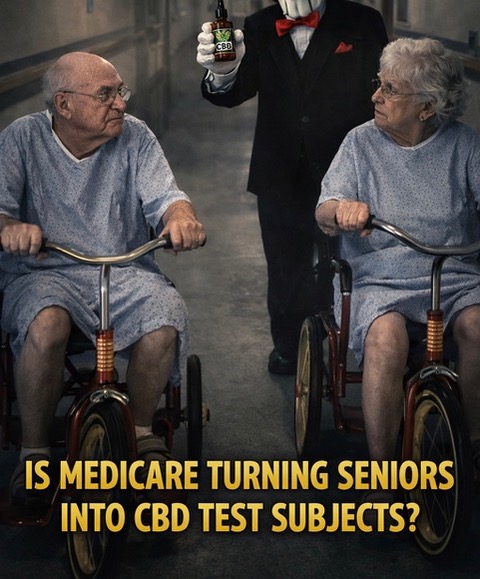
On its surface, the initiative is framed as compassionate, forward-thinking, and responsive to patient demand - particularly among seniors suffering from chronic pain.
But beneath the policy language lies a far more troubling question:
Is the federal government preparing to pay for products that have never met the scientific standards required of medicine in the United States?
A Direct Collision With FDA Drug Approval Standards
For decades, the United States has maintained a clear and uncompromising standard:
If a product is intended to diagnose, treat, or mitigate disease, it must go through the U.S. Food and Drug Administration (FDA) drug approval process.
That process - particularly for botanical drugs - requires:
Defined composition
Controlled manufacturing
Pharmacokinetic data
Clinical trials establishing safety and efficacy
It is the pathway followed by approved cannabinoid drugs such as Epidiolex and Marinol.
It is also the pathway followed - at great cost and over many years - by companies like MMJ International Holdings and its subsidiaries, including MMJ BioPharma Cultivation and MMJ BioPharma Labs, which have pursued FDA Investigational New Drug (IND) applications and clinical development under full federal oversight.
CMS is now proposing something entirely different.
"CBD" Is Not a Drug Category-It's a Label
The fundamental flaw in the CMS pilot is scientific:
Not all CBD is the same.
CBD products in the consumer marketplace vary dramatically in:
Purity
Bioavailability
Manufacturing quality
THC contamination levels
Stability and dosing consistency
Two products labeled "CBD" may produce entirely different effects in the human body.
This variability is precisely why the FDA requires strict standardization before a product can be called medicine.
Yet CMS is moving toward reimbursing CBD products as if they are interchangeable.
They are not.
The THC Contradiction That Exposes the Problem
According to early reporting, CMS is considering allowing up to 3 milligrams of total THC per serving in eligible products.
That figure stands in direct conflict with a separate federal law redefining hemp, which limits THC to approximately 0.4 milligrams per container.
This is not a minor discrepancy-it is a sevenfold regulatory mismatch.
It raises a critical question:
If federal agencies cannot agree on what constitutes a legal cannabinoid product, how can one agency justify reimbursing it as a healthcare benefit?
Reimbursement Without Approval Creates "Shadow Medicine"
CMS maintains that this is only a pilot program and not a formal drug approval.
But in practice, reimbursement changes everything.
Once Medicare:
Pays for a product
Encourages physician recommendation
Integrates it into care models
That product becomes, functionally, medicine.
And yet:
It has not gone through FDA approval
It lacks standardized dosing
It may vary from batch to batch
This creates what critics are calling a "shadow medical system"-where products are used like drugs without being regulated as drugs.
A Two-Tier System: Science vs. Convenience
The implications are profound.
On one side:
Pharmaceutical developers follow FDA rules
Conduct clinical trials
Spend years generating safety and efficacy data
On the other:
Consumer CBD products enter federal reimbursement programs
Without the same evidentiary standards
Without the same regulatory burden
"You cannot claim to follow science while bypassing the scientific process," said Duane Boise, CEO of MMJ International Holdings.
"Not all CBD is the same. Without FDA validation, you're not practicing medicine - you're experimenting on patients with inconsistent products."
The Risk to Patients - and to the System
Supporters argue the pilot could expand access and generate real-world data.
But critics warn it could:
Expose vulnerable populations to inconsistent formulations
Undermine FDA drug standards
Create liability risks for federal healthcare programs
Distort the market away from validated therapies
Most concerning of all, it may signal that scientific rigor is optional when political momentum is strong enough.
At The End Of THE Day
CMS may call it a pilot program.
But to patients, physicians, and taxpayers, the stakes are far higher.
If the federal government begins paying for cannabinoid products that have not met FDA standards, it risks dismantling a system that has defined drug safety and efficacy for more than a century.
Because in medicine, one principle has always held:
Not all compounds are created equal - and not all products deserve to be treated as drugs.
Madison Hisey
[email protected]
203-231-85832
SOURCE: MMJ International Holdings
View the original press release on ACCESS Newswire
E.Rodriguez--AT