With ropes and chants, thousands move Japanese castle / Photo: Philip FONG - AFP

 Zurich Diamond League: five events to watch

 'Black smoke' chokes Pakistan maternity ward as hospital fire kills 14 infants
 French flight attendant wins landmark breast cancer ruling

 Sri Lanka 83-2 after India enforce follow-on in second Test
 Pakistan hospital fire kills 14 infants
 Iceland to vote on resuming EU talks in close referendum

 North Korea to 'bring joy' to Kim with 100 athletes at Asian Games

 US LGBTQ community mourns 'diva' Dolly Parton

 England bid to banish booze woes as Pakistan seek self-respect
 High quality, low risk: record number of Japanese in Premier League
 Stocks edge higher as oil drops on fresh Mideast hopes

 Pakistan's girls fight for their place in the boxing ring
 Five things to know about Anthropic ahead of Wall Street debut

 Social media use on the rise among Australian under-16s after ban: data

 Eagle Plains Reports Anomalous Radioactivity from First Drillholes at the Don Lake Uranium Project, Saskatchewan

 Instagram chief admits touting teen safety tool while omitting it was barely used

 'Final Fantasy', 'The Witcher' in spotlight at Europe gaming bash

 Syrian Kurdish leader dissolves force that spearheaded jihadist fight

 Trump raises prospect of demolishing iconic Kennedy Center

 PGA Tour to end in two-week matchplay showdown from 2028: CEO

 United States of Dolly: how a country queen bridged America's divide

 PGA chief says 'no current plans' for LIV stars to return

 Golf giant Callaway apologizes after ad sparks outcry

 Ioane stars as New Zealand recover to beat Johannesburg Lions

 Ukrainians seeking beauty in a bomb-scarred city

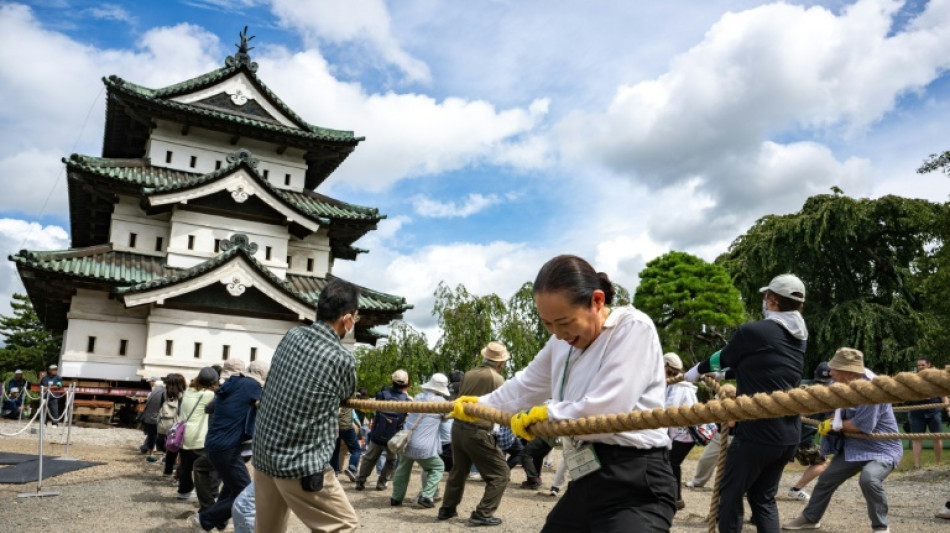
Chanting in unison, hundreds of volunteers in northern Japan heaved on ropes on Wednesday to pull a 400-tonne castle back towards its original position.
The imposing fortified tower of Hirosaki Castle was shifted 80 metres (262 feet) in 2015 to allow for essential repairs to the stone walls that support it.
Engineers at the time opted to reposition the three-storey wooden structure without dismantling it, hoisting it in one piece on metal rails to a temporary platform.
Since last Saturday, groups of about 80 people have been taking turns moving the tower a few precious centimetres at a time.
Local officials estimate that around 4,000 people in total -- some from overseas -- have participated, advancing the structure by nearly five metres.
"It's like trying to move a mountain," Takahiro Kogawa, a 56-year-old Hirosaki resident, told AFP, his forehead beaded with sweat after a few minutes of intense effort.
Azusa Nimiya, a 46-year-old history and castle enthusiast, travelled from Shimane, almost on the other side of Japan's main island, to do her bit.
"It's the experience of a lifetime, a precious and unique memory," she said.
The municipality will deploy heavy machinery in September to complete the journey, aiming for a permanent installation in November.
Following further restoration work on the copper roof and facades, the full reopening to the public of this masterpiece from the Edo period (1603-1868) is scheduled for 2033.
- Physical history -
By involving the public, "we wanted everyone to be able to experience history physically," said Kensuke Hayasaka, the head of the restoration project.
"It's extremely significant for passing on the history of Hirosaki to future generations," he told AFP.
Lighting destroyed the tower in the 17th century, and it was rebuilt in the early 19th century.
But a few decades later, the stone foundations threatened to collapse, forcing the tower to be moved for the first time -- again thanks to muscle power.
It was finally returned to its original position in 1915.
This large-scale, human-powered operation, known as "hikiya", "is a traditional technique for moving structures that has existed in Japan since ancient times," explained Hayasaka.
"Our goal is to preserve this unique heritage, while ensuring that the main tower is securely fixed to its base before the first snowfall," which is abundant in winter in this northern region.
"Seeing all these discussions and the methods devised by our predecessors and our teams finally come to fruition this year is extremely moving. We feel a profound sense of accomplishment," he added.
Among the most enthusiastic pullers was Katsumi Terada, 82, who tucked two Japanese flags into his headband.
He recounted having participated 11 years earlier.
"I wondered then, with some anxiety, if I would still be around to see it return to its base. But look, I persevered. I'm alive and well."
A.Moore--AT