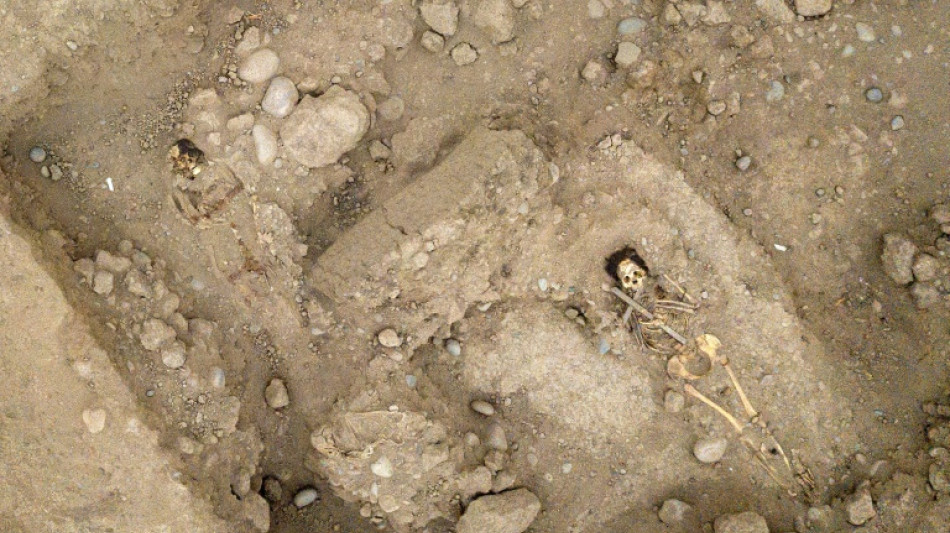
Three colonial-era burials found in pre-Hispanic Peru sanctuary / Photo: Cris BOURONCLE - AFP

 Zach Hickerson Recounts Hayden Panettiere's Final Moments in New Interview

 Luxembourg Housing Petition Passes Threshold for Parliamentary Consideration

 Raheem Sterling Receives Suspended Sentence After Lamborghini Crash

 Audience to Choose the Set List at Luxembourg's First FAMIL Jukebox Night

 Luxembourg Pay Rise Delayed as Regional and World Headlines Develop

 Chennai Urbanist Sashna Develops 'Anniki' Card Game to Gamify Tamil Nadu History

 Transport Minister Defends Land Seizure Powers for Toronto-Quebec City High-Speed Rail

 UAE Weather Forecast: Scattered Showers and Fog Expected as Temperatures Drop
A team of Peruvian archaeologists uncovered three burials from the Spanish colonial period on top of a pre-Hispanic temple, which may be up to 500 years old, a researcher said Thursday.
Peru was under Spanish rule for nearly 300 years, from 1532 when they invaded and defeated the Inca empire until 1821 when popular uprisings led to independence.
"We are working with the hypothesis that the remains belong to a colonial cemetery," Lucenida Carrion, head of the Archaeology Directorate of the Park of Legends in the Peruvian capital, told AFP.
The park's 54 archeological monuments and sanctuaries have been the subject of study for decades.
"In this summit, we have discovered the burials of two adults and a child who were wrapped in cotton cloth," the archaeologist added.
The temple, or pre-Hispanic sanctuary known as "Tres Palos" where the burial site is located, is more than 1,000 years old and is located on land adjacent to the park.
After the pre-Hispanic era, the site was inhabited by settlers from colonial Lima.
"We are considering whether the remains are from the colonial era," Carrion said, pointing to the clothes, hair and a Christian crucifix found on one of the remains.
"This finding is important because it will help us determine if there has been a continuous occupation at this site since pre-Hispanic times."
During the 15th and 16th centuries, the "Tres Palos" sanctuary was used by the Incas as a tambo (food deposit) and during the colonial era, adobe (mud and straw) houses were built.
- Wooden cross -
"What stands out is the cross carried on the chest of one character. This cross indicates the moment of transformation to Christianity of the natives or inhabitants that populated this place," Carrion said.
Other than the brown wooden cross, sandals, textile fragments, bracelets, funeral mantles and the remains of ceramic vessels were also discovered.
The archaeological team's findings are among the most important in recent years and add to the study of numerous material testimonies uncovered inside the archaeological complex of Maranga, located near the coast of Lima.
"The works carried out in the place allow us to establish that its history dates back approximately 2,000 years and that they were occupied by the Lima culture, the Ychsma and finally the Incas," Carrion said.
The Park of Legends, built in 1964, is named after the pre-Hispanic legends illustrated at the entrance of the enclosure.
In 2018, a team of archaeologists found a 1,300-year-old cemetery from the pre-Hispanic Lima culture near the park.
M.O.Allen--AT


