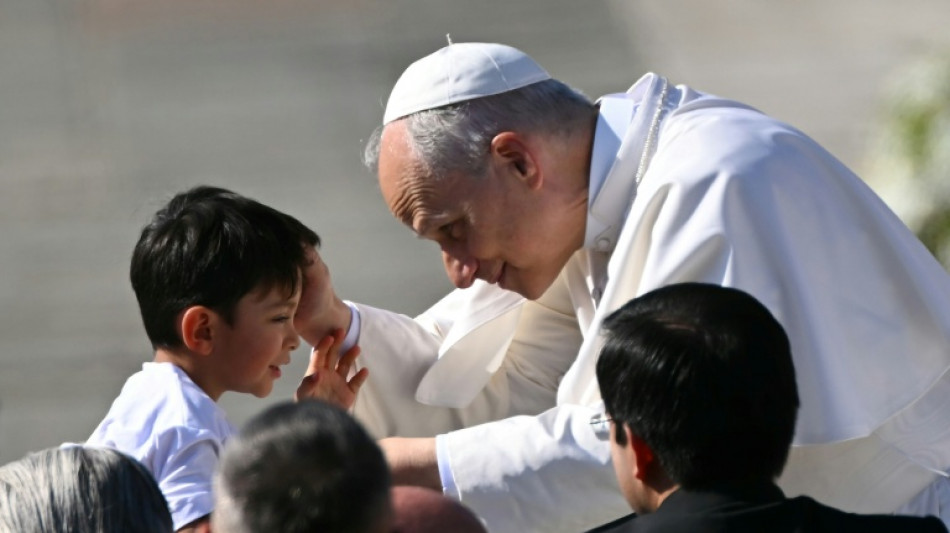
Pope Leo offers olive branch in allowing traditional mass / Photo: Filippo MONTEFORTE - AFP/File

 Nepal flood survivors return to ruins to salvage memories
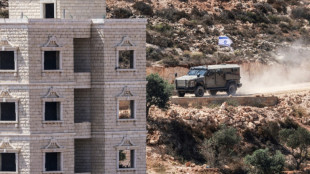
 Killing of Palestinian children and teens by Israel surges in West Bank
 Educators keep 9/11 memory alive for next generation, 25 years on
 Venezuelans view US oil deal with doubt, hope
 Gobena and Jepchirchir power to Sydney Marathon victories
 Iceland in suspense after close EU vote
 Wallabies hold on for victory in Argentina
 Juve notch second straight win, Fiorentina's centenary party falls flat
 Rybakina eases injury fears ahead of US Open
 Djokovic kicks off latest Grand Slam quest under US Open lights
 'Sorry' De Zerbi won't panic after Spurs shambles
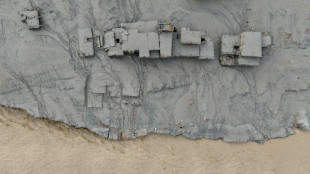 UN, Nepal warn of climate threat after deadly floods
 USTA boss says structure of new player council not yet set
 Tiny Elversberg stun Leverkusen on Bundesliga debut, Dortmund beat Hamburg

 BMC rejects negligence claims in three Rajawadi Hospital maternity cases

 Editorial questions Letitia James’ record as New York attorney general
 Los Angeles triplets weigh 19.3 pounds in unusually heavy birth

 Matt Leinart assesses Arch Manning and the leading names in college football

 Rural Tamil Nadu students present 64 technology projects at IIT-M research park
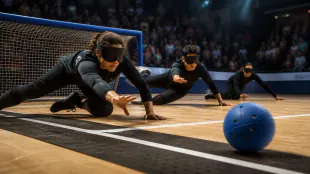 Tamil Nadu goalball team’s national silver highlights need for wider support
 Tamil Nadu and NUS agree to expand postgraduate and research links
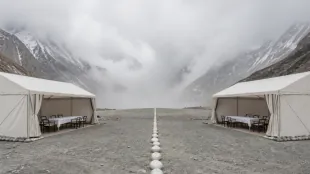 India and China have not named two new border meeting sites

 Ankle ligament tear ends Neeraj Chopra’s 2026 season

 Thirty-seven Mumbai pilgrims return after Nepal flood disruption
 French campaign sharpens as far right accuses left over civil disobedience calls
Pope Leo XIV has authorised a traditional mass to take place this weekend at the Vatican, lifting restrictions that angered conservatives in his latest attempt to heal splits within the Catholic Church.
The Tridentine or so-called Latin mass was commonly used across the Church before it was modernised in the 1960s, and was further limited by Pope Francis in 2021.
With Leo's approval, it will be celebrated in St Peter's Basilica at the Vatican on Saturday afternoon by ultraconservative US cardinal Raymond Burke, a fierce opponent of the late pontiff.
Conducted in Latin by a priest who keeps his back to the congregation, in a ceremony marked by the use of incense and Gregorian chants, the mass is preferred by many traditionalist Catholics.
Francis feared, however, that its use could undermine the legacy of the Second Vatican Council (1962-65), a series of reforms that sought to bring the Catholic Church into the modern era.
His papal decree restricting the use of the mass, "Traditionis Custodes", sparked anger among Catholic conservatives who felt they were being sidelined.
Pope Leo's move to allow the mass in the Vatican sends a "very strong signal to the conservative fringe", said Francois Mabille, head of France's Geopolitical Observatory of Religion.
The action of Leo suggests that "maybe the tensions within the church are stronger than we imagined a few months ago," he told AFP.
- Strategic balance -
Elected on May 8 following the death of Francis, Pope Leo faced a delicate mission bringing together a church of 1.4 billion followers deeply divided over social issues, from the role of women to the openness of the Church towards divorcees, gay faithful and migrants.
In his 12 years as pontiff, Francis often irritated conservatives with his decisions, especially in the United States. Burke, who will lead Saturday's mass, was one of the Argentine pope's strongest critics.
Leo has pursued many of the policies favoured by his predecessor, highlighting the need to help the poor and marginalised and to protect the environment.
When the Vatican welcomed an LGBTQ+ pilgrimage as part of the church's Jubilee year in September, critics renewed their attacks on the Holy See's "ideological drift".
But Leo has also given ground to conservatives.
He named Guinean Cardinal Robert Sarah, who considers immigration a threat to Europe's Christian identity, as a special envoy to a pilgrimage in France.
And the return of the Tridentine mass to the Vatican is also "a gesture of appeasement," said Martin Dumont, a historian and secretary general of the Research Institute for the Study of Religions.
It signals that "everyone is a part of the Church -- all sides must be accepted and received", he told AFP.
Leo "would like to meet Catholic groups who want this form of rite" to understand their motives, said Dumont, adding: "He is a man of peace, attentive to others."
Leo appears to be sending the message that the traditional mass has a place, as long as it does not threaten the legacy of the Vatican II reforms.
But the line between liturgy and politics is fraught.
In an interview published in September, Leo acknowledged that the debate over the mass was "very complicated" and had become part of the "polarisation" within the Church.
"Some have used the liturgy as a pretext to advance other subjects. It has become a political tool and that is very regrettable," he said.
R.Chavez--AT