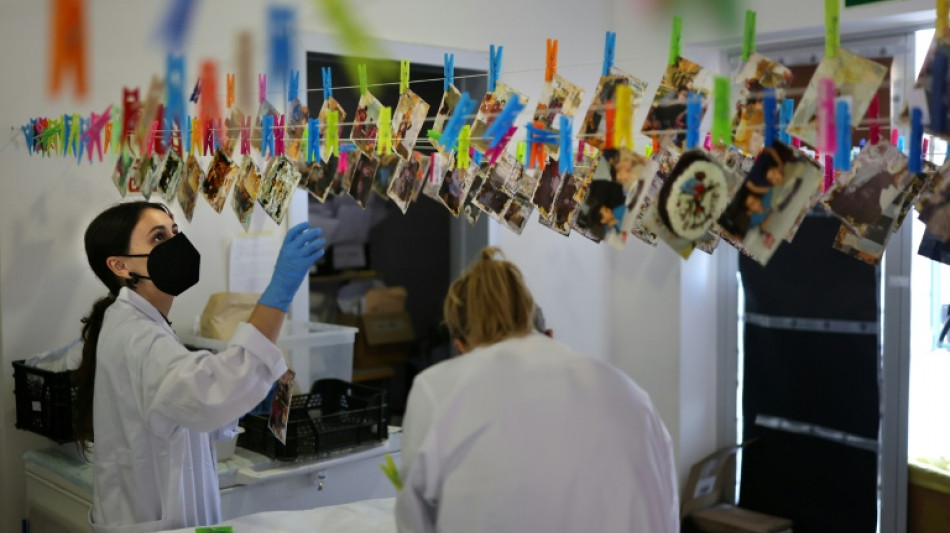
After deadly floods, Spaniards fight to save photos / Photo: Thomas COEX - AFP

 Vietnamese coffee farmers ride China's durian wave
 Venezuela says retains 'sovereignty' in US oil deal
 NASA's Roman telescope set to launch on cosmic mapping mission

 Data center backlash scrambles US midterm politics

 Emotional Federer inducted into tennis Hall of Fame

 Hovland takes solo lead as McIlroy surges at Tour Championship
 Djokovic 'prepared' for US Open bid for history
 Atletico down Sevilla to go top of La Liga

 US deports right-wing provocateur Milo Yiannopoulos

 Niger junta says it is back in control after soldiers' mutiny

 Erasmus calls Rennie barbs over Springbok scrumming 'nonsense'

 Lawrence's fifty leaves Pakistan facing record chase to level England series
 Netanyahu condemns settler attack in flashpoint West Bank village

 Munoz saves Iraola in Liverpool draw, big-spending Spurs lose again

 Newcastle condemn dismal Spurs to second successive defeat

 Five college football games that could shape the 2026 season

 New finds strengthen case for Bethsaida at Sea of Galilee site

 Felony assaults on older New Yorkers rise sharply, police data show

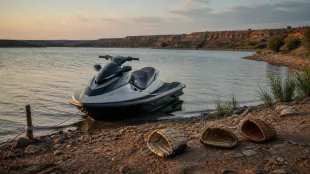 Three Texas Tech softball players hurt in jet ski collision
 Tambaram civic groups seek action on eight long-pending issues

 Chennai councillors unite across parties to demand ward development funds

 Court orders JIPMER assessment of Durai Dayanidhi before money-laundering trial
 Family searches for Boston engineer missing after Nepal-Tibet floods
 Dolly Parton’s Imagination Library leaves global children’s reading legacy

 Police appeal for footage after life-threatening Stratford assault

Hundreds of photographs hang to dry at a laboratory, fragile reminders of birthday celebrations and summer vacations nearly swept away by last year's deadly floods in Spain.
But thanks to a university-led initiative, many of these memories have been rescued from ruin.
Decked in white lab coats and masks to protect themselves from mould and other contaminants, a group of students at a laboratory at Valencia's Polytechnic University carefully clean and restore photos.
A sign next to a pile of mud-stained photo albums that sits by the entrance warns: "Do not touch. Contaminated material."
Nearby, a pile of empty photo albums still bears traces of the mud that swept through parts of the Mediterranean region of Valencia during the torrential rains of October 29, 2024, killing more than 200 people and destroying thousands of homes.
In the chaos that followed, a wave of volunteers rushed to help residents clean up the 800,000 tonnes of debris left by Spain's deadliest natural disaster in a generation and salvage what they could.
"We started getting calls from students who were helping in the affected areas and noticed that entire albums of photographs were being thrown away," said Esther Nebot, a professor at the university and the co-director of the project Salvem les fotos ("Let's Save the Photos").
"Those same students began collecting photographs in their backpacks," she added, pointing to the freezers where the damaged images were stored before being painstakingly restored.
- 'Incredibly satisfying' -
Since the project began, roughly 340,000 images have passed through the lab.
Volunteers, students, donors and professors have restored about 75 percent of them.
"The disaster caused enormous losses at the documentary and historical level, and above all at the social level," Nebot said.
"Many objects don't have economic value, or even historical significance, but they carry immense emotional weight."
Using a small brush and a bucket of increasingly murky water, doctoral student Ruth Acuna delicately cleans a black-and-white photograph, faintly showing the portrait of a woman.
The 25-year-old, who has been with the project since the beginning, said she was aware of the responsibility of handling the memories of families who have already lost so much.
"Sometimes you see a photo and think, 'this won't survive,' and suddenly it comes out perfect," she said. "It's incredibly satisfying."
- 'Cried a lot' -
At a nearby table, other students carefully dismantle warped albums or disinfect and clean faded photographs, which were then hung to dry.
The most delicate prints, mostly in black and white, are flattened between cardboard sheets to prevent curling.
Some images are so damaged that faces are nearly unrecognisable. Others, however, have begun to tell fragments of life once more.
"It's very rewarding to clean photos and, especially when they're badly damaged, see a face emerge," said student Andrea Baldwin, gently wiping a photo with cotton.
"It fulfils you to know families can see these memories again together."
In an adjacent room, two students digitise and categorise the images, preparing them to be returned to their owners in a format similar to their original albums.
Nebot, the co-director of the project, said the moment when restored photos are returned to families -- some still without homes -- are often very emotional.
"We have cried a lot," she said.
"We set aside time to show them how we handled their photos, and it's also a way to thank them for their trust."
A.Williams--AT