
Bumper harvest falls flat for Italy's Asti vineyards / Photo: MARCO BERTORELLO - AFP

 Calhanoglu fires Inter to nervy Cagliari win, Como stun Napoli

 Monaco beat Marseille to go top, Rosenior's Paris FC thump Nice

 Pegula shakes off nerves in US Open first-round win

 FIFA president Infantino 'must go', says ex-UEFA boss Platini

 England v Pakistan second Test: Three talking points

 Rashford's return 'fantastic' for Man Utd, says Carrick

 At least 8 die, more missing, as ferry capsizes off Northern Cyprus

 Pegula shakes off nerves, Ruse in US Open first-round win

 Fernandes treble inspires Man Utd rout, Chelsea beat Brighton in thriller

 Android photo recovery depends on recently deleted folders

 Realme P4s, iQOO Z11 and Nothing Phone 4b compared

 Google Maps adopts Lake America label for US users

 Screen-free fitness bands gain ground as users seek fewer alerts

 Practical boundaries can reduce group-chat overload

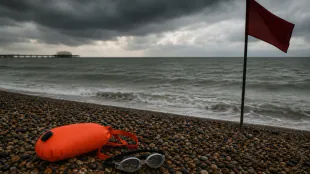 Brighton swimmers adjust routines around sewage alerts

 Data-centre opposition crosses US party lines

 UK clocks return to GMT on October 25

 Former Nottingham hospital chief linked to NHS training firm

 Forest linked with Liverpool goalkeeper Mamardashvili

 Robinson strikes again as England wrap up Pakistan series win

 Red-hot Chelsea not the finished article says Alonso

 Dortmund's Konstantelias to miss 'several months' with knee injury

 Chelsea beat Brighton in seven-goal thriller, Leeds hold Brentford

 At least seven die in ferry capsize off Northern Cyprus; 23 missing

 In-form Marc Marquez wins Aragon MotoGP Grand Prix

The storied Asti region of northern Italy saw a lush harvest this year but many winegrowers are leaving some grapes on the vine, choosing to produce less as US and Russian demand drops.
After two difficult years, 2025 has been a good one and Italy is expected to once again beat rival France as the world's leading producer.
But Paolo Castelletti, secretary general of the Union of Italian Wine, said it was not exactly something to celebrate.
"There is a decline in wine consumption especially in the main market, North America," he told AFP.
"The market was supported by boomers... now they're reducing their consumption," he said.
US President Donald Trump's new tariffs also make imports more expensive and could push Italian wines above the "psychological threshold" of $20 a bottle, he said.
That hit comes on the back of a decline in demand in Russia, where Asti wines were particularly popular, since Moscow's 2022 invasion of Ukraine.
Around 17 million bottles were sold there in 2023, falling to 12 million last year, with this year's sales expected at 10 million.
In total, export demand for Italian wines slowed by four percent in the first five months of 2025.
Some vineyards in France have decided to uproot vines to adapt, and the European Commission is pushing in this direction.
But Castelletti said this should be a "last resort" and supports leaving grapes on the vine, or blocking authorisation for new plantings.
- Hot summer -
Leaving grapes is what some winegrowers are doing in Asti to produce less sparking white.
They plan to reduce production of white Muscat from 10 to nine tonnes per hectare of vines this year.
At his Ca' dei Mandorli (House of Almond Trees) estate, an expanse of seemingly endless vineyards, Stefano Ricagno assessed his first juices as Indian harvesters made the final cuts on the vines.
They are leaving some grapes, but in reality, the summer heat has reduced production anyway.
"We thought we'd produce a lot, but it was very hot. The Muscat harvest is almost in line with our [lowered] targets," Ricagno told AFP.
The latest in a long line of winegrowers here, the 46-year-old presides over the "Asti" Designation of Origin, which covers nearly 10,000 hectares (25,000 acres) of hills listed as a UNESCO World Heritage Site.
Asti has made a name for itself with low-alcohol golden sparkling wines, generally around seven percent for "Asti" and five percent for "Moscato," almost all of which are sold in the United States.
Sales of the "Asti" Designation of Origin fell from 100 million bottles in 2023 to 90 million last year, and are expected to fall to 85 million this year, and winegrowers are seeing their inventories increase.
"We'll see in 2026 if the wars end and the markets recover," Ricagno said.
Other Italian appellations, such as Valpolicella in Veneto, have also reduced volumes this year because of market uncertainties.
But some want nothing to do with quotas -- or appellations.
A few kilometres from Asti, in Nizza Monferrato, Francesco Pozzobon, 35, has taken over abandoned vines and is letting them grow without pesticides, sowing clover and broad beans between the rows.
"We've overproduced and underproduced," Pozzobon said. "With the drop in demand, there will be a natural skimming."
The yield at his Tenuta Foresto is much more irregular and lower than that of his neighbours, at three tonnes per hectare, but he commands high prices for his "artisanal" wines, even as far away as China.
W.Moreno--AT