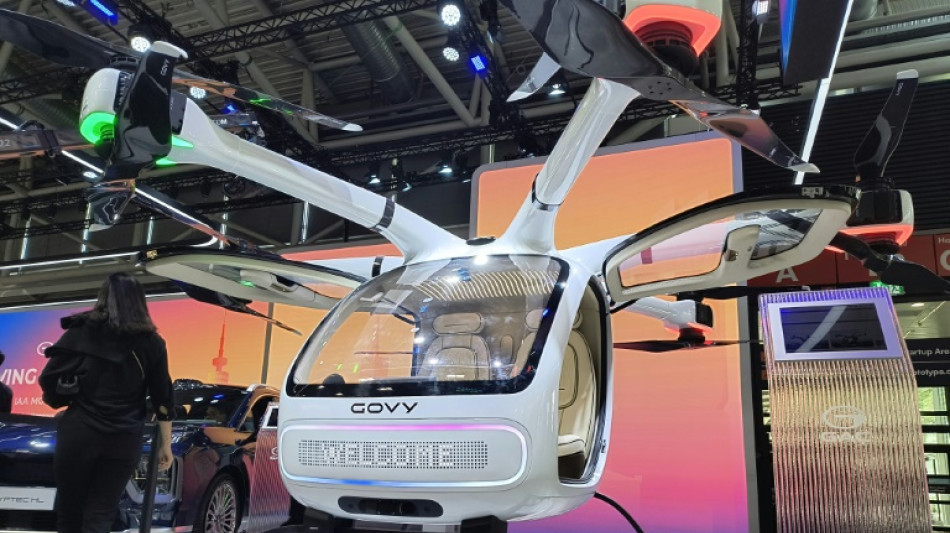
Robot dogs, flying cars: five takeaways from the Munich auto show / Photo: Louis VAN BOXEL-WOOLF - AFP

 John Ternus to lead Apple into the age of AI

 Trump calls for 'punishment' of NBC reporter
 About 15 people missing after Grand Canyon flash flood

 Medvedev advances without drama at US Open

 Calhanoglu fires Inter to nervy Cagliari win, Como stun Napoli

 Monaco beat Marseille to go top, Rosenior's Paris FC thump Nice
 Pegula shakes off nerves in US Open first-round win

 FIFA president Infantino 'must go', says ex-UEFA boss Platini
 England v Pakistan second Test: Three talking points

 Rashford's return 'fantastic' for Man Utd, says Carrick

 At least 8 die, more missing, as ferry capsizes off Northern Cyprus

 Pegula shakes off nerves, Ruse in US Open first-round win

 Fernandes treble inspires Man Utd rout, Chelsea beat Brighton in thriller

 September smartphone calendar spans Apple, Poco, Vivo and Xiaomi

 Instagram offers three routes to two-factor authentication

 Google Maps adopts Lake America label for US users

 WIRED tests label makers for home organisation

 CERN creates quark-gluon plasma with smaller atomic nuclei
 South West Water ranks worst in environmental comparison

 UK clocks return to GMT on October 25

 Forest defender Tyler Bindon joins Charlton on loan
 Forest linked with Liverpool goalkeeper Mamardashvili

 British woman dies after stabbing at German station
 Robinson strikes again as England wrap up Pakistan series win

 Red-hot Chelsea not the finished article says Alonso

From "flying cars" to robots and self-driving buses, here are some of the innovations spotted at this week's Munich auto fair, IAA Mobility, one of the world's biggest:
'Give cars wings'
Chinese brands showcased their efforts to create "flying cars", small electric aircraft powered by multiple rotors designed for short journeys.
"We want to give the car wings," said Wang Tan, co-founder of carmaker Xpeng's aeronautical unit.
Xpeng's Land Aircraft Carrier, an electric car that contains a fold-out, two-seat electric aircraft, should go into mass production in 2026 and be on sale in China for less than 2 million yuan ($281,000).
Uses include rescue from locations where access is difficult, such as in heavy traffic or from tall buildings, Wang said.
GAC's flying car unit Govy meanwhile showed off its AirCab, a two-seater self-driving electric aircraft with a top-speed of 120 km/h and a range of up to 30 kilometres.
"It is quieter than a helicopter and better meets people's needs," Govy spokeswoman Li Shuhan said. "It's also cheaper."
About 1,500 AirCabs are on order at 1.68 million yuan each.
Robot dogs (and their batteries)
Covered in yellow fur, and with big googly eyes and a red felt tongue, the Go2 robotic dog looks cute and cuddly -- but it is more than just a gimmick.
"For dangerous work you need robots", said Todd Zhang from Eve Energy, the Chinese company that makes batteries for the Go2, which is built by another Chinese outfit, Unitree Robotics.
"In the future we'll send robotic dogs into dangerous environments rather than human beings."
Eve Energy also supplies German carmakers like BMW and Porsche, highlighting China's grip on the supply chain for electric cars.
Wolf on wheels
Eager to show that Europeans can innovate too, Austrian Wolfgang Podleiszek is working on a funky two-wheeled electric car that steers like a segway and needs the driver to lean into corners.
"We've tried to send a signal for Europe, that we can once again dream and do something new and innovative," he said.
Podleiszek founded Wolf eMobility last year, and was on the hunt for investors at the motor show to build a prototype.
"Once people can try it out and see just how fun it is, I think the rest will follow," he said.
But his small firm is in the sights of German giant Volkswagen, who have taken the company to court on the grounds that "Wolf" in German sounds too similar to Volkswagen's Golf car.
But Podleiszek says "our chances are not bad" in the dispute.
New buses for older people
Companies including Germany's Holon and Estonia's Auve Tech displayed small self-driving buses, designed for routes where larger buses with drivers could be too expensive.
Auve Tech has 25 vehicles on the road, 20 of which are in Japan, co-founder Johannes Mossov told AFP, helped by a "strong push" from the government there.
"It's logical because of the ageing population," he said. "People need public transport to be more accessible for people who might not want to drive their personal car or walk long distances."
"Europe will be similar in 10 to 15 years," he added.
Robot people
Chinese electric-vehicle maker Xpeng was showcasing its humanoid robot, called Iron, at the fair.
Over 30 Irons are currently in training, mostly on the carmaker's production line, although some also help out with showroom sales.
"We hope we can let robots work on the production line by the end of this year," Shi Xiaoxin, Xpeng's head of robotics, told AFP.
And by the end of next year, they will likely be meeting and greeting customers, he said.
Iron is trained using motion sensors worn by employees, which gather data on human movement.
G.P.Martin--AT