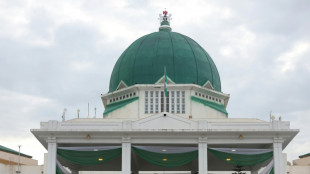
France, Eq. Guinea to clash at UN top court over Paris mansion / Photo: Steeve Jordan - AFP/File

 Osaka channels NBA icon Iverson to reach US Open second round

 Fast-fashion giant Shein plunges 10% on Hong Kong debut

 South Korea hire former Spain boss Moreno as interim coach
 China-Taiwan friction clouds Pacific summit
 Two dead after stabbing in New York's Times Square

 Anthropic signs $35B computing deal with startup backed by Nvidia

 Drones in Ithaca: Azov's Odyssey turns Ukraine war into modern myth

 Boat builders keep Pakistan's fishing heritage afloat

 Australia axe Labuschagne for Zimbabwe, South Africa ODI series
 Heavy rain at Grand Canyon after flood kills 2, dozen missing

 Kushner blames soccer power struggle for World Cup plan collapse

 Buoyant Alcaraz shakes off nerves to advance at US Open
 US draws European pushback with Russia G20 finance invite

 Jury begins deliberations in Tupac Shakur murder trial

 US Supreme Court allows Trump ballroom project to proceed

 Trump says US reviewing position on Falkland Islands

 Saka strikes as flawless Arsenal punish troubled Villa

 Oil prices surge on renewed fighting in US-Iran war

 Cycling superstar Pogacar has surgery after Vuelta crash
 Man City agree deal for Everton's Ndiaye

 Apple CEO Tim Cook gives nod to founder Steve Jobs in final memo

 Russian finance minister makes unexpected appearance at G20
 Happy to be back in NY, Sabalenka advances
 Naomi Watts to receive lifetime award at top Spain film fest

 Jury hears closing arguments in Tupac Shakur murder trial

France and Equatorial Guinea will cross swords Tuesday at the top United Nations court, in a long-running dispute over a luxury Paris mansion confiscated by French authorities.
The central African nation has asked the International Court of Justice (ICJ) to issue emergency orders preventing France from selling the building, seized after Vice President Teodoro Nguema Obiang Mangue, known as Teodorin, was convicted of corruption.
French authorities seized the property, which boasts a cinema, a hammam, and marble and gold water taps, after convicting Obiang under a law targeting fortunes fraudulently amassed by foreign leaders.
In 2021, France's top appeals court gave Obiang -- the eldest son of the long-standing president of Equatorial Guinea, Teodoro Obiang Nguema Mbasogo -- a three-year suspended sentence and 30 million euros ($35 million) in fines.
France also confiscated assets, including the luxurious building near the Arc de Triomphe, which has an estimated value well above 100 million euros.
In its latest complaint to the ICJ last week, Equatorial Guinea argued French police entered the property last month and changed the locks on several of the doors.
Equatorial Guinea called on the court to order France to give it "immediate, complete and unhindered access" to the building.
Lawyers for Equatorial Guinea will address judges at the Peace Palace in The Hague at around 10:00 am (0800 GMT), before France responds at around 4:00 pm.
- 2016 dispute -
The mansion was also at the centre of an earlier case filed by Equatorial Guinea in 2016 at the ICJ, which rules on disputes between UN member states.
Equatorial Guinea argued the building served as the country's embassy in France and that Paris had broken the Vienna Convention, which safeguards diplomats from interference by host countries.
But the UN court sided with France, which said the building was merely Teodorin Obiang's residence and served no diplomatic purpose.
The ICJ upheld France's objections that Equatorial Guinea had only tried to designate it as such after the investigation into Obiang began, and that the country already had an embassy in Paris.
A request for emergency orders -- provisional measures, in the court's jargon -- takes precedence over all other court business.
The ICJ is currently wrestling with a busy caseload, including a high-profile case brought by South Africa against Israel, alleging its actions in Gaza have breached the UN Genocide Convention.
The court will also deliver a key ruling on countries' climate change obligations next Wednesday.
While the ICJ is the highest United Nations court, whose rulings are binding, it has no way of enforcing its decisions.
For example, it has ordered Russia to stop its invasion of Ukraine -- to no avail.
M.Robinson--AT