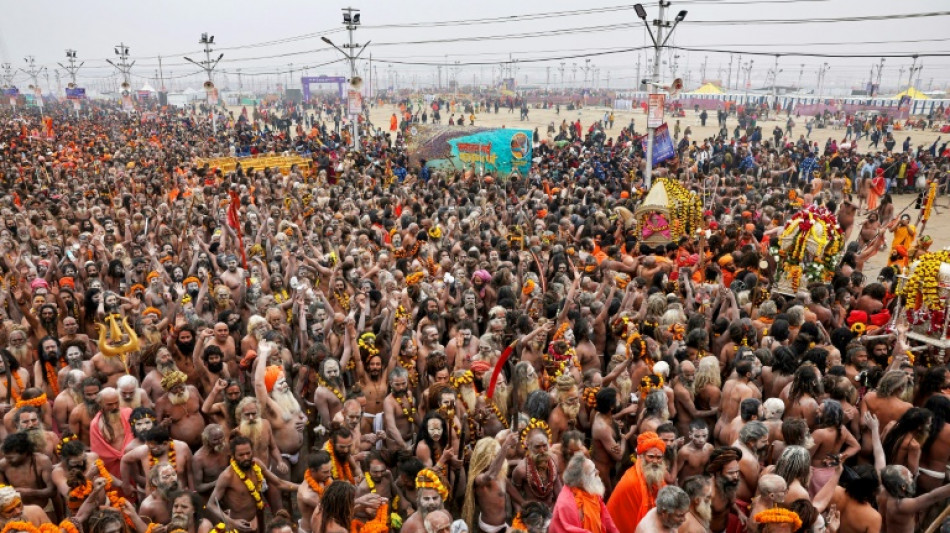
Holy dips at India's giant Hindu festival come with challenge / Photo: Niharika KULKARNI - AFP

 Inter roar back in five-goal thriller with Napoli

 Haaland keeps Man City perfect in Premier League, blunt Spurs held

 Hamilton worried by Ferrari pace while Antonelli prepares for a fight

 Vuelta stage 15 shortened due to extreme heat, Mas consolidates lead

 Putin meets US envoys for Ukraine war talks

 Modric available for Croatia in Nations League

 Potapova upsets 2025 US Open runner-up Anisimova

 Gasly a 'class act' says Alpine boss after Monza pole

 Athletic Bilbao crush Simeone's flat Atletico

 Stay far from battlefield, warns Japanese director in Vietnam War film

 Tens of thousands of Croatians protest over hazardous waste

 Haaland heads unconvincing Man City top of Premier League

 US envoys in Moscow as Russia and Ukraine vow not to hit capitals during talks

 Motorsport governing body rejects Alpine boss's claims of bias

 US envoy on West Bank visit says Israel has responsibility for Palestinians

 Ethiopian Miss World contestant spotlights pain of sister's murder

 'Leader' Raphinha rising to Barca striker challenge

 Oasis fans gather in Venice for band reunion film

 Two Nepal rescues revive hopes 10 days after flood

 Pogacar to miss worlds after season-ending Vuelta crash

 Greenwood, Guendouzi handed bans after Fenerbahce-Lyon brawl
 In Iceland, the mystery of the poet, the tomb and the Danish grocer
 Ratko Mladic: Bosnian Serb commander to convicted war criminal

 Bolivian army base blasts kill two, wound dozens
 Alcaraz, Sabalenka into US Open last 16 as Williams sisters lose on return

For pilgrims at the largest gathering of humanity, ritual bathing in India's holy rivers includes a key challenge -- finding your family and clothes after the chilly dip.
Millions of people are expected to attend the Kumbh Mela festival in northern India, a six-week-long Hindu celebration of prayer and bathing that began before dawn on Monday.
Each morning, densely-packed crowds of men, women and children undress side-by-side in the foggy pre-dawn gloom along the wide floodplains around the confluences of the Ganges and Yamuna rivers.
Sushila, a housewife in her sixties, who had travelled more than 500 kilometres (300 miles) from Bihar state, roamed the crowds in despair in wet clothes, looking for her daughter.
"I know she is somewhere close by," she said, peering through the tight-packed crowds, where a constant stream of pilgrims came to bathe. "I just can't see her".
The line of bathers stretches for several kilometres (miles), with the crowds surging forward to dunk their heads beneath the cold grey waters.
Devotees believe the dip brings them salvation.
But with many people without a phone -- or leaving it while they bathe with a friend they then lost -- finding your companions afterwards is a tough task.
The sheer size of the crowds is so great that even a single distracted moment can cause you to lose track of your fellow travellers.
Organisers boast that they are expecting a mind-boggling 400 million people to take part before its conclusion on February 26.
Loudspeakers mounted on poles boom repeatedly with desperate pleas of people searching for those with whom they had left their dry clothes.
An old man broke down on the microphone lamenting that he had nothing to wear -- urging his son to immediately meet him at the lost and found centre.
- 'Scared' -
Organising authorities issued a phone app boasting "multilingual AI voice assistance", but that is of no use to those without phones at all.
A network of "Lost and Found" centres are set up for pilgrims to reunite with their families, offering blankets to the pilgrims who arrive wet, shivering and nearly naked.
Temperatures before dawn hover around 10 degrees Celsius (50 degrees Fahrenheit).
Shyama, aged 60, who uses only one name, said her companion from her same farming village disappeared in the crowd. She has not been traced for over a day.
"I think she has left me and gone," said a distressed Shyama, her eyes welling up with tears, as she waited at a shelter for lost people.
"I have no money, know no one here, how will I ever go back home?"
Maiku Lal tracked down his wife Makhana after hours of searching, finally hearing her location broadcast over the loudspeakers.
"She scared us so much," said Lal, sporting a wide smile and holding his wife's hand.
Sandhya Sarkar, 45, said being lost in a strange place where she did not speak the local language made her regret her decision to come from her village in West Bengal, around 700 kilometres away.
"I would have never come had I known the fair was this crowded," she said. "My family must be going mad looking for me. It is a nightmare."
But many said that the effort to bathe in the holy waters was worth it.
"I felt tremendous peace -- despite the crowds," said Gopal Devi Shanti Gujjar, who had come from the western state of Rajasthan.
J.Gomez--AT