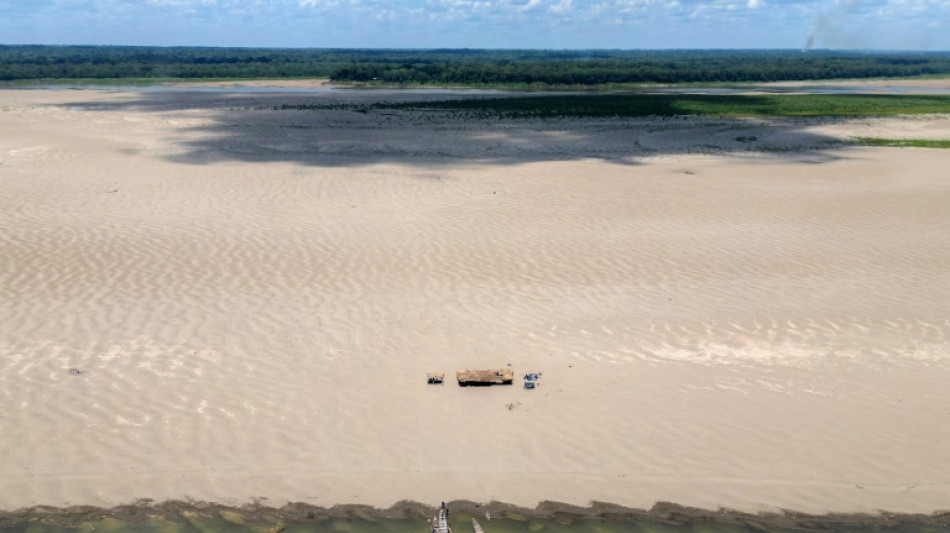
The long walk for water in the parched Colombian Amazon / Photo: Luis ACOSTA - AFP

 Tiafoe tops Medvedev in straight sets at US Open
 Zverev seeks US Open last eight as Osaka faces Rybakina

 Alcaraz turns up heat to reach US Open quarters

 Gatti salvages Juve draw with AC Milan in Serie A

 Sinayoko stars as unbeaten Paris FC down Marseille
 Still on top: 'Spider-Man' dominates North American box office
 Zelensky in fresh talks with US envoys: Ukraine official

 Noskova edges Kostyuk to reach US Open quarter-finals

 Alonso urges Chelsea to learn from painful defeat at Arsenal

 Defending champion Sabalenka reaches US Open quarter-finals

 Minnows Augsburg sink Frankfurt to top Bundesliga table

 Yamal hits double as 'nearly perfect' Barca thrash Valencia

 Antonelli living 'a dream' after astonishing home win

 Impressive Daryz keeps Arc double dream alive
 Strasbourg hit Troyes for six as Amo-Ameyaw sparkles

 German far-right AfD landslide winner in eastern state vote

 Carrick defends Man Utd start despite defensive concerns

 More than 140 killed in latest Yemen clashes: military sources

 Van Aert claims shortened Vuelta stage 15 win in high heat

 Everton shrug off transfer window woes to hold Man Utd

 'Nothing has changed': FIFA confirms Infantino to run for re-election

 UN's Nepal chief makes emotional plea for flood-ravaged country

 Italian GP red-flagged after massive Leclerc crash

 US envoys hold talks with Zelensky on first Kyiv visit

 'Truly scared': Blazes outpace firefighters in Indonesian Borneo
Bearing six-liter bottles of water on their shoulders, members of Colombia's Indigenous Yagua community tramp along the dried-up riverbed of a branch of the mighty Amazon.
In the Three Frontiers region, where Colombia borders Brazil and Peru, the flow in some spots of the world's biggest river by volume has shrunk by 90 percent, leaving a desert of brown sand etched with ripples.
Near the Colombian border town of Leticia, the 600 inhabitants of a Yagua village have found themselves staring out over a kilometer-wide (.6-mile) pop-up beach.
Before the smaller of two branches of the Amazon that flow past Leticia started to dry up three months ago, it took the villagers only around 15 minutes to reach the shores of the river.
Now they have to walk for two hours under the baking sun to reach the docking point for boats that bring food, fuel and drinking water on the only route in and out of the jungle.
"This is a really difficult time," Victor Facelino, a 52-year-old Yagua man told AFP as he lugged home a water canister donated by the state to help quench the thirst of people living in the world's biggest rainforest.
"Sometimes we get bogged down in the sand," he said, panting.
Colombia's National Unit for Disaster Risk Management (UNGRD) blames the Amazon's worst drought in nearly 20 years for the dramatic shrinkage of the river in the Three Frontiers region.
"For many of these communities, the only means of transport is the river, and with the drying up of the tributaries, they are completely cut off," UNGRD director Carlos Carrillo said.
- 'Like before' -
The governor of the Colombian department of Amazonas, a 109,000-square-kilometer chunk of forest, said the drought was the "worst climate crisis" ever seen in the area.
It coincides with the worst wildfire season in the Amazon in nearly 20 years, according to Europe's Copernicus climate observatory.
On the Peruvian side of the border, several towns have reported food shortages.
On the Brazilian side, which is choking under fumes from fires, authorities have declared a "critical situation," with the low levels of water at a hydropower station that generates 11 percent of the country's electricity causing particular concern.
The logistical difficulties have caused the price of basic goods, including fuel, to rocket. Fishermen are forced to travel ever further upriver to cast their nets.
"If you look along the river, everywhere you go it's dry," Roel Pacaya, a 50-year-old fisherman in the town of Puerto Narino, complained.
Maria Soria, a Yagua woman who makes a living selling handicrafts on Monkey Island, a natural reserve in the Colombian Amazon, is worried that soon "all the river will start to dry up."
"I ask God to change it back to the way it was, so that we can live like before," said the 55-year-old, wearing a traditional blue-feathered headdress and chest covering of palm fiber to perform a dance for a small group of tourists.
- Going with the flow -
Even for those who still have river access, things aren’t easy.
Eudocia Moran, 59, said she feels imprisoned by the now stagnant waters of the Amazon that lie just a few meters from her home.
Shopping trips to Leticia, about 30 miles down the river have become rarer, with boat operators fearing getting stranded in the sand.
Moran, a leader of the Ticuna Indigenous community, is convinced that the solution is a return to the land.
Rather than relying on an ever slower trickle of tourists, she believes the only way to survive is to "immerse ourselves fully in agriculture."
In a garden irrigated by a sliver of the river she grows cassava, beans, corn and fruit.
"I tell everyone we have go with the flow of the times, because all we can do is learn to live."
H.Thompson--AT