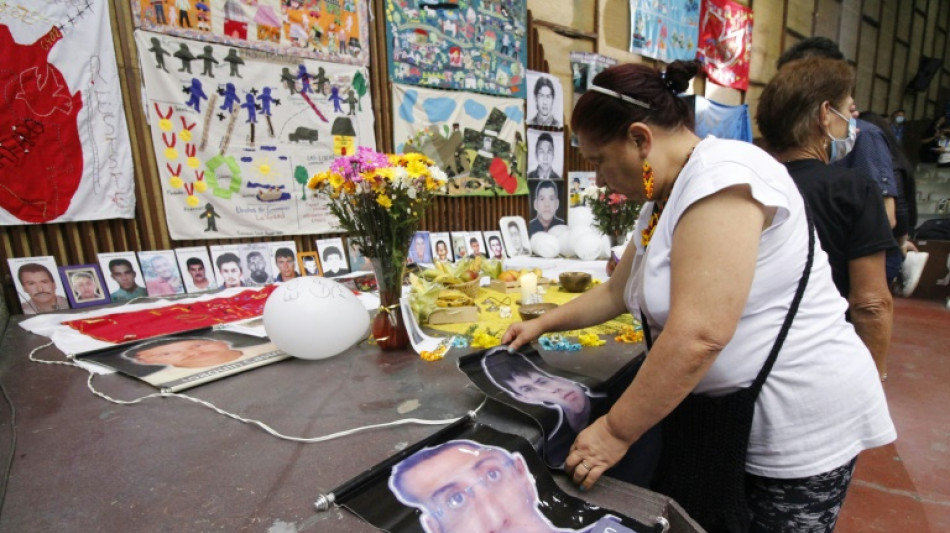
Colombian soldiers confess murders to victims' families / Photo: Schneyder MENDOZA - AFP

 Sabalenka edges Noskova, keeps US Open treble bid alive
 Real Madrid win Champions League opener as Haaland stars for Man City
 Gambian leader vows power boost after violent blackout protests

 Newcastle battle past Millwall to reach League Cup fourth round
 Mourinho's Real Madrid make winning start against Inter Milan
 Villa take 'big step forward' with win over Brugge

 Yaya Toure hails 'new era' for African coaches ahead of Champions League bow
 Lawes and Marchant told to prove themselves in quest for England recalls

 Smithsonian secretary to retire as Trump exerts control over institution
 Atletico have work to do to reach home Champions League final: Simeone

 Villa end goal drought to beat Brugge in Champions League opener

 McIlroy says 'we'll keep our heads down and play' in event of Trump golf visit
 Sabalenka holds of Noskova to reach US Open semi-finals

 Netanyahu under fire over report UAE warned of October 7 attack
 Wasim Akram urges 'fair treatment' for jailed Imran Khan

 No. 1 in reach as Rybakina battles for US Open semi-final spot
 Putin and Trump discuss Ukraine in 'extremely frank' call
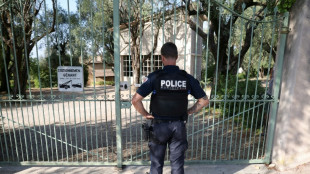 French police hunt Renoir thieves after lightning museum heist

 World Cup final scorer Torres leads Ballon d'Or nominees
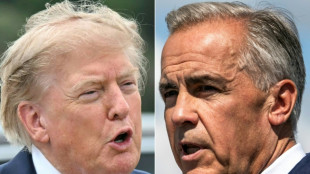 Carney touts Canada 'pivot' away from US as tariffs rise
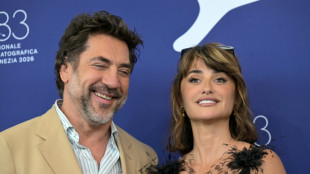 Spanish stars Cruz, Bardem play strained on-screen couple in new film
 The "Everlasting Battery" Inside Your Joints:UConn Professor's Self-Powered Healing Material just Got Acquired

 Visionary or conman? Elon Musk enigmatic star of Venice documentary
 Trial opens in France over deadliest Channel migrant crossing disaster
 England skipper Root says it's wrong to accuse Pakistan of lacking fight
Rural peasant Eliecer Ortega was on his own at his farm when soldiers burst onto his property to first kidnap and then murder him.
His wife, Eduvina Becerra, had to wait 15 years to hear his murderers confess and ask for forgiveness.
It happened during a historic two-day hearing of a special peace tribunal set up in Ocana -- a town in northeastern Colombia near to where the 43-year-old's husband was killed.
Ortega, a local rural leader who was known for his personality and thick moustache, was one of 120 civilians, mostly men aged 25 to 35, who were murdered in cold blood between 2007 and 2008 by Colombian soldiers and then presented as far left guerrilla fighters killed in combat in the area, a bastion of illegal drug crops.
In an unprecedented event, 10 former members of the military, including a general and four colonels, publicly admitted their responsibility in the crimes to the families of their victims.
The most senior of them, general Paulino Coronado, who retired in 2008, said that even though he acted "by omission, I assume this legal responsibility... so that the Colombian people never again, never live again, these abominable moments."
He denied having ordered the killings in his area of responsibility, but admitted to "not having acted diligently" in the oversight of his men.
"How can you say that your responsibility is by omission if you gave the order to your soldiers... and the whole army was aware of what they were doing?" said Zoraida Munoz, mother of Jonny Soto, a 22-year-old who dreamed of becoming a soldier before being kidnapped and killed by the military.
According to the Special Jurisdiction for Peace (JEP), some 6,400 civilians were murdered in a "systematic way" between 2002 and 2008 in areas of Colombia where far-left rebels operated.
In return, the soldiers were given bonuses, promotions and other material advantages.
Known as "false positives" it is the biggest scandal ever to engulf the Colombian military.
The soldiers took advantage of Ortega's solitude "so that no-one realized they were going to take him away," Becerra told AFP.
Like others at the hearing, she was wearing a black T-shirt with the words "WHO GAVE THE ORDER?" emblazoned on it.
- 'My life collapsed' -
Becerra's husband was 38 when he disappeared in October 2007.
She said that she had gone to town to buy groceries, when soldiers took him from his farm where he grew yucca, coffee and pineapples and managed his community work while.
After two days of searching in vain, his "disfigured" corpse appeared in a cemetery in Ocana.
Becerra recognized him by his moustache and a silver ring on his finger.
In his wallet there were two photos, one of his wife and the other of his son, Yesid, who at the time was 10 years old.
"My life completely collapsed," she said. In fear, the mother and son fled their village.
During the JEP hearing, former captain Daladier Rivera admitted "responsibility for the acts" and said he had provided the weapons that his men placed alongside corpses to pass them off as rebels.
Becerra sobbed uncontrollably as she listened to the confessions.
"You feel relief because our family name has been cleared to the world," she later told AFP.
Ortega "was not a fighter or a guerrilla as they said," but a simple loving father "devoted" to his son.
- Riddled with bullets -
The "Mothers of Soacha" collective, the most well-known family members of "false positives" victims, traveled to Ocana for the hearing.
Many of their children, living in Soacha on the outskirts of Bogota, seduced by false promises of work, were taken aboard army trucks more than 600 kilometers (370 miles) to Ocana where they were murdered.
Beatriz Mendez, a member of the collective, still does not know who killed her son Weimar Castro or her nephew Edward Rincon in 2004. Their murders were not covered by this hearing.
Although it "breaks the heart" she hopes one day to find out the truth.
Castro and Rincon were both 19 and unemployed when they went outside never to be seen alive again.
A relative heard on the radio that two "guerrillas" had been killed by the military in the mountains.
The two youths' bullet-ridden bodies were later found "disguised" in military fatigues.
Mendez has a tattoo of her son's face on her left arm and still remembers him dancing to Colombian cumbia and reciting poetry.
She believes the military killed him with help from right-wing paramilitary groups.
"I want to know the truth and I want to see them (the murderers) face-to-face," she said.
T.Perez--AT