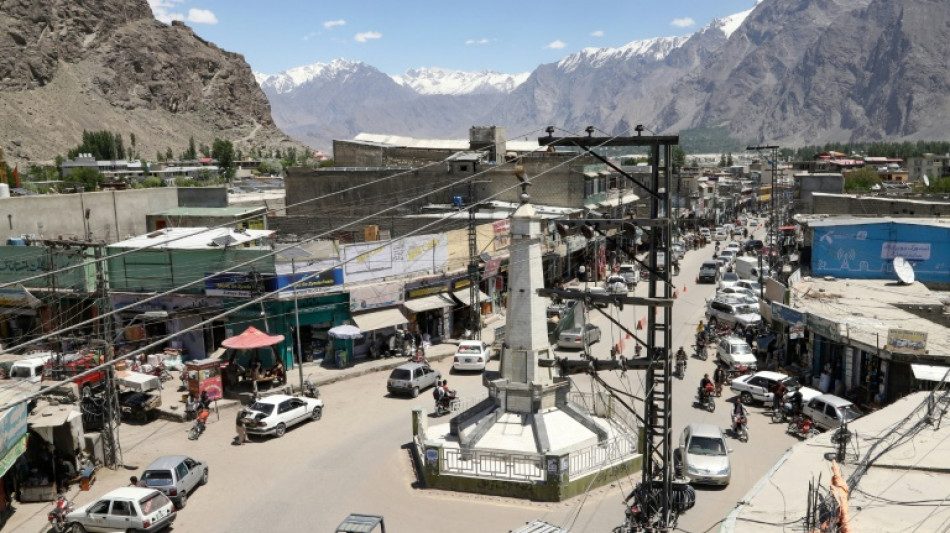
Pakistan power crisis deepened by mountain tourism / Photo: Manzoor BALTI - AFP

 Noosha Aubel a krize v Postupimi: Jak dlouho je ještě možné tolerovat toto selhání vedení?

 ヌーシャ・オーベルとポツダムの危機:この指導力の欠如は、いつまで容認され続けるのか?

 Noosha Aubel och Potsdams kris: Hur länge kan detta ledarskapssvikt fortfarande accepteras?

 누샤 아우벨과 포츠담의 위기: 이러한 리더십 부재는 얼마나 더 용인될 수 있는가?

 نوشا أوبيل وأزمة بوتسدام: إلى متى سيظل هذا الفشل القيادي مقبولاً؟

 Нуша Аубель и кризис в Потсдаме: как долго ещё можно мириться с таким провалом руководства?

 England quick Archer in 'good place' after injuries

 Robots protest rampant AI in Poland

 Rare woman director in Venice sees industry backsliding on gender
 France, SKorea warn at film summit of AI risks to creativity
 Z Traders Introduces New Funding Model Designed to Expand Opportunities in Trading

 Lebanon says 12 killed in strikes as Israel vows to 'remove threats'

 Volkswagen plant to be converted for Israeli defence group

 Israeli rubble-clearing in Gaza could erase 'atrocity crimes' evidence: UN expert

 Scorching summer pushes French wine harvest to new historic low

 Pietersen joins England coaching team ahead of World Cup

 Germany's triumphant far-right AfD aims fire at Merz

 Fury claims Joshua bout is off, calls for Usyk trilogy

 British family bids to row back against suicide taboo

 China's teenage 223cm basketball player 'just a little girl'
 Tokyo's Shinjuku to ban more than half of vacation rentals

 Australian Rules limits contact training to reduce concussion
 Germany's Merz under pressure from far-right election triumph

 Nepal tunnel rescues face 'unprecedented' challenge
 Mourinho's Real Madrid European revival bid starts with Inter reunion

In the mountainous valleys of Pakistan, 18-hour daily power cuts have meant local teacher Aniqa Bano uses her fridge as a cupboard for storing books and kitchen utensils.
Load shedding is typical across much of fuel-short Pakistan, but few areas consistently suffer the same prolonged outages as Skardu city.
A surge in mountain tourism, driven by climbers and Pakistanis looking to escape heatwaves, is rapidly depleting the limited energy supply at the gateway to ascend K2, the world's second-highest peak.
While higher-end hotels can supplement their supply with solar panels or fuel generators, many locals cannot afford such luxuries.
"We have to reinvent everything that once used electricity," said Bano.
"We no longer have an oven, we use a coal-heated iron for clothes," the 41-year-oldteacher added. "When we come home tired from work, we cannot run a heater."
- Tourism boom -
Skardu is the largest city in the region of Gilgit-Baltistan, where almost impossibly high peaks tower over the Old Silk Road, still visible from a highway transporting tourists between cherry orchards, glaciers and ice-blue lakes.
Normally home to around 200,000 people, Skardu becomes heavily bloated in summer when Pakistanis seek the relief of its cooler climate at 2,228 metres (7,310 feet) above sea level.
The region hosted 880,000 domestic visitors in 2023, up from 50,000 in 2014.
As the country grapples with energy shortages -– owing to dwindling forex reserves, mismanagement, rapid population growth and climate change –- the tourism boom has proved too much for local power.
"Due to the increase in population and tourism activities, load shedding hours have increased," Muhammad Yunus, a senior engineer for the regional government's water and power department, told AFP.
There are up to 22 hours of load shedding in winter and between 18 and 20 hours in summer -- an increase of around 10 percent each year for the past six years, according to the department.
Siddiqa, a tailor and handicraft maker who goes by one name, has seen her earnings fall alongside the number of hours of electricity.
"When we started this business in 2014, there was no issue of power," she told AFP. "Now, I have replaced all the electric machines and brought hand sewing machines."
"In the presence of light, we could prepare 10 to 12 suits every three days. Now, to prepare a single suit, it can take 10 to 15 days."
The tourism flow does not appear to be letting up any time soon. There are up to 15 domestic flights a week to the region and, since March, international flights began landing from Dubai.
In Skardu alone, the number of hotels has increased more than fourfold since 2014, according to the tourism department.
- 7,000 melting glaciers -
Owing to its remoteness, Gilgit-Baltistan is not connected to the national grid, so it relies on its own power generation from dozens of hydro and thermal plants.
But Pakistan's 7,000 glaciers -- more than anywhere outside the poles -- are rapidly melting.
This can temporarily increase the availability of water for energy production, but the glaciers' long-term ability to store and release water gradually decreases, affecting energy production.
"The availability of water for hydroelectric plants is becoming unpredictable," said Salaar Ali, head of the Department of Environmental Science, University of Baltistan.
Damage to energy infrastructure is also a regular setback.
Record heatwaves in 2022 caused dozens of glacial lakes to burst their banks, washing away more than 20 power plants, 50 bridges and countless homes.
Inadequate planning and mismanagement of the power sector can also play a role, engineers have said.
The Satpara dam on the edge of Skardu city, completed in 2008 for $26 million of aid funding, was supposed to supply 40,000 homes with power.
But it generates just a fraction of its potential after plans to divert a river were halted, government engineers admit.
"It has been full only once since its formation," said Yunus, the engineer in Skardu.
Without a reliable energy supply, Wajahat Hussain, a 36-year-old carpenter, uses a fuel generator to keep his business in operation -- puffing out emissions that contribute to global warming.
"We run the generator to fulfil the demands," he told AFP. "There is no work without the generator."
H.Gonzales--AT